Leading Strategy Beyond Uncertainty
Vishwanath Madhugiri
Chief Strategy Officer
SAAZ Micro Inc.
Leading Strategy Beyond Uncertainty
Vishwanath Madhugiri
Chief Strategy Officer
SAAZ Micro Inc.
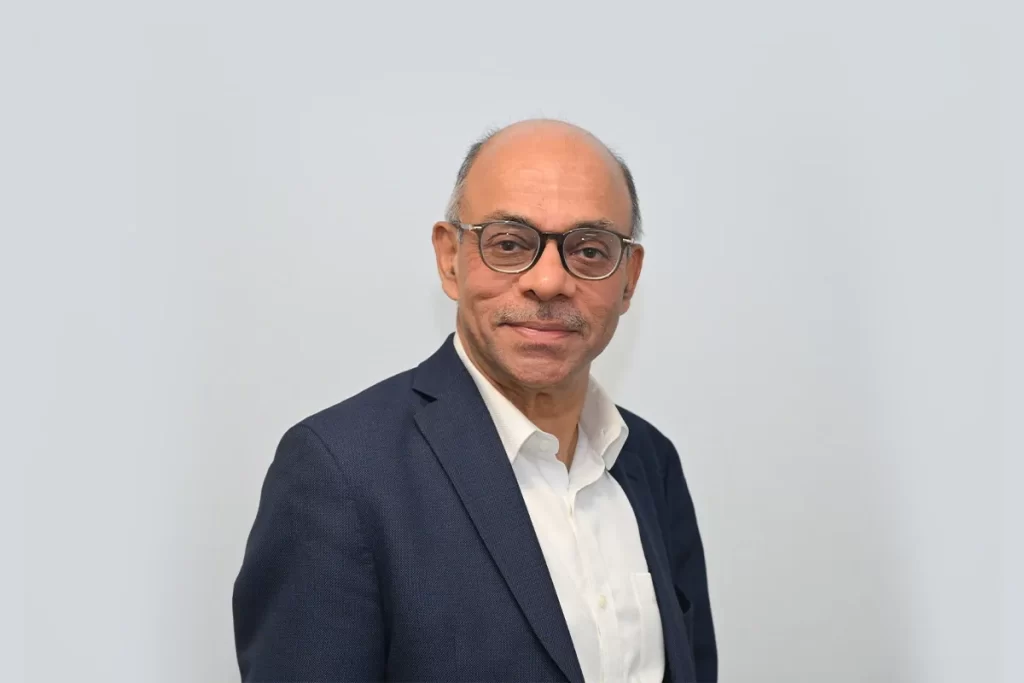
Leadership, in some careers, emerges quietly through repetition rather than proclamation. Over time, patterns form, judgment sharpens, and responsibility deepens. Vishwanath Madhugiri’s journey reflects that arc. Across research institutions, global enterprises, policy forums, and boardrooms spanning three continents, his work has consistently focused on building what lasts. As Chief Strategy Officer at SAAZ Micro Inc., he has helped shape advanced imaging systems for space, defence, and scientific missions, collaborating closely with organisations including NASA and international space agencies. Earlier roles at Infosys, Lycamobile Group, and the University of Birmingham reveal a CXO path defined by ecosystem thinking and longhorizon decision-making. During an exclusive conversation with TradeFlock, he discussed the journey, the challenges along the way, and what lies ahead.
How did your journey evolve to board-level leadership, and what changed your view most?
I began in hands-on business and innovation leadership, where success was measured by execution: building products, scaling teams, entering new markets, and solving immediate customer and operational problems. Very early on, I realised that strategy only becomes real when teams are aligned, incentives are clear, and execution is disciplined. As my career progressed into enterprise-wide and cross-functional roles at the intersection of technology, transformation, and growth, the nature of decisions began to change. Optimising for a single product, function, or quarter no longer made sense. I had to think in terms of portfolios, trade-offs, and long-term consequences, while constantly balancing innovation with risk, speed with resilience, and ambition with governance. Leadership slowly shifted from driving outcomes to asking better questions and creating the conditions for others to succeed. The transition to board-level strategy marked the most profound shift. You are removed from day-to-day execution, yet deeply accountable for outcomes. The role becomes one of stewardship: shaping purpose, ensuring ethical and financial integrity, overseeing leadership succession, and helping management navigate uncertainty. That movement from leader as driver to leader as steward and multiplier reshaped how I approach leadership today.
In what ways did academia, industry, and government shape your decisions?
Working across academia, industry, and government fundamentally shaped how I think about tough, high-stakes decisions. Each world operates on a different logic of value, time, and accountability, and moving between them trained me to hold multiple truths at once. Academia taught intellectual rigor and patience. Decisions there are driven by evidence, peer scrutiny, and long time horizons, which forces comfort with uncertainty and a discipline of separating signal from noise. That grounding instilled the habit of asking what we truly know, what we are assuming, and what evidence would challenge our view. Industry introduced urgency and accountability. Decisions carry immediate consequences for customers, employees, and capital, often with incomplete information. From this environment, I learned to balance analysis with action, aiming for decisions that are good enough, fast enough, and reversible when possible. It also reinforced a hard truth: even strong strategies fail if they do not align with how people actually behave. The government added a third dimension. Public trust, equity, regulation, and long-term societal outcomes are always in play. Exposure to this context forced questions about who is affected, who bears the risk, and how decisions will be judged over time. Together, these experiences shaped an integrative approach that accepts tension rather than trying to resolve it prematurely.
What did trade and investment exposure change about your global thinking?
Experience in trade and investment, particularly at the intersection of business and national policy priorities, reshaped how I think about building technology businesses globally. It became clear that success is not driven by technology alone, but by geopolitics, regulation, talent flows, trust, and national strategic intent. This exposure also changed how I evaluate scale. Market size alone proved insufficient. Attention shifted to where talent is being nurtured, where capital is patient, and where governments actively support innovation ecosystems. Over time, this reinforced the importance of designing for regulatory and geopolitical diversity early, aligning innovation with long-term societal and national outcomes, building credibility alongside speed, and thinking in ecosystems rather than only enterprises.
Which initiative tested your strategic instincts the most?
The initiatives that tested my strategic instincts most involved committing to long-horizon innovation partnerships and deep-technology bets without immediate commercial payoff. At Infosys, this meant building global partnerships with leading universities and research institutions across the UK, the US, Europe, and India, without clear quarterly revenue targets or simple ROI models. The trade-off was explicit: short-term performance pressure versus long-term capability building. Choosing to invest in ecosystems, research talent, intellectual property, and trust-based relationships reflected a belief that future competitiveness would be shaped years before returns became visible. At SAAZ, similar commitments continue in advanced sensor technologies for space, astronomy, and defence, where development cycles are long, technical risk is high, and funding is uncertain. Persisting under those conditions reinforced the belief that strategy is about informed commitment in the face of uncertainty.
What did the space sector teach you about leadership?
Telecom and IT services reward speed, scale, and adaptability, allowing room for iteration and recovery. Even in semiconductors, where precision is non-negotiable, improvement remains possible. Space is different. In the space sector, decisions are irreversible. Once a system is launched, there are no second chances. A small oversight or an unchallenged assumption can invalidate years of work. Leadership becomes accountability to physics, where rigor, honesty, and the courage to surface uncomfortable truths early matter more than hierarchy or narrative.
Which imaging capabilities excite you most going forward?
The maturation of advanced neuromorphicbased imaging sensors for next-generation space and airborne payloads is particularly compelling. Monitoring Earth’s health, tracking space debris, and early fire detection will increasingly depend on sensing precision and real-time intelligence.
How do you stay grounded outside work?
Staying grounded comes from remaining calm in demanding situations, practising humility, maintaining a sense of purpose, continuing to learn, and being comfortable with uncertainty.
Featured Magazine -

All Magazines-