

Redefining Accountability In Technology Leadership
Rangarajan Narasimhan
Chief Information Officer - ASI, Global Hub Leader- Pune, Global Automation Head
Vertiv
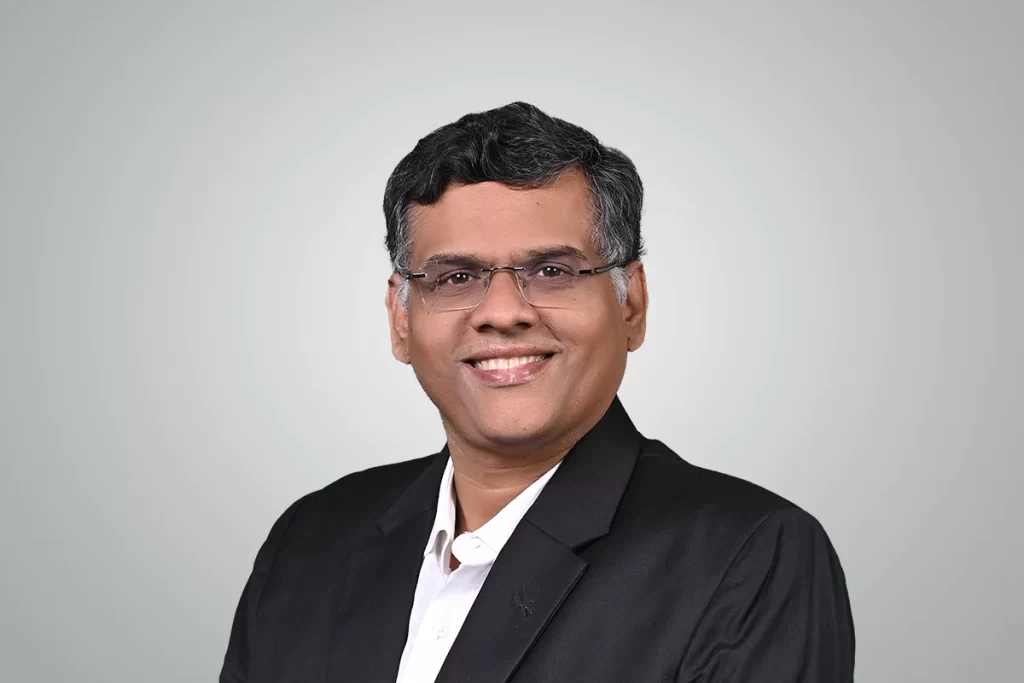
Redefining Accountability In Technology Leadership
Rangarajan Narasimhan
Chief Information Officer - ASI, Global Hub Leader- Pune, Global Automation Head
Vertiv
As enterprises expand across regions and industries, technology leadership is no longer carrying support weight; it is carrying business weight. Systems can no longer remain in the background when they now sit directly in the path of revenue, compliance, automation, and enterprise risk. Expectations from CIOs have shifted accordingly, pushing the role beyond keeping operations steady to shaping how organisations scale, compete, and hold up when conditions tighten.
This shift has played out clearly across the career of Rangarajan Narasimhan, whose work has consistently lived at the intersection of execution and accountability. With more than two decades of experience spanning global delivery, ERP-led transformation, automation, and P&L ownership, he has worked across environments in which digital decisions have immediate, measurable business consequences. From leading large transformation and life sciences programmes at Virtusa to running IT operations and ERP implementations across more than 100 manufacturing plants in Asia during his tenure at Adient, his work has been shaped by scale, complexity, and expectations.
Today, as Chief Information Officer – ASI, Global Hub Leader in Pune, and Global Automation Head at Vertiv, I lead a journey that extends well beyond technology operations. It spans enterprise resilience, intelligent automation, and the kind of business alignment where technology is expected to withstand scrutiny, not simply enable ambition. In an exclusive interaction with TradeFlock, Rangarajan shares his perspective on how the CIO role has evolved, the leadership decisions that have tested him under pressure, and the responsibilities technology leaders must now own as expectations continue to rise.
What defines a CIO’s role beyond systems, delivery, and uptime today?
Keeping systems stable and delivering projects on time has become an expectation rather than a differentiator, fundamentally changing how I view the role of a CIO today. The responsibility no longer starts with technology ownership but with business accountability, because the real test of technology leadership now lies in whether digital decisions visibly shape growth, profitability, and the organisation’s ability to act with confidence.
What that means in practice is moving deliberately into partnership with the business. Technology choices only matter when they can be explained in terms the enterprise already cares about, whether that is measurable P&L impact, speed of decision-making, or the ability to scale without friction. When conversations remain anchored in platforms or architectures, they rarely travel far, but when data, automation, and the vendor ecosystem are positioned as levers for growth, the CIO naturally earns a seat in strategic discussions rather than having to ask for one.
This shift also changes how success itself is judged. System uptime and delivery discipline remain important, but they no longer tell the full story. What matters just as much is stakeholder confidence: that investments will deliver real returns, that systems will scale as the business grows, and that technology will enable faster, better decisions rather than becoming a bottleneck. When that confidence exists, IT stops being perceived as a support function and starts behaving like infrastructure for revenue and scale.
Innovation sits inside this responsibility, not alongside it. AI, process mining, and generative technologies are no longer experimental tools; they are operational capabilities that can drive 20% to 30% efficiency gains when embedded thoughtfully into core processes. The challenge is not adoption for its own sake, but ensuring these capabilities align with enterprise priorities and improve how work actually gets done. The same sense of ownership applies to cybersecurity. Enterprise risk can no longer be delegated or treated reactively. Championing zero-trust principles and proactive security governance has become essential to protecting critical systems while still enabling the business to move forward without unnecessary drag.
As regulations increase across regions, how do CIOs stay compliant without slowing business?
The complexity of compliance today comes less from regulation itself and more from scale. Operating across America, Europe, and APAC means navigating different data privacy and regulatory regimes while still maintaining a unified digital landscape, and that challenge becomes sharper when legacy platforms are involved. Introducing compliance upgrades without disrupting live operations requires both architectural discipline and organisational alignment.
The tension between speed and security is constant. The business expects faster releases and deeper automation, while regulators expect stronger controls, traceability, and audit readiness. Treating these expectations as opposing forces often creates unnecessary friction. I have found that progress accelerates when compliance is treated as a design principle rather than a checkpoint.
Requirements such as data localisation, audit trails, and access controls are built into the solution architecture from the outset, rather than retrofitted later. Automated governance through native ERP and cloud controls reduces manual effort and improves consistency across regions. Just as importantly, close partnerships with Legal, Finance, and Quality teams ensure that regulatory interpretation happens early, before implementation begins. Phased rollouts allow core compliance needs to be addressed first, with enhancements following in a controlled manner, ensuring deadlines are met without slowing the business.
How do you measure whether an initiative has truly succeeded?
I measure success by sustained business value, not by deployment milestones. A solution has truly worked when it is adopted, trusted, and used consistently to make better decisions.
That requires a multi-dimensional measurement approach. On the business side, I track outcomes such as order processing cycle time, production lead-time reduction, and on-time delivery. From a systems perspective, stability and reliability matter, reflected in uptime, transaction success rates, and integration performance. User adoption provides another critical signal, visible through training completion, active usage patterns, and support ticket trends. Financial discipline reinforces credibility through ROI realisation and control of total cost of ownership.
Governance anchors this process. Clear baselines and targets are set before initiatives begin, progress is reviewed regularly with business owners, and post-implementation assessments compare intended outcomes with actual results. Alongside metrics, I pay close attention to qualitative signals, particularly stakeholder confidence and the reduction of manual workarounds.
"The clearest sign of success is not when a system goes live, but when the business stops finding ways around it."
What has been one of the toughest technology or business decisions you’ve made, and why?
One of the most difficult decisions I faced came during the launch of a new manufacturing plant in Asia, where we had to proceed with an Oracle EBS deployment even as the plant’s scope continued to expand. Business timelines were aggressive and largely immovable, yet system stability and long-term sustainability could not be compromised. We ultimately chose to split the deployment into two phases, absorbing additional scope along the way, knowing that this decision would introduce short-term complexity in service of long-term resilience.
The impact was felt across the organisation. Manufacturing teams experienced delays related to WIP visibility, which directly affected production planning. Finance had to operate with interim reporting solutions longer than planned. IT teams were stretched, constantly rebalancing effort between infrastructure readiness and application deployment. Procurement and planning functions adopted limited functionality earlier than intended simply to keep operations moving. None of this was easy, and none of it was hidden.
That experience reinforced for me that phased delivery only works when dependencies are clearly mapped and communicated early. Transparency around revised timelines mattered as much as the technical decisions themselves. Conscious management of technical debt across MES, WMS, and configurator solutions helped preserve stakeholder confidence even under pressure, as stakeholders understood the trade-offs and the rationale behind them.
Leadership is most evident when long-term integrity is chosen over short-term relief, even when the pressure to do otherwise is intense. Sustainable outcomes are built through clarity and trust, not speed alone.
In large organisations, how do you decide when urgency, risk, and compliance collide?
In complex organisations, the cost of indecision is often underestimated. I have learned that the speed of a decision can matter as much as the decision itself, because uncertainty tends to accumulate risk rather than reduce it. Clarity comes from structure.
I rely on a disciplined decision framework that weighs business impact, compliance obligations, and long-term technical debt together rather than in isolation. Non-negotiables such as regulatory deadlines and security standards are defined upfront, which prevents difficult conversations from becoming abstract later. Trade-offs are made explicit. For each option, the impact on timelines, cost, and risk is documented so stakeholders can see the consequences clearly.
Formal governance forums help drive shared ownership instead of isolated decision-making, while interim solutions play a role when urgency outpaces completeness. Phased delivery, temporary workarounds, and clearly defined migration paths allow progress without compromising compliance. Throughout, disciplined communication remains essential. Setting realistic expectations early and involving Finance, Operations, and Legal in solution design reduces last-minute surprises and sustains alignment.
How do you decide where to focus your time and energy as a CIO?
As expectations grow, focus becomes a leadership choice rather than a constraint. I am deliberate about where I spend my time, ensuring it aligns with where my involvement creates the greatest impact.
A significant portion of my energy goes into enterprise transformation, long-term architecture decisions, and shaping the innovation roadmap, while operational oversight is handled through governance and escalation rather than constant immersion. I invest equally in people and culture because leadership development, talent retention, and cross-functional trust ultimately determine whether strategy survives execution.
Leverage makes this possible. Building a strong leadership layer allows operational ownership to be delegated with confidence. Standard governance models and automation reduce repetitive decision-making and scale accountability. I block time for strategic thinking, stay connected through skip-level conversations, and consciously decline initiatives that do not align with enterprise priorities.
What myths about technology, digital transformation, or the CIO role need debunking?
One persistent myth equates faster deployment with better results. Speed alone does not create value. Rushing solutions without adequate testing, training, and alignment often creates technical debt and user resistance, ultimately slowing the organisation. Well-adopted, sustainable implementations deliver far greater long-term impact.
Another misconception treats digital transformation as a project with an end date. Markets, regulations, and technologies continue to evolve. Transformation is not something to complete and move past; it is an ongoing capability that requires continuous adjustment of systems, processes, and mindsets.
Looking ahead, what will CIOs be held accountable for next?
CIO accountability is expanding well beyond operational stability. Responsible AI governance will demand frameworks that address bias, explainability, and data privacy. Sustainability and green IT will move from aspiration to measurable obligation, with digital infrastructure scrutinised for environmental impact. Cyber resilience will extend beyond prevention into recovery readiness and supply chain security.
At the same time, organisations will expect workforce digital fluency, not just tool deployment, and real-time, predictive intelligence rather than historical reporting. Democratising data while maintaining governance and quality will test both architecture and leadership. CIOs who anticipate these demands and embed proactive frameworks early will be best positioned to lead the next phase of enterprise transformation.
Featured Magazine -

All Magazines-








Other Interviews-
- Inaas Arabi-Best Corporate Leaders in USA 2026
- Mark Newsome-Best Corporate Leaders in USA 2026
- Manar Elsakka-Best Corporate Leaders in USA 2026
- Dawn Stastny-Best Corporate Leaders in USA 2026
- Troy Negley-Most Inspiring Global HR Leaders 2026
- S. Indrani Shanmugam-Most Impactful Women Leaders from Asia 2026
- Gutti Malleswara Reddy-10 Best Tech Leaders in India 2026
- Rajesh Pasari-Best Education Leaders in India 2026
- Sinan Safaa Aboeless-Asia’s Best Business Leaders 2026
- Dr. Sandeep Chatterjee-Best Education Leaders in India 2026
