When Operations Meets Empathy
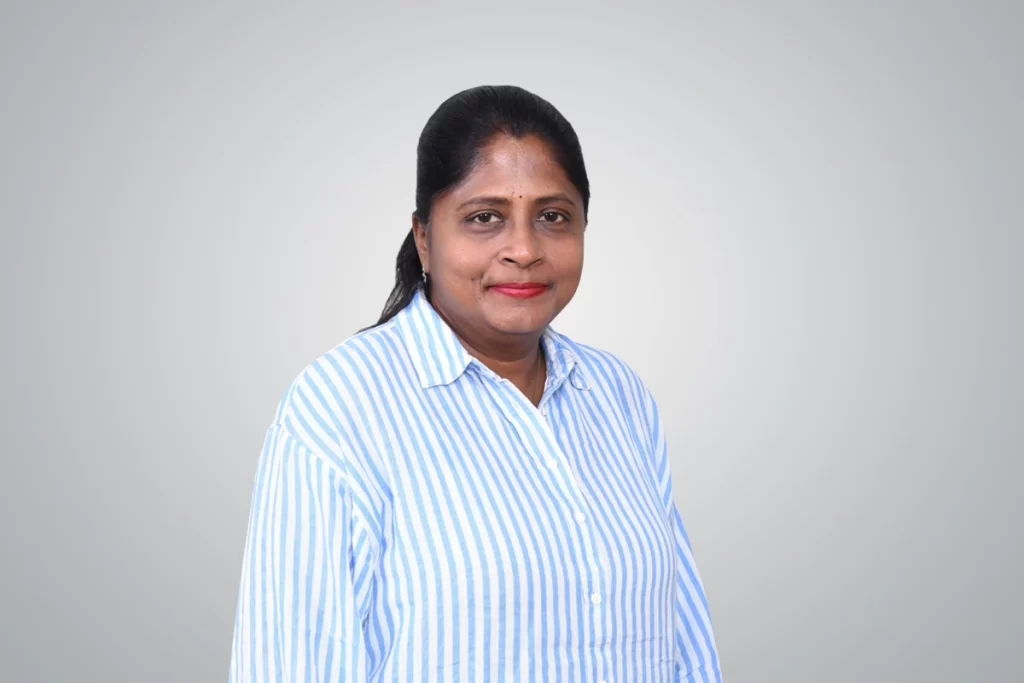
Shanthi Abayam
Head HR
Global Healthcare Billing Partners
Who would have thought that an ambivert would find her calling in one of the most people-intensive functions of the corporate world? Interestingly, for Shanthi Abayam, Head of HR at Global Healthcare Billing Partners, this balance has become a defining strength of her leadership.
Shanthi’s career did not start in HR. Armed with a degree in printing engineering, she spent nearly a decade in operations, managing structured, process-driven environments that demanded precision, discipline, and systems thinking. Yet she realised that what truly energised her was working with people while understanding their perspectives, supporting teams, and fostering collaboration. A pivotal moment came when she joined the HR team for a campus recruitment drive. Observing how HR professionals engaged candidates, assessed motivations, and evaluated cultural fit sparked a realisation: her passion for people could evolve into a purposeful career.
Transitioning into HR, Shanthi leveraged her operations experience to design initiatives aligned with business realities. Today, her leadership blends empathy, business acumen, and self-awareness. In this exclusive interview with TradeFlock, she shares insights from a journey defined by curiosity, connection, and impactful people leadership.
What has been one of the biggest challenges in your HR career?
Data can guide HR decisions, but it rarely captures the full story. One of the biggest challenges in HR is working with people who bring diverse expectations, experiences, and perspectives. This means a one-size-fits-all approach simply does not work. Staying connected with employees across all levels like listening to their concerns and understanding their day-to-day realities, helps HR leaders move beyond numbers and design initiatives that are practical, relevant, and truly meaningful.
How do you foster trust and psychological safety among diverse generations at work?
I view multi-generational workplaces as a strength rather than a challenge. Each generation brings unique perspectives, skills, and experiences that enrich an organisation. Younger professionals today are often clear about their career goals, vocal about expectations, and highly adaptable to technology, while earlier generations were sometimes hesitant to openly disagree due to cultural norms. This openness helps organisations design better policies and inclusive workplaces.
Leaders can build psychological safety by fostering transparency, respecting boundaries, and focusing on outcomes rather than constant monitoring. Valuing diverse viewpoints and work-life balance naturally grows trust, making collaboration across generations more effective and dynamic.
How are you leveraging technology and data in your HR strategies?
Technology and data play a critical role in modern HR decision-making. We use employee surveys, pulse studies, and exit interviews to identify patterns, but the real value lies in connecting those insights to operational realities. For instance, when engagement drops in a specific team, we examine workload distribution, manager capability, and process bottlenecks rather than assuming it is purely a people issue.
By analysing patterns and identifying specific issues within teams, we work closely with operational leaders to implement targeted improvements. Continuous dialogue and progress tracking ensure solutions remain effective and create meaningful organisational impact.
How are you preparing the next generation of HR leaders?
I encourage emerging HR leaders to move beyond technical proficiency and develop the habit of asking the right “why”. Data can reveal patterns, but it rarely explains the full story. Staying connected with employees helps uncover the context behind the numbers.
At the same time, empathy is critical. The most effective HR leaders balance analytical thinking with emotional intelligence to create workplaces where people feel valued and inspired to perform.
Is there a leadership or HR approach that has consistently worked for you?
Staying genuinely connected with employees means going beyond occasional check-ins to foster consistent, meaningful engagement. Trust is not built through policies; it is built through everyday interactions. Employees notice whether leaders listen, whether feedback leads to action, and whether conversations remain open even when opinions differ. Understanding individual motivations, challenges, and aspirations, beyond performance metrics, strengthens this connection.
Encouraging open dialogue and feedback creates a workplace where employees feel valued and heard, driving collaboration, engagement, and a culture where people are motivated not just by targets but by a shared sense of purpose and belonging.
How can leaders balance performance expectations with work-life balance?
Conflicts around work-life balance often arise when managers see themselves only as task managers rather than mentors or coaches. When leaders focus solely on assigning work and expecting results, friction can quickly develop. A coaching mindset helps shift this dynamic, as leaders who act as mentors support growth and guide employees through challenges. Empathy is equally important, since employees bring personal realities to work. While HR plays a key role, managers must also lead people, with HR enabling them through guidance, engagement, and stronger communication.
How do you see the role of HR evolving in the next five years?
Over the next five years, HR will evolve significantly, largely driven by technology. As technology automates routine HR tasks, the human aspect of HR will become even more important. The paradox is that the more digital workplaces become, the more organisations will depend on leaders who understand people, culture, and human motivation. As operations become digital, HR’s focus will shift toward strengthening leadership capabilities, emotional intelligence, and workplace culture.
On the other hand, data analytics will play a larger role, with HR leaders expected to interpret workforce metrics and use insights to drive more strategic business decisions.
Featured Magazine -

All Magazines-
Other Interviews-
- Victoria Tzareva-Most Influential Leaders to Watch in 2026
- Mitul Gada-Most Influential Leaders in India 2026
- Anu Bedi Salwan-Women Leaders in India 2026
- Shweta Singh-Women Leaders in India 2026
- Archana Tarun Dave-Women Leaders in India 2026
- Dr Bharati Banerjee-Women Leaders in India 2026
- Justine Paula Nichol-10 Best Healthcare Executives Transforming 2026
- Vivek Jhanjhri-10 Best COOs in India 2026
- Jerry Creech-10 Best Healthcare Executives Transforming 2026
- Daniel Gandia-10 Best Healthcare Executives Transforming 2026
