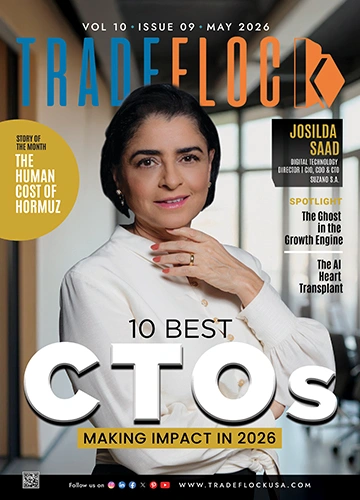

Setting A New Standard For Transformative Tech Leadership
RAVILLA KISHAN BABUJI
Chief Technology Officer,

Setting A New Standard For Transformative Tech Leadership
RAVILLA KISHAN BABUJI
Chief Technology Officer,
IRI-Sys
The role of the Chief Technology Officer is no longer just about keeping systems running—it’s about leading change from the core. As businesses race to stay ahead in a technology-first world, CTOs are stepping up as Chief Transformation Officers, helping organizations rethink how they work, build, and grow. At IRI-Sys, that role belongs to Ravilla Kishan Babuji, a new-age tech leader with calm confidence and a clear vision. His journey began not in a boardroom but in labs and classrooms at the University of North Carolina, where he blended computer science with real-world applications. He later joined Sonos, first as an intern and then as a full-time software engineer. At Sonos, he led initiatives that enhanced product integration and remote collaboration systems—efforts that improved performance and laid the groundwork for smarter, more connected solutions. Now, as CTO of IRI-Sys, he aligns innovation with impact, introducing intelligent automation and building systems that scale with purpose. In this exclusive with TradeFlock, Babuji shares his journey, insights, and what it takes to lead through transformation.
How did your journey—from Sonos intern to CTO at IRI-Sys—shape your leadership style?
Starting as an intern at Sonos, I learned the power of precision—how thoughtful engineering and user-centric design can turn everyday tech into something people truly love. That experience taught me what quality looks like at scale. But it was the messy, fast-moving world of startups that really shaped me. I discovered the importance of speed, iteration, and staying obsessively close to the problem.
Excellence is in the details, but progress lives in momentum.
Today at IRI-Sys, that contrast defines how I lead: build fast, listen closely, and evolve constantly. I don’t just value user feedback—I rely on it to guide every major decision. It’s about marrying technical excellence with adaptability, and never losing sight of the people we build for.
What’s one project you’re most proud of, and what impact has it made?
I’m especially proud of Regi, our AI-powered compliance agent. It taps into our proprietary dataset of 30,000+ cosmetic ingredients and regulations from over 70 countries, turning a once-manual, opaque process into something smart, fast, and transparent. Clients can now instantly see how compliant their formulations are and get clear steps to fix issues. This is slashing costs, speeding up launches, and giving brands real confidence in a space where errors can be costly. Innovation isn’t just about what you build—it’s about what you change. With Regi, we’re not just keeping up with regulation—we’re helping the industry rethink how compliance fits into product development.
Do you see yourself staying on the CTO path or exploring other tech leadership roles?
Right now, I love being a CTO—it puts me right where product, engineering, and strategy meet. Especially with AI evolving so fast, it’s an incredible time to be building. That said, I’m less focused on titles and more on solving real problems. In the long term, I could see myself stepping into a founder or product-driven CEO role. What drives me isn’t the seat—it’s the chance to build meaningful tech with impact and great people.
What major technical or team challenges have you faced as CTO, and how are you handling them?
One of the biggest challenges has been scaling a complex technical vision while staying lean. As a bootstrapped startup, we can’t afford waste—so we hire for grit and ownership, not just resumes. Our systems are designed to evolve, but in our highly regulated space, “move fast and break things” doesn’t fly. AI for regulatory compliances needs to be stable, traceable, and auditready from day one. To address this, we’ve built targeted optimizations that reduce variability and improve reliability, ensuring our platform is capable and compliant. But staying lean isn’t just about code—it’s about culture. We move fast together, with clarity, trust, and shared purpose. That alignment is our real velocity.
Which emerging tech—AI, edge, or quantum—excites you most, and why?
AI excites me most because it blends everyday utility with extraordinary scale. It’s not just about automating tasks— it’s about reimagining how we think, decide, and solve problems that were once too complex to touch. What really moves me is how AI can turn friction into flow. Things that were slow, error-prone, or manual suddenly become intelligent, adaptive, and scalable. That doesn’t just boost productivity—it removes barriers, unlocking new possibilities we hadn’t even considered. But with that power comes responsibility. As AI becomes embedded in how we work and live, we have to grapple with big questions around transparency, ethics, and human alignment. That tension—between promise and accountability—is what makes building in AI so urgent and thrilling.
What’s your top advice for early-career engineers or future CTOs who want to create real impact?
Don’t just chase cool tech—chase real problems. Get close to your users, feel their friction, and build from that place. The best products don’t start in code —they start in context. One of the most overlooked yet critical skills in technology leadership is communication. The most effective leaders are not only strategic thinkers but also skilled interpreters—capable of translating complex concepts into clear, actionable insights. By articulating a compelling vision and aligning teams around it, they do more than deliver solutions—they influence meaningful, long-term outcomes.
Featured Magazine -