
Profit-First Operator Navigating Growth Without Dilution
Vladyslav Podoliako
Founder & CEO
Belkins and Folderly

Profit-First Operator Navigating Growth Without Dilution
Vladyslav Podoliako
Founder & CEO
Belkins and Folderly
In today’s startup ecosystem, certainty is no longer a luxury leaders can wait for. Markets shift faster than plans, capital comes with conditions, and decisions often need to be made before clarity arrives. For founders who choose to bootstrap, that responsibility is unavoidable from day one.
That belief sits at the core of how Vladyslav Podoliako has built his career. Known for bootstrapping businesses instead of diluting accountability, Podoliako has scaled Belkins to $15 million in annual recurring revenue without external funding, while also building complementary ventures such as Folderly. Each company reflects a consistent operating mindset rooted in a profit-first discipline, sharp execution, and clear ownership.
Rather than focusing on a single flagship venture, Podoliako has built a portfolio that adapts to volatility rather than resisting it. His leadership style mirrors this structure. Decisive but not detached. Optimistic without being careless. Deeply intentional about where responsibility sits.
As automation, AI, and changing market dynamics redefine how companies are built, Podoliako stands out as a leader who treats mindset as infrastructure and leadership as a system, not a title.
TradeFlock spoke with Vladyslav Podoliako to understand his early challenges, the principles shaping his leadership philosophy, and how he is thinking about the road ahead.
What principles guide your decision-making when uncertainty, risk, and difficult trade-offs are unavoidable?
I’ve always considered myself to have an open mind, so my thought processes and leadership never developed within a single lane. Moving between disciplines gave me an awareness that decisions rarely exist in isolation. Writing sharpened my sensitivity to structure and narrative, while entrepreneurship forced me to test whether ideas actually work in the real world.
Capital markets were where theory first met consequence. In 2019, working as a day trader with an independent proprietary desk, every decision had immediate financial feedback, leaving little room for interpretation. Fundamental and technical analysis became less about prediction and more about understanding how information moves through systems. Those frameworks carried forward as I moved into real estate and blockchain in early 2020.
Building a startup at that intersection required immersion well beyond the core concept. Construction, supply chains, banking, fund administration, and trade finance also became important to me. Real estate tokenization is my primary focus, but that broader experience helps me see patterns across different sectors and challenge my own assumptions. As a result, my decision-making process focuses on understanding the full range of inputs and consequences before acting. That shift also explains my interest in urban planning and smart cities; real estate affects infrastructure, mobility, environmental impact, and daily life. Good leaders recognize that every decision is part of a larger ecosystem.
How do you balance long-term vision with the need to stay agile in fast-changing markets?
After operating through sustained volatility, I stopped treating stability as the goal. Uncertainty is not an obstacle anymore. It is the operating condition. Most companies are designed like buildings, optimised to resist movement. I have built something closer to a fleet, where each business can navigate independently and align when necessary.
The balance comes from knowing what never changes. Across Belkins and Folderly, the constant is profit-first, bootstrap discipline. Revenue is oxygen. Even our agency roll-up strategy follows this logic. We acquire proven operators, inherit their market intelligence, and apply shared operating playbooks. Agility is not about endless pivoting. It is about protecting the principles that allow everything else to move quickly.
Leadership In Action
What Does Success Mean to You?
Success is alignment, building meaningful work that compounds while preserving freedom, values, and energy.
One Manifestation for 2035
By 2035, I lead the world’s most profitable AI-native services portfolio built on ownership, not permission.
Which leadership challenges have shaped you most, and how do they influence how you approach hard problems today?
The most formative mistakes in my leadership journey came from waiting too long, not from acting too soon. Delayed correct decisions leave deeper scars than wrong ones, especially when people are involved. Like many empathetic operators, I overvalued the benefits of giving chances and underestimated the cost to the system.
The realization was uncomfortable but clarifying. Keeping someone in the wrong role is not kindness. It simply transfers your discomfort onto everyone else. That lesson reshaped how I approach difficult problems today. I move faster without abandoning empathy. Speed is a form of respect. When I feel the urge to collect one more data point or have one more conversation, I recognise it as decision debt. That is the signal to act, not to hesitate.
What aspects of your current role energise you most, and what personal shifts were required to operate at that scale?
What energises me most today is the multiplied impact. Building one strong company is rewarding. Enabling multiple companies and hundreds of people to deliver results simultaneously is something entirely different. My role evolved accordingly, from direct execution to system design to orchestration across a portfolio.
The hardest shift was not strategic. It was personal. I had to let go of the identity of being the person who gets things done with their own hands. Growth required restraint. The skill that replaced execution was selective attention. With several ventures running in parallel, depth everywhere is impossible. Knowing where my focus truly matters, and where trust must replace control, is what allows scale without chaos.
As data, AI, and automation accelerate, what capabilities will define influential technology leaders over the next decade?
AI fluency will be expected. Judgment will be decisive. I believe breadth will outperform depth. Leaders who can recombine multiple tools creatively will outpace specialists tied to a single system.
What many underestimate is knowing when not to use AI. Recognising confident hallucinations. Understanding which human capabilities become more valuable as automation expands. My work with LinguaLive and NoCancer focuses on those seams where AI enables outcomes that were previously impossible, not just faster execution. As more work becomes automated, leadership shifts toward taste, trust, architecture, and meaning-making. Leaders who develop these capabilities will shape industries. Those who only chase tools will eventually find themselves managed by the systems they adopted.
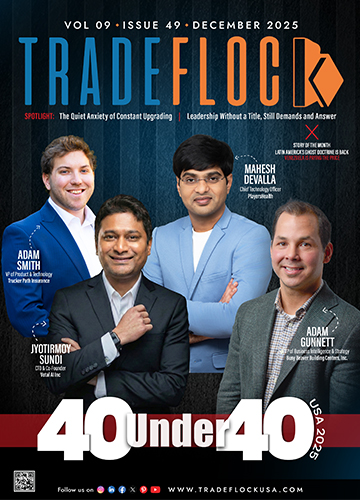
Featured Magazine -

All Magazines-




Other Interviews-
- Rangarajan Narasimhan 10 Most Inspiring CIOs in India 2025
- Alejandro Aguilera – Best CEO from Asia 2025
- Dr Majed Algarni- Best CEO from Asia 2025
- Dr. Shravan Khetan – 40 Under 40 2026
- Ashish Choudhary – 40 Under 40 2026
- Deepak Gangwar – 40 Under 40 2026
- Vladyslav Podoliako – 40 Under 40 USA 2025
- Kurniawan Eka – Asia’s 40 Under 40 2025
- Prajyoth Krishna Mirajkar – Asia’s 40 Under 40 2025
- Jane Rustial Tiongco-Aguirre – Asia’s 40 Under 40 2025
