
Transforming legacy enterprises with AI
Venkatesh A
Chief Growth Officer
SBA Info solutions Pvt Ltd

Transforming legacy enterprises with AI
Venkatesh A
Chief Growth Officer,
SBA Info solutions Pvt Ltd
India’s largest enterprises are sitting on decades of untapped potential, trapped in legacy systems, fragmented data, and outdated processes. For years, AI has promised transformation, but most organisations have struggled to translate pilots into real value. Amid this challenge, Venkatesh A, Chief Growth Officer at SBA Info Solutions, has been quietly rewriting the playbook. Starting as a Management Trainee, he engaged directly with enterprise clients, gaining an understanding of their core technical and operational challenges. He then built SBA’s marketing engine from the ground up, expanding customer acquisition channels and establishing brand presence. Transitioning into technical leadership, he translated high-level strategies into actionable AI roadmaps and collaborated with engineering teams to solve real-world client problems. Today, as CGO, Venkatesh has built a profitable 15-person AI business unit generating ₹50–60 lakhs in recurring revenue, bridging strategy, technology, and people. In an exclusive conversation with TradeFlock, he shares insights on his journey, leadership philosophy, and vision for India’s AI-driven transformation.
"To those starting in product or growth AI roles: fall in love with a problem, not a technology."
Which milestone are you most proud of, and what unexpected twist taught you the most?
The milestone I am most proud of is building our AI business unit at SBA Info Solutions, a 30-yearold system integration and digital engineering company. Coming from a marketing and product background, I was an unlikely candidate for this technical leadership role, but my obsession with solving business problems and communicating value became my unfair advantage. I started by personally handling everything from sales to building no-code POCs on platforms like IBM WatsonX. From that hands-on start, I built a 15-person division, recruiting fresh talent from Tier 2 and 3 cities. Together, we’ve won global hackathons and deployed solutions across healthcare, media, and beyond. The most profound lesson came from early failures. We had technically strong POCs that never converted because we were selling features, not outcomes. We shifted from leading with AI to co-designing ROI with clients. AI is often just the final API call in a larger solution. True transformation depends on systems thinking and project management, not just algorithms.
What gaps in India’s AI ecosystem are most overlooked, and how are you addressing them?
The most under-recognized leverage in India’s AI ecosystem isn’t in glamorous startups, but in modernizing legacy enterprises and activating untapped talent in Tier-2 cities. India’s banks, manufacturers, and healthcare giants struggle with legacy systems, data sprawl, and process fragmentation. Solving this requires systemic change. Our talent strategy is the key. We don’t just hire from Tier-2 cities for cost; we turn ambitious individuals into last-mile solution builders. By equipping them with low-code AI platforms and immersing them in client problems, we create specialists who can navigate complex systems. Our legacy is solving their legacy by utilising talent that others overlook.
What legacy do you want to leave, and what advice would you give newcomers in AI?
I hope my legacy proves you can build a worldclass AI business inside a 30-year-old firm, that extraordinary teams emerge from Tier-2 talent, and that India’s greatest AI opportunity lies in revolutionizing—not replacing—legacy industries. True innovation comes from bridging the old with the new. To those starting in product or growth AI roles: fall in love with a problem, not a technology. Insights aren’t buried in datasets but in hospitals, factories, and call centers. AI is powerful, but only meaningful when tied to a real human context. Success is hitting a metric, meaning it is changing someone’s reality. Chase that, and you’ll achieve both.
How has your leadership style evolved as you’ve scaled teams and products?
My leadership style had to be re-engineered as we scaled. I began with a bias for action, making rapid decisions—a style that worked as an individual contributor but proved risky when a team and client success were on the line. I now distinguish between “one-way door” decisions, which require deep reflection, and reversible “twoway door” choices, where speed remains an asset. I also see delegation differently. Earlier, I thought it was all or nothing. Now I balance staying hands-on with architecture and high-level problem-solving while empowering my team with full ownership. The most profound shift has been moving from managing tasks to leading people. My primary responsibility is to create an environment that enables my team to perform at its best.
Where do you envision AI/agentic AI in India over the next 5–10 years, particularly for growthdriven firms?
My vision for AI in India isn’t about creating the next shiny object. It’s about industrial-strength AI silently powering the engines of our economy. I see agentic AI modernizing manufacturing, banking, and healthcare. Instead of disrupting, AI will unlock decades of trapped value, making organizations globally competitive. This future depends on AI practitioners from Tier-2/3 cities bridging legacy systems and automation. For growth-led firms, AI will act as a digital nervous system, orchestrating workflows across silos. To make this a reality, legacy firms must transition from pilots to full-scale brownfield innovation. We must also industrialize the talent pipeline, turning ambitious graduates from smaller cities into world-class AI solution integrators.
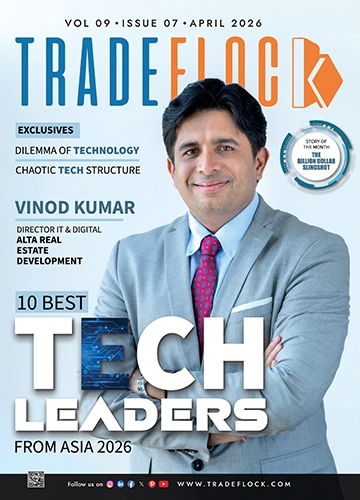
Featured Magazine -