Bridging Research and Real-World AI
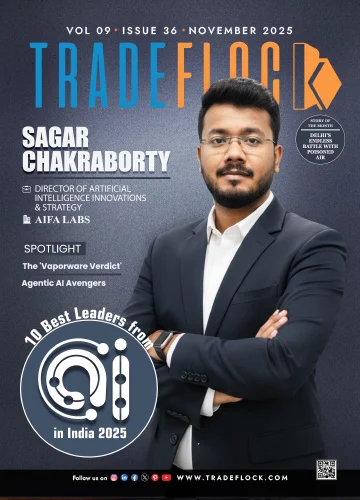
Sagar Chakraborty
Director of Artificial Intelligence Innovations & Strategy
Aifa Labs

Bridging Research and Real-World AI
Sagar Chakraborty
Director of Artificial Intelligence Innovations & Strategy
Aifa Labs
Every enterprise talks about AI innovation, but few actually create solutions that transform business outcomes. The gap between research and real-world impact is huge. Closing it takes leaders who can navigate both worlds—like Sagar Chakraborty, Director of Artificial Intelligence Innovations & Strategy at AiFA Labs. He takes complex AI research and turns it into solutions that really work. Sagar’s journey spans global academia and industry. He began by automating circuit analysis as a researcher in Taiwan, and later helped pioneer AI-driven robotics at Amazon, streamlining warehouse operations. At BAAR Technologies, while leading AI product engineering and automation, he developed DocVision, a document intelligence platform that extracts information from documents, enabling faster and smarter enterprise workÁows. During his tenure with Wipro’s AI Practice, Sagar architected and implemented AI solutions for multiple Fortune 500 clients, delivering businesscritical projects using Wipro Holmes’ IDP platform. At AiFA Labs, he leads teams building agentic AI platforms, such as Cerebro SASA, which frees developers from repetitive work so they can focus on strategy and innovation. TradeFlock spoke with Sagar to explore his journey, the challenges he’s faced, and the aspects of AI that excite him most for the future.
What early experiences shaped your journey to AiFA Labs?
Initially, I was deeply passionate about theoretical AI and believed that academia was the right path for me. But life had a different plan. A nudge from my family led me to explore industry opportunities, and I joined a massive AI transformation program at Amazon. Coming from research, I was used to incremental advances, but Amazon exposed me to building systems that impact millions globally. That experience shifted my perspective. I realised that realworld AI innovation requires not just theoretical knowledge but the ability to deliver at scale, and that combination genuinely excites me. Over the years, I have worked across both product and service companies. Product organisations taught me how to innovate, while service companies taught me how to deliver consistently. AiFA Labs is where both worlds converge, and that blend shapes how I lead AI strategy and innovation today.
"We should use Generative AI as an enabler, not a shortcut. True innovation still depends on curiosity, patience, and the desire to learn."
How did you maintain hands-on involvement while leading teams?
I never fully stepped away from the technical trenches. I continue to build personal projects, consult, and work closely with our engineering teams. AI evolves constantly, and I learned that disconnecting from technology risks making uninformed decisions on architecture, product direction, and feasibility. I have always believed that a modern AI leader cannot be on the sidelines; you must stay close to innovation to guide it effectively. Being hands-on allows me to understand what is technically possible today, anticipate what will be possible tomorrow, and guide my teams with clarity and empathy. It also ensures that we build solutions that genuinely solve customer problems, pushing boundaries rather than simply checking boxes. Staying close to the work keeps me grounded, sharpens our innovation, and ensures everything we create meets industry standards. “If a leader disconnects from the technical layers, they lose the ability to make informed decisions on architecture, product direction, and feasibility.”
"My philosophy is clear: people come first, then the product, then the client."
How do you manage execution while shaping long-term strategy at AiFA Labs?
At AiFA Labs, we anchor every decision in customer impact, understanding not just what we build but why it matters for design, reliability, feature depth, and client success. Our core philosophy is customer delight, delivering an experience that goes beyond satisfaction. In AI, yesterday’s breakthrough quickly becomes today’s baseline, so balancing immediate execution with the pace of technological change requires both discipline and flexibility. This balance requires being acutely aware of the four forces that shape every decision: the pressure to deliver on time, the commitments outlined in our product roadmap, the expectations of our enterprise clients, and the pace of AI’s evolution. Navigating these factors effectively is crucial for sustained innovation. Our approach is deliberately incremental. We ship early, functional versions that help customers move from zero to one, and then iterate rapidly based on real-world usage. We also maintain a quarterly reÁection rhythm to reassess our tech stack, integration architecture, market shifts, customer feedback, and prior investments. This combination of incremental delivery and structured reÁection helps us stay aligned, course-correct intelligently, and deliver consistent enterprise value without allowing our technology to become outdated.
"If a leader disconnects from the technical layers, they lose the ability to make informed decisions on architecture, product direction, and feasibility."
How are you advancing agentic AI at AiFA Labs?
Agentic AI is one of the most exciting areas of our work. Traditional SAP development is notoriously slow, with manual documentation, repetitive testing, and migration projects often lasting for years. We built Cerebro SASA, our SAP SDLC copilot, to automate these slow and manual tasks, including FDS and TDS creation, test generation, and intelligent code suggestions. These capabilities have reduced delivery timelines by up to 50%. I focus on ensuring that AI frees developers from repetitive tasks, allowing them to concentrate on architecture, business logic, and innovation. When you are migrating MuleSoft integrations to SAP BTP or accelerating S/4HANA migrations, every week saved translates into millions of dollars in business value. SASA is SAP-certified and listed on the SAP Store, providing enterprises with confidence that it meets compliance standards while transforming the development lifecycle. Every developer at AiFA Labs utilises agentic tools, including Claude Code, GitHub Copilot, and SASA itself. We build, use, refine, and scale these tools based on real-world experience to ensure they are practical and effective in daily operations.
What guidance would you give to emerging AI leaders?
We are living through one of the most transformative eras in technology. I advise aspiring AI leaders to start by mastering product thinking. Ideas are abundant today, but execution is what sets leaders apart. Understanding user needs, identifying real gaps, and building solutions that deliver immediate value is essential. Operational excellence is equally critical. Speed, quality, and efficiency often matter more than the idea itself. I also emphasise staying updated because AI, agentic systems, and automation evolve weekly, and you cannot lead what you do not understand. Focusing on real-world impact is vital. AI adoption accelerates when the value is selfevident, so clear that it requires no lengthy explanation. Instead of asking whether something is innovative, I ask whether it improves a customer’s work in a way they can immediately recognise. Finally, I encourage not over-indexing on today’s technology. Large language models and agentic AI are powerful, but they are the tools of today, not the destination. The future could be quantum, AGI, or something we are yet to imagine. Staying curious and exploring the frontier between research and innovation, and industry needs, prepares leaders for what comes next. “You can’t lead what you do not understand. The field evolves weekly, and leadership requires understanding those shifts firsthand.”
What new AI-related risk areas are emerging that companies still underestimate, and how are we tackling these challenges at scale?
Several risk areas are quietly accelerating inside agentic AI environments, and many companies do not yet realise how quickly they compound. These risks are interconnected, and they demand solutions that work in real operational settings. The first challenge is autonomous hallucination. When an agent misreads information, it acts instantly and with confidence. A system can move funds based on incorrect approvals, trigger compliance workÁows on false citations, or escalate incidents without proper justification. These mistakes happen at machine speed, which leaves almost no room for recovery. SASA addresses this through tiered autonomy. The platform handles tasks such as documentation, scaffolding, and code suggestions independently, while all decisions with real business impact are automatically escalated to human review. This approach has helped enterprises shorten delivery timelines while adhering to robust governance boundaries. The second challenge involves privileged access for AI agents. Traditional PAM models were built around human identities, not algorithmic ones. When an autonomous agent gains unauthorised access, it can move through systems more quickly and extensively than any employee. We extended AIOps to close this gap. Privileges are elevated only when needed, unusual activity is Áagged immediately, and unauthorised actions are blocked in real time. Every step an agent takes is recorded with context, providing enterprises with a clear audit trail and protecting them from silent escalations. The third challenge is governance at scale. Many organisations still operate without a clear framework for monitoring decisions, cost spikes, or behavioural drift. Cerebro AGOP solves this by automating compliance checks and creating a structured environment where large-scale AI can operate safely. Teams gain visibility into how decisions are made and where risks are emerging, and they significantly reduce manual governance effort. These risks are evolving more rapidly than most enterprises anticipate. Our focus is on building systems that make AI powerful and safe at the same time, because both are required if agentic environments are going to succeed at scale.
In a field obsessed with optimisation, what do you intentionally not optimise in your leadership style, and why?
I never optimise transparency. In an industry where leaders refine messaging, control timing, and share only what feels safe, I choose to communicate with my team in a way that is direct, immediate, and honest. It is not the polished route, but it is the one that builds trust. “My philosophy is clear: people come first, then the product, then the client.” That order guides every decision I make and shapes how I speak to my team. They hear good news early, and they hear bad news even earlier. If a competitor gains an edge, they know immediately. If a target misses, they hear it directly from me rather than through rumour. If I fall short personally, I do not hide it. This level of openness can be uncomfortable. It means the team feels the same pressure and uncertainty I do. Some leaders avoid that because it introduces tension. I see it differently. Sharing the full picture is a sign of respect. My team is made up of capable people who deserve to know what they are walking into and how decisions are being made around them. This matters even more in agentic AI. We are building systems that make decisions on behalf of global enterprises, and the stakes are too high for partial information to be considered. If I hold back on challenges until they are neatly wrapped, the team is already behind. They cannot prioritise, respond quickly, or trust that they are seeing the full landscape. Transparency is not something I fine-tune. It is the foundation that allows the team to operate with autonomy, confidence, and shared ownership of the mission.
"You can’t lead what you do not understand. The field evolves weekly, and leadership requires understanding those shifts firsthand."
Featured Magazine -
All Magazines -