

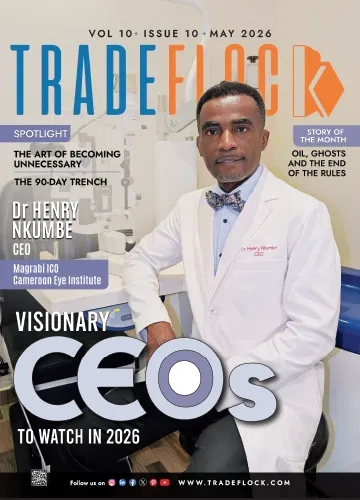
A Visionary Redefining Accessibility and Scalability in Healthcare
Henry Nkumbe
CEO
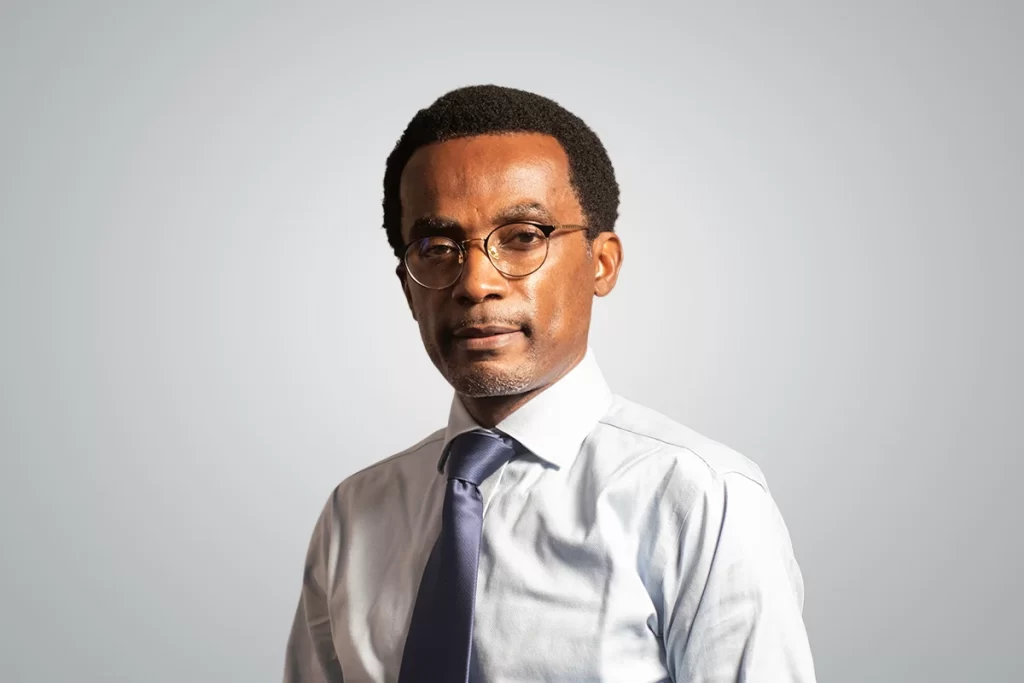
A Visionary Redefining Accessibility and Scalability in Healthcare
Henry Nkumbe
CEO
Magrabi ICO Cameroon Eye Institute
Across sub-Saharan Africa, an estimated 80 percent of vision loss remains preventable or treatable, yet the trained specialists and institutional capacity to address it at scale have long been missing. Closing that gap demands leaders who combine surgical precision with the patience to build systems that outlast any single intervention.
Dr Henry Nkumbe is that leader. His story begins in a small Presbyterian hospital in Cameroon, where at 13, he put on his first pair of glasses and saw clearly for the first time. What he also saw was a single doctor surrounded by hundreds of waiting patients, carrying an impossible weight with quiet dignity. That image never left him. It drove him through training at the Universities of Goettingen and Lausanne, a surgical fellowship at Aravind Eye Hospital in India, exposure with the WHO in Geneva, and eye care leadership across several African countries. Fellowship from the West African College of Surgeons, an MSc from the London School of Hygiene and Tropical Medicine, Business Management and Leadership Certifications from Yale School of Management and the London School of Economics and Political Science, and recognition from two heads of state mark a career built with uncommon deliberateness.
Today, as CEO of the Magrabi ICO Cameroon Eye Institute, he channels those decades into shaping the continent’s next generation of surgical leaders, guided by a conviction that has run through every role he has held: that lasting change in African healthcare is built through people, not projects. During an exclusive conversation with TradeFlock, he discussed his journey, the challenges he has navigated, and his roadmap for the future.
With your journey spanning Europe and Africa, what moment solidified your commitment to advancing eye care access across the region?
Before medical school, before Europe, there was a single afternoon in a village clinic in Cameroon. An eye specialist had come for outreach, one of fewer than five ophthalmologists in the entire country at the time, and over 300 patients were waiting to see him. The queue was long, the conditions basic, and he had every reason to be brisk. He was not. Each person who sat across from him received his full attention, his patience, and something that felt almost radical in that setting. In a place where hospital visits carried real fear, he brought hope into the room. Walking away that afternoon, I knew what I wanted to do with my life.
Years later, clinical rotations in Cameroon and Gabon alongside my training in Germany and Switzerland gave that memory new weight. The gap between what well-resourced systems could deliver and what most Africans had access to was no longer abstract. It was visible in every consultation room, in the villages, and wider than I had imagined as a child.
The work that followed has been about closing that distance, or at least contributing to closing it. The Magrabi ICO Cameroon Eye Institute has grown into francophone Central Africa’s leading referral eye care centre, with over half a million consultations carried out over nine years, 20 percent of them entirely free through a sliding-scale model, and more than 35,000 complex eye operations performed. But the number I return to most often is 250, the eye care professionals we have trained from 13 African countries. One of my earliest trainees recently shared that he had, in turn, trained 17 ophthalmologists in modern cataract surgical techniques in his home country, Guinea. An instrument maintenance technician from Burkina Faso later crisscrossed the country fixing previously abandoned ophthalmic equipment. That ripple reaching beyond our walls is what the work was always trying to create.
What guiding principle would you emphasise most for young professionals seeking impact across medicine, leadership, and society?
Nigerian entrepreneur Paul Onwuanibe once offered a principle that has stayed with me: find a problem that affects the masses, solve it in a way that no one else can, and work with the best people possible. It sounds simple. But it asks you to orient yourself outward before you think about yourself, which is exactly where healthcare leaders need to begin. The best people, it is worth noting, do not only mean skilled colleagues. It includes the mentors who shape your instincts before you know they need shaping, the role models who show you what conviction looks like in practice. Warren Buffett has observed that he has never seen a business that truly delighted its customers fail. The same holds in medicine. The doctor I watched at 13 was not simply competent. He delighted every person who sat across from him (especially me), and that single afternoon set the course of my life. Stay close to the patient. Build around real problems. The rest tends to follow.
With the benefit of experience, what is one decision or approach you would change if starting over?
Trust with more discernment. Earlier in my career, I assumed that the people and institutions I worked alongside shared the same values I held, the same commitment to integrity, the same sense of purpose. Experience taught me, more than once, that this assumption was not always warranted.
That is not an argument for cynicism. Leadership without trust becomes cold and transactional. But there is a real difference between trusting openly and trusting wisely. Taking more time to observe whether what people say and what people do are actually the same thing, building partnerships on mutual accountability rather than goodwill alone, those habits would have changed some outcomes. It has made me a better leader and, I think, a more grounded person.
What question are you rarely asked as a leader, yet find yourself reflecting on most often?
“How are you doing?” Leadership presents itself as a position of strength and clarity. What it does not advertise is how isolating it can be. People look to you for direction and steadiness, especially when things are uncertain. You hold the weight of institutional vision, absorb the anxiety so others can move forward, and make the hard calls in the spaces no one else sees. Very few people think to check on the person doing all of that.
Self-care has become a leadership discipline rather than an indulgence. Mindfulness, real rest, protecting silence, stepping away genuinely rather than performatively. You cannot give what you do not have. The health of the person leading an organisation shapes that organisation, often in ways that are invisible until they are not. More leaders should be asked the question. And when they are, they should answer honestly.
Having worked with WHO and across African health systems, which leadership lessons have proven most enduring?
Working with WHO as a young doctor was an education in humility. The most valuable moments were rarely in conference rooms. They were in the field, watching clinicians and researchers navigate genuine constraints with limited resources and remarkable determination. You absorb things in those environments that formal training cannot replicate.
The lesson that has shaped everything since then is that no single person or institution can transform a health system. Sustainable impact requires collaboration between governments, international agencies, the private sector, and, most importantly, the local communities. Partnerships with organisations such as CBM, the West African College of Surgeons and institutions such as the Aravind Eye Care System in India reinforced this at every turn. The work does not scale any other way.
Closely connected to that is the question of where you build. Programmes that depend entirely on external expertise and external funding tend to collapse when those leave. Lasting change requires training local professionals, strengthening institutions from within, and designing systems that communities can carry forward without you. And the hardest lesson of all: humility about what you do not know. What works in one context can fail completely in another. Progress in health systems is slow, often invisible, and demands a long-term view on days when the short-term evidence offers very little encouragement.
How do you define empathy in leadership, and how does it influence decisions during high-pressure situations?
Empathy in leadership is the ability to see the person before you see the role. It sounds straightforward, but under pressure, when decisions are urgent and problems are piling up, the easier thing is to see a function to be performed rather than a human being carrying real weight. The discipline is in refusing to take that shortcut.
February 2020. Douala International Airport. The COVID-19 pandemic started being felt in Africa. A RwandAir crew walked in: seven young team members and a captain who appeared to be in his mid-fifties. Their flight had been rescheduled, and every person in that group was visibly affected. What the captain did next is something I have thought about many times since. He moved quietly around the terminal, locating charging points, finding the Wi-Fi code, and making sure each crew member could connect and reach home. When it was time to leave, he was the last to stand, walked the room once more, and checked that nothing had been forgotten. Before he walked out, I approached him and complimented him on what I had observed. He smiled and said something very simple:
“They are also human.”
He was not managing a disruption. He was caring for people in his charge, and he understood exactly what that care would produce once they were airborne: a crew that trusted him completely and would give him and his passengers everything they had. Empathy, practised consistently and without performance, builds the kind of team that holds together when it matters. It is not warmth for its own sake. It is the most strategic quality a leader can develop.
What qualities do you prioritise when identifying future leaders, and how do you prepare them effectively?
Character before competence, always. Skills can be developed over time, but integrity, the quiet consistency between what a person values, what they say, and what they actually do when no one is watching, is the foundation on which everything else rests. It is always the first thing I look for. After that comes empathy: a leader who cannot read what the people around them are experiencing cannot protect them or inspire them. Then followership, which tends to be underestimated. Some of the finest leaders I have encountered were, at an earlier point, exceptional followers. They learned what it means to support someone else’s vision, to work within constraints, to trust the person ahead of them. That experience builds humility and perspective that you cannot acquire any other way. And finally, the ability to hold steady under pressure, when information is incomplete, and people are looking to you for clarity.
Once I identify those qualities, my approach is direct. I mentor where I can, connect people with someone better placed when I cannot, and invest in their development through real exposure. From the beginning, I make one thing clear: my goal is not to prepare them to work for me indefinitely, but to prepare them for opportunities that may take them far beyond this organisation. Leadership development, done with that intention, is an act of stewardship.
Featured Magazine -

All Magazines-



Other Interviews-
- Inaas Arabi-Best Corporate Leaders in USA 2026
- Mark Newsome-Best Corporate Leaders in USA 2026
- Manar Elsakka-Best Corporate Leaders in USA 2026
- Dawn Stastny-Best Corporate Leaders in USA 2026
- Troy Negley-Most Inspiring Global HR Leaders 2026
- S. Indrani Shanmugam-10 Best Healthcare Executive Transforming 2026
- Gutti Malleswara Reddy-10 Best Tech Leaders in India 2026
- Rajesh Pasari-Best Education Leaders in India 2026
- Sinan Safaa Aboeless-Asia’s Best Business Leaders 2026
- Dr. Sandeep Chatterjee-Best Education Leaders in India 2026
