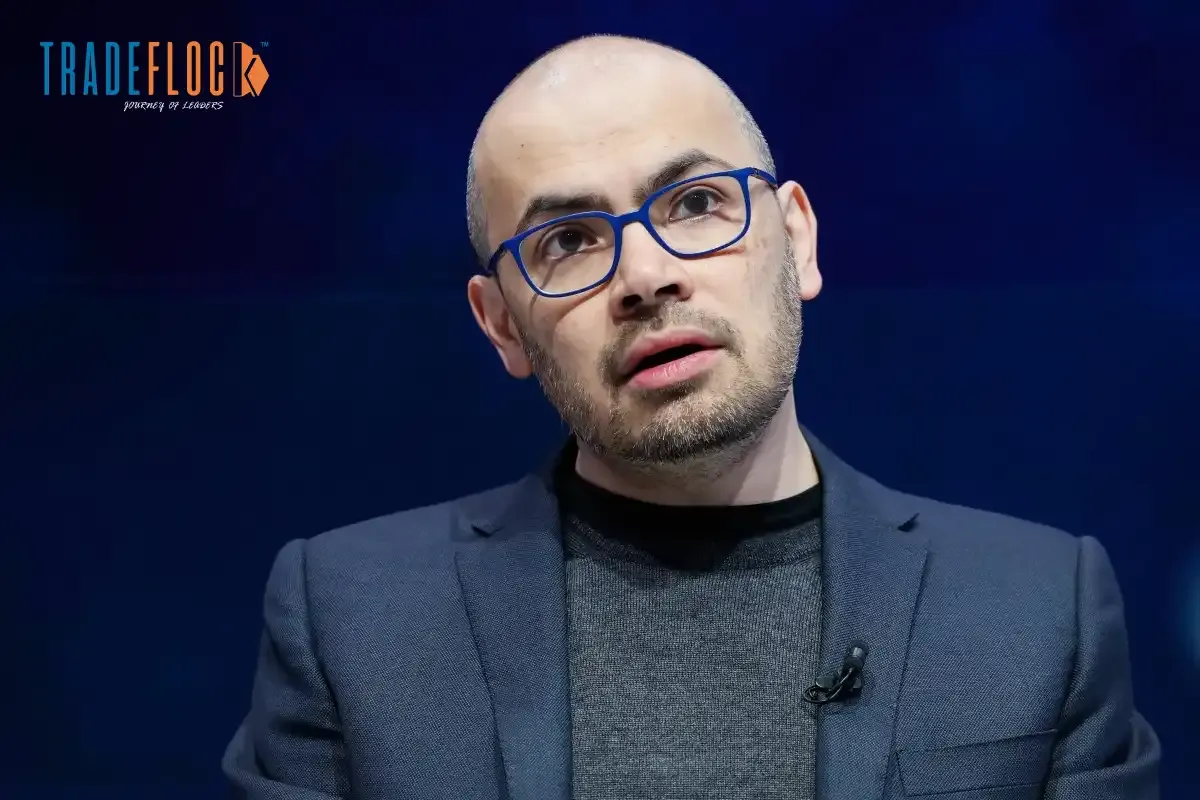
In today’s digital landscape, millions of individuals around the globe are using Artificial Intelligence applications like ChatGPT and Gemini. These technologies are revolutionising the world we live in, making everything more efficient, faster, and easier. Although most individuals have an idea of how AI works, very few individuals recognise the people responsible for making some of the latest breakthroughs in the field. One individual whose contribution in this area cannot be understated is Demis Hassabis.
From winning the chess championship as a child to now becoming one of the leading Artificial Intelligence researchers in the world. The man achieved it all. During his career journey, Hassabis started Google DeepMind, which brought innovations in the gaming industry and other sectors like healthcare.
So, who exactly is Demis Hassabis, and why do many experts believe he is going to be one of the most influential figures in AI?
Table of Contents
Demis Hassabis: Early life and education
Demis Hassabis is an AI expert, neuroscientist and Chief Executive Officer (CEO) of Google DeepMind. A London-born genius, Demis Hassabis proved his incredible intelligence skills right from an early age.
Before Demis Hassabis earned recognition for his work in the AI industry, he had already created his own identity world. The British AI genius earned immense fame through his outstanding talents as a chess player. By the age of 13 years, Hassabis had already attained mastery levels, proving his advanced strategic thinking capacity.
Demis Hassabis (From 1976 to Present)
| Category | Details |
| Full Name | Demis Hassabis |
| Born | July 27, 1976 |
| Nationality | British |
| Company | Google DeepMind |
| Position | CEO & Co-Founder |
| Education | University of Cambridge, UCL |
| Major Achievement | AlphaGo, AlphaFold |
| Nobel Prize | Chemistry (2024) |
| Net Worth | Estimated $500–600 Million (2025–2026) |
| Research Focus | Artificial General Intelligence (AGI) |
His actual academic journey started at the University of Cambridge, where he studied computer science. However, Demis Hassabis’ education and curiosity for technology extended beyond coding. What truly inspired Demis Hassabis was a much bigger question:
How does human intelligence actually work?
That piqued his interest in neuroscience and the inner workings of the human mind. The man felt compelled to learn about how the human brain operates so that he could develop more sophisticated AI systems.
It was this unusual combination of computer science, cognitive psychology, and neuroscience which eventually formed the cornerstone of Demis Hassabis’s education.
The Journey From Chess Prodigy to AI Pioneer
Before becoming the world leader in artificial intelligence technology, Demis Hassabis had already established himself as a success story in many areas. His journey is an exceptional example of how diverse experiences from chess to entrepreneurship can result in world-changing innovation.
Early Career Timeline
| Year | Milestone |
| 1989 | Achieved chess master level at age 13 |
| 1997 | Graduated from Cambridge University |
| 2005 | Sold gaming company Elixir Studios |
| 2010 | Began the DeepMind project |
| 2014 | Google acquired DeepMind |
| 2016 | AlphaGo defeated Lee Sedol |
| 2020 | AlphaFold2 solved protein-folding challenge |
| 2024 | Won Nobel Prize in Chemistry |
Hence, while others focused solely on programming machines, Demis Hassabis focused on understanding intelligence itself. This distinction set him apart from traditional AI researchers.
How Demis Hassabis Built DeepMind From Scratch
In 2010, Hassabis co-founded DeepMind with a visionary direction that seemed almost impossible to achieve. He wanted to build artificial intelligence that could learn, adapt, and reason in ways similar to humans.
Unlike the other tech companies focused on short-term applications, DeepMind purely concentrated on fundamental AI research. The company’s mission was simple and clear from the start:
Solve intelligence and use it to advance science and benefit humanity
It was certainly an ambitious idea during its execution. Thankfully, the startup managed to catch the eye of some leading investors and scientists. In 2014, Google bought DeepMind, providing it with all the necessary funding and global reach that were required for further progress.
As opposed to other tech giants who were after profits, DeepMind remained committed to conducting long-term research. Long-term vision of Demis Hassabis did not involve creating better software; it was rather developing independent learning capabilities for AI technologies. The commitment of the firm towards innovative solutions made it one of the best AI research companies in the world.
The Breakthrough That Changed AI Forever: AlphaGo
The most defining moments in Artificial Intelligence history came in 2016 with AlphaGo.
For many seasons, the ancient board game Go used to be among the hardest problems for artificial intelligence. Unlike chess, Go has an incomprehensibly large set of possible actions, thereby making the game very hard for computer systems to solve. For many people who were working in the gaming industry, there was a belief that it would take years before AI became able to beat the greatest players at Go.
Everything seemed to change following the advent of AlphaGo, which used advanced machine learning techniques and mastered its skills using experience rather than through programming only. Under the vision of Demis Hassabis, the machine was finally able to beat the greatest player in the world, Lee Sedol. The victory not only left researchers in awe but also demonstrated to the world that AI can:
- Solve highly complex problems
- Adapt to new situations
- Learn from experience
In short, AlphaGo represented the moment AI shifted from theoretical potential to real-world use case. This immediately accelerated global investment in artificial intelligence research.
Beyond Games: How AlphaFold Revolutionised Science
While revolutionary as AlphaGo, the following innovation from DeepMind had an even more profound effect on humankind. What was it? This problem had been tormenting science for decades. AlphaFold aims at predicting protein structure, which is a very hard task in biology.
Let us put it simply, proteins are involved in virtually all life processes in our body. Being able to understand how they are structured can help in developing new drugs, studying diseases, and improving healthcare in general. However, obtaining their structure would normally require years of research.
This is where AlphaFold comes into play. It revolutionised science by providing the ability to predict protein structure with the use of AI. Today, researchers can now use AlphaFold to:
- Accelerate drug discovery
- Improve disease research
- Support vaccine development
- Advance medical innovation
The breakthrough was so significant that it contributed to Demis Hassabis’s global recognition in science. The success of AlphaFold further cemented Hassabis as a visionary whose work extends far beyond traditional AI applications.
Healthcare Breakthrough: Earned Demis Hassabis a Nobel Prize
In 2024, Demis Hassabis won the Nobel Prize in Chemistry owing to his development of AlphaFold, which is an artificial intelligence system. It could predict the 3D structure of proteins in a highly accurate manner. This Nobel Prize signified the first ever time when artificial intelligence was used to help solve some of the most significant challenges faced by biology.
Major Awards and Acclaims of Demis Hassabis
| Year | Awards |
| 2024 | Nobel Prize in Chemistry |
| 2024 | Knighted for Services to Artificial Intelligence |
| 2023 | Time 100 Most Influential People in AI |
| 2022 | Princess of Asturias Award for Technical & Scientific Research |
| 2021 | Breakthrough Prize in Life Sciences (AlphaFold Team) |
| 2017 | Commander of the Order of the British Empire (CBE) |
What’s Next for Demis Hassabis in the Future
The future remains exciting for the co- founder of Google DeepMind.The company continues to advance AI capabilities with world-renowned projects. These involve areas such as Gemini, scientific research, healthcare innovation and robotics. Though one of his long-term goals is the development of Artificial General Intelligence (AGI). It is an AI system capable of understanding and performing a wide variety of tasks at a human-like level.
According to Demis Hassabis, AGI could bring major transformation in every industry. From healthcare to education, advanced AI systems could help humanity solve challenges that currently seem impossible. As AI becomes increasingly integrated into everyday life, DeepMind will likely remain at the centre of those technological developments.