

Balancing Scale with Soul in Modern Education
Vamshi Krishna
Principal
Delhi Public School Surat
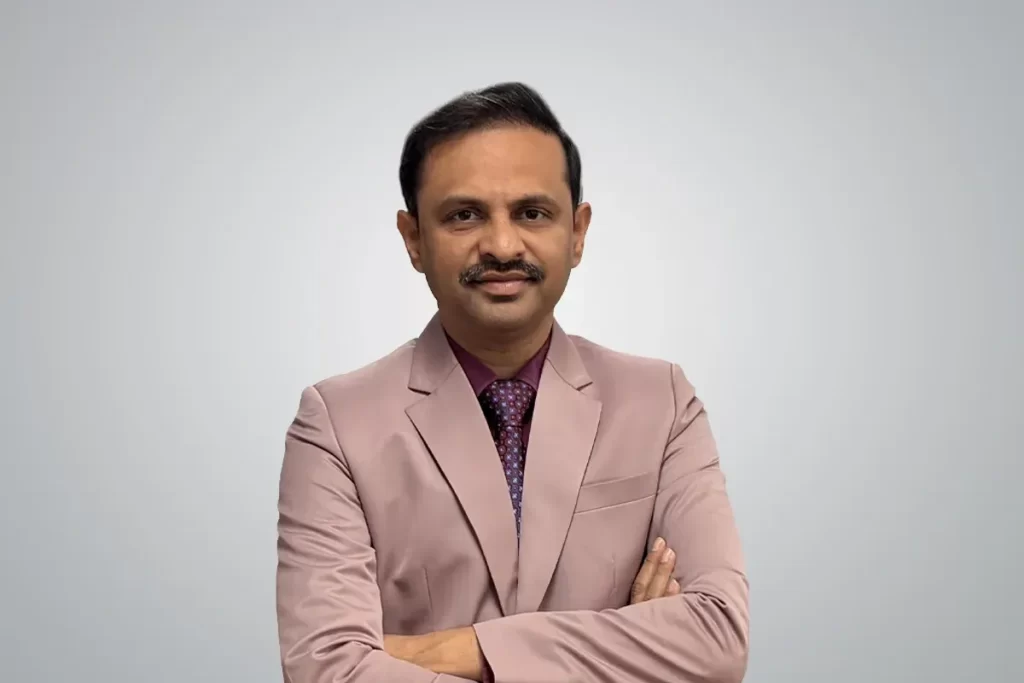
Balancing Scale with Soul in Modern Education
Vamshi Krishna
Principal
Delhi Public School Surat
Growth in education often comes with a trade-off—the risk of losing the very essence that makes learning meaningful. P. Vamshi Krishna has consistently challenged this notion through a leadership approach that proves scale and sensitivity can coexist. At Delhi Public School Surat, his defining strength lies in ensuring that institutional expansion never distances the school from its human core, where student wellbeing, authentic relationships, and the joy of learning remain central.
With over 24 years of association, including twelve years as principal, his journey reflects a quiet yet powerful transformation. Rather than pursuing growth as an end in itself, he has shaped it into a purposeful evolution that integrates academic excellence with emotional resilience, curiosity, and character.
Under his leadership, DPS Surat has evolved into a holistic learning ecosystem. Experiential and project-based learning, strengthened co-scholastic and sports programmes, and a deep emphasis on social-emotional development have redefined student engagement. Simultaneously, his focus on building institutional depth through a dedicated training and development centre and strong parent–school partnerships has fostered a culture of shared growth and sustained excellence.
What truly sets his leadership apart is the intent and empathy behind it. Beyond leading a school, he is shaping a dynamic, evolving institution designed to grow with its people and the times.
Vamshi shares details about his beautiful journey in this exclusive interview with TradeFlock.
Principals today are culture builders, technology adopters, and crisis managers. Which role is most underestimated?
I often say that a principal today is a visionary by morning, a firefighter by noon, and a diplomat, a data analyst, and an emotional anchor by dusk. Yet, in my view, the most underestimated role is that of a culture builder. Schools invest heavily in strategies, policies, and performance benchmarks, but it is culture that determines whether these truly come alive or remain on paper.
Schools are fundamentally human organisations. When culture is nurtured with intent, it builds trust, strengthens collaboration, and fosters resilience among both educators and students. It creates psychological safety for innovation and encourages shared ownership of outcomes.
Ultimately, sustainable transformation is not strategy-led alone but is also culture-enabled, shaping institutions where learning is purposeful and excellence becomes a shared way of life.
Based on your global experience, how does school leadership abroad differ from India?
My interactions with school leaders across the US, Ireland, Finland, and the UK have shown that while student aspirations are universal, leadership ecosystems differ significantly in trust and autonomy.
In Finland, leadership prioritises teacher empowerment, academic depth, and student wellbeing, with minimal emphasis on high-stakes testing. Ireland reflects a collaborative, community-driven approach centred on student voice and pastoral care. The UK blends strong accountability with data-driven systems and distributed leadership, while in the United States, principals often act as entrepreneurial change-makers driving innovation.
In contrast, Indian school leadership operates within a complex, high-pressure environment shaped by scale and exam expectations, where commitment often compensates for limited autonomy.
Looking ahead 3–5 years, what key institutional shift will define DPS Surat’s future identity?
As we look ahead to the next 3–5 years, the defining shift I am prioritising at Delhi Public School Surat is reimagining what meaningful learning truly means. The focus must move beyond answer reproduction to application, critical thinking, and real-life relevance.
We are deepening interdisciplinary and experiential learning while strengthening future-ready pathways such as AI literacy, design thinking, and structured career mentorship. At the same time, we are reinforcing early childhood foundations and social-emotional development.
Equally important is nurturing teacher leadership and amplifying student voice, ensuring shared ownership and shaping confident, adaptable learners.
Is the system an over-engineering achievement at the cost of childhood?
Not entirely, and certainly not across all schools. Today, Indian education boards are creating space for flexibility and innovation within the broader framework of the National Education Policy. Many progressive institutions are using this to prioritise childhood through experiential learning, continuous assessments, and play-based engagement in early years.
However, at the secondary and senior secondary levels, there is a growing tendency to over-structure achievement. Layered assessments, tightly scheduled routines, and constant comparison can unintentionally create pressure, often driven by parental expectations and competitive higher education pathways.
The way forward is not to reduce rigour, but to redesign learning, making it more meaningful, age-appropriate, and emotionally responsive so that achievement and childhood can coexist.
Are school leaders keeping up with the shift to digital and AI-driven education? What’s needed to close the gap?
While the intent and momentum around digital transformation are clearly visible, leadership readiness across schools remains uneven. In many cases, technology adoption is still driven by infrastructure investments rather than a clear focus on pedagogy, learning design, or teacher preparedness. As I often emphasise, meaningful transformation begins with mindset, not procurement.
School leaders today must navigate the dual challenge of understanding emerging technologies while managing everyday academic and operational responsibilities. Bridging this gap requires sustained leadership development in digital pedagogy and AI literacy, supported by continuous teacher capacity-building.
Equally important is maintaining balance by leveraging technology to enhance learning while preserving creativity, collaboration, and human connection through thoughtful integration.
Featured Magazine -

All Magazines-




Other Interviews-
- Keshmahinder Singh-Asia’s Best Business Leaders 2026
- Rifkhan Siddeek-Asia’s Best Business Leaders 2026
- Dr Nabeel Abdul Hour Tomman-Asia’s Best Business Leaders 2026
- Kate Melnikova-Most Inspiring Leaders in Finance USA 2026
- Lalit Laungani-Asia’s Best Business Leaders 2026
- Mayur Nandan-Asia’s Best Business Leaders 2026
- Dr Aarti Mishra Tripathi-Most Impactful Women Leaders from Asia 2026
- Deema Anani-Most Impactful Women Leaders from Asia 2026
- Dr Samah Abu Assab-Most Impactful Women Leaders from Asia 2026
- Vikas C Sajjan-10 Best Tech Leaders in India 2026
