Blending Foresight, Ethics, and Operational Excellence
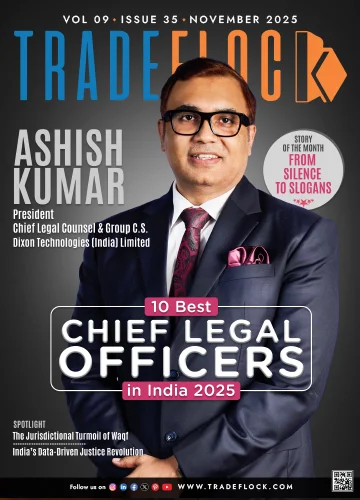
Ashish Kumar
President- Chief Legal Counsel & Group C.S.
Dixon Technologies (India) Limited

Blending Foresight, Ethics, and Operational Excellence
Ashish Kumar
President- Chief Legal Counsel & Group C.S.
Dixon Technologies (India) Limited
In boardrooms where billion-dollar decisions hang in the balance, calm, clarity, and conviction are rare currencies. Ashish Kumar, President, Chief Legal Counsel & Group Company Secretary at Dixon Technologies, embodies them all. Over more than two decades, Ashish has built a career navigating the most complex and high-stakes legal and governance challenges, from landmark public issues in India to shaping strategic frameworks that safeguard business growth and innovation. For him, leadership in the legal domain has never been just about technical expertise; it is about balancing risk with opportunity and enabling businesses to make informed, confident, and transformative decisions. Mentorship from some of India’s most respected governance leaders has deeply influenced his approach, instilling an unwavering commitment to integrity, transparency, and ethical rigour. Known for his composed demeanour, analytical precision, and mission-driven mindset, Ashish approaches every challenge with clarity and purpose. Whether steering crossborder transactions, advising on regulatory strategy, or shaping corporate governance frameworks, he transforms complexity into opportunity, ensuring that legal and business imperatives move in harmony. Today, Ashish stands as a benchmark for corporate legal leadership as someone who blends strategic foresight, ethical principles, and practical problem-solving to create sustainable impact, not just for Dixon Technologies, but for the broader business ecosystem. TradeFlock interviewed Ashish to find out more about his fascinating journey, work and experience.
“Don’t just know the law, know the business.” Great lawyers combine legal precision with commercial insight. Ask, observe, and anticipate challenges.
Which experiences most shaped your leadership journey?
Looking back, a few pivotal experiences stand out as the foundation of my leadership journey. Early in my career, I was entrusted with highstakes transactions and governance matters that demanded not just legal precision but strategic judgement. Those experiences taught me that technical expertise alone isn’t enough; true leadership in the legal and governance space is about balancing risk with opportunity and enabling the business to make confident, informed decisions. Another defining milestone was leading through transformation, whether navigating regulatory changes, restructuring operations, or embedding a stronger culture of governance and ethics. Guiding teams through uncertainty honed my ability to communicate with clarity, foster trust, and align people around a shared purpose. Mentorship has also been critical. Learning from leaders who exemplified integrity, courage, and empathy shaped my approach, and I strive to pay it forward by nurturing the next generation of legal and governance professionals. Ultimately, I’ve realised leadership is less about authority and more about influence, creating the conditions for others to thrive while ensuring sound governance and long-term sustainability
From healthcare to high-speed electronics, what has been your biggest ‘Am I ready for this?’ moment?
Making the shift from healthcare regulations to the fast-paced world of high-speed electronics was one of the biggest transitions of my career. Healthcare emphasised patient safety, clinical compliance, and long regulatory cycles, while electronics demanded innovation velocity, intellectual property awareness, and agile global supply chains. What kept me grounded was the realisation that principles of good governance and ethical leadership remain constant—only the context changes. I relied on curiosity, asking questions, listening to operational people and visiting production lines. Leadership, I learnt, isn’t about knowing everything—it’s about integrity, building trust, and navigating uncertainty with confidence and empathy.
What legal gaps hold back India’s appliances and electronics sector, and what policy could help?
India’s appliances, electrical, and electronics manufacturing sector faces multiple structural and operational challenges. The component ecosystem remains a primary weakness, as high-complexity parts such as chips, precision components, camera modules, advanced sensors, and battery cells are still largely imported. This drives up costs, lengthens lead times, creates quality and IP risks, and exposes manufacturers to sudden supply chain shocks, such as import/export restrictions on rare earth materials. Quality and safety regulations, including the Bureau of Indian Standards’ mandates, face staggered implementation and uneven enforcement, which disproportionately affects MSMEs. The fragmented regulatory framework across central and state laws, covering labour, safety, and environmental standards, adds further time, cost, and uncertainty. Incentives for R&D and highcomplexity manufacturing are limited, and skill gaps in advanced manufacturing persist. Evolving sustainability regulations, including e-waste management, also add complexity. To address these challenges, I advocate for a dedicated Component Ecosystem Incentive & Regulatory Hub. This would combine targeted incentives, fast-track regulatory clearances, technology transfer facilitation, R&D and upskilling support, and infrastructure through industrial zones, along with a one-stop compliance interface for central and state authorities. The impact would be significant: reduced import dependence, lower costs, improved quality control, faster time-to-market, global competitiveness, and better integration into value chains, all aligned with India’s “Make in India” ambition.
“Knowledge itself is a constant motivator, as learning never stops. What drives me daily are challenges, especially complex transactions or new/more challenging assignments.”
One real-world lesson you’d share with a junior lawyer?
The one real-talk lesson I’d share: “Don’t just know the law, know the business.” Great lawyers combine legal precision with commercial insight. Ask, observe, and anticipate challenges. Advice becomes powerful only when it’s practical, relevant, and aligned with organisational objectives. That mindset earns trust and credibility and positions a lawyer as a true partner, not just a technical gatekeeper.
Over your career, which challenge tested you most, and what smart step helped you succeed?
Over the past two decades, I have faced situations that tested every facet of my legal, commercial, and leadership capabilities. One of the most demanding challenges came during my time outside India, when the organisation I was associated with underwent a complex financial restructuring that coincided with a regulatory review, requiring careful navigation of compliance, stakeholder communication, and business continuity priorities. The pressure was immense— every decision was scrutinised, timelines were tight, and emotions ran high across stakeholders. Yet, navigating through this storm ultimately culminated in a successful outcome that validated the team’s resilience and strategic focus. During my tenure in the manufacturing sector, the introduction of new environmental and safety regulations across multiple jurisdictions posed a particularly demanding challenge. Rapid alignment of processes, documentation, and reporting was essential, and the consequences of non-compliance were severe. What made it especially complex was the scale: dozens of plants, diverse local regulations, and teams already stretched to meet production targets left no room for error. The small but smart move that made the difference was bringing compliance closer to the shop floor. Instead of treating it as a purely legal or corporate exercise, we embedded compliance champions within operations—individuals who understood both the regulatory requirements and the realities of daily production. We also established a cross-functional “response cell”, bringing together Legal, Compliance, and Operations to ensure decisions were coordinated, transparent, and defensible. This approach transformed compliance from a checklist into a shared responsibility and a cultural value. Through these experiences, I realised that true compliance isn’t about control—it’s about ownership. When teams understand the “why” behind the rules and are empowered with the right tools, compliance becomes part of the organisation’s DNA. More importantly, leadership during a crisis isn’t about having all the answers; it’s about fostering calm, asking the right questions, and guiding people through complexity with integrity and purpose
Tell us about a project that energises you and its personal significance.
One initiative that excites me most is embedding sustainability and ethical governance into the core of our manufacturing operations. We’re moving beyond compliance checklists to create a framework that drives responsible growth, from sourcing materials to managing waste, energy, and community impact. This initiative matters to me personally because it unites everything I’ve learnt over my career: the legal discipline of doing things right, the operational rigour of manufacturing, and the human responsibility to leave a positive footprint. Seeing teams take ownership, shop-floor executives initiating energy-saving measures or procurement insisting on traceable sourcing is deeply rewarding. Governance, when done right, empowers, builds trust, and creates lasting value.
From your time in the Middle East, which leadership practice do you still follow?
From my UAE days, I learnt the power of foresight. Waiting for challenges, be it regulatory changes or operational disruptions, is risky. I instilled in my teams the habit of thinking ahead, anticipating scenarios, and preparing solutions before issues arise. This approach keeps our Dixon legal team proactive, collaborative, and strategic. It transforms our role from transactional problem-solvers to value creators, ensuring we stay ahead in an industry where timing, insight, and agility define success.
Who do you look up to in law, and what keeps you going?
I draw inspiration from many legal luminaries, past and present, in India and globally; it would be unfair to single out one. Knowledge itself is a constant motivator, as learning never stops. What drives me daily are challenges, especially complex transactions or new/ more challenging assignments. Composure, clarity, and crossfunctional coordination often outweigh speed. Successfully navigating high-pressure situations and seeing tangible outcomes keeps me motivated to continually raise the bar.
Featured Magazine -
All Magazines -