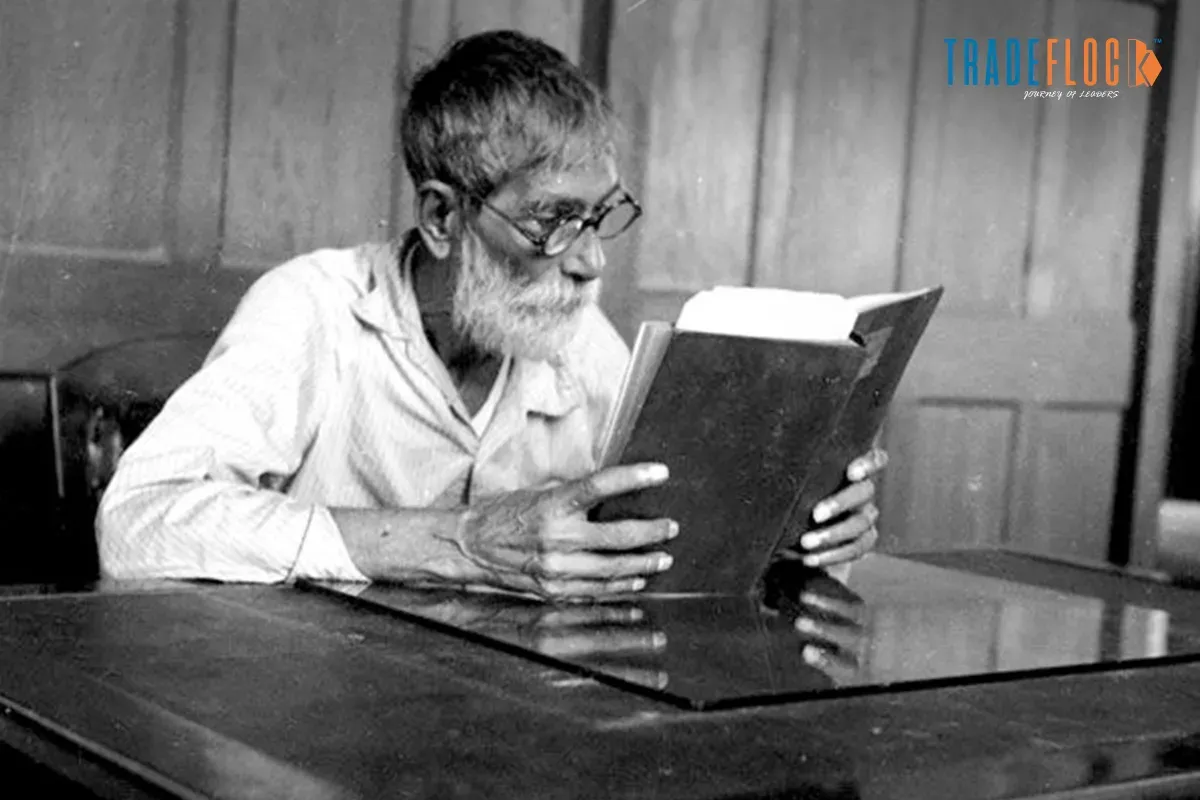
Here’s a thing people don’t often tell you about science.
It rarely starts in perfect conditions. No grand labs, no billion-dollar funding, no neat timelines. More often than not, it begins where things are… well, a bit rough around the edges.
Late 19th-century India was exactly that. Colonial rule, limited infrastructure, and a scientific ecosystem that barely existed. If you wanted to pursue chemistry seriously, you were already swimming against the tide.
And yet, somehow, one man decided to roll up his sleeves and get on with it anyway.
That’s where the story of the father of Indian chemistry begins, with Acharya Prafulla Chandra Ray, a man who didn’t wait for the stars to align. He worked with what he had and built from there.
Table of Contents
A Start That Didn’t Follow the Script
Prafulla Chandra Ray was born on August 2, 1861, in Raruli-Katipara, now in Bangladesh. Now, if you’re expecting a straight-line journey, think again.
At one point, illness knocked him off track for nearly two years. No school, no structured learning. For most people back then, that would’ve been game over.
Ray, though, took a different route. He turned to books, not just science, but literature, history, anything he could get his hands on. You could say he made a virtue out of necessity.
Later, he joined Presidency College in Calcutta, one of the few places where science had some footing. Even then, opportunities were thin on the ground.
Then came a break.
In 1882, he earned the Gilchrist Scholarship and headed to the University of Edinburgh. That wasn’t just a ticket abroad, it was a big deal. By 1887, he had completed his D.Sc. in chemistry, at a time when Indian scientists in global academia were few and far between.
Back Home, But Not Exactly Rolling Out the Red Carpet
When Ray returned to India in 1888, he stepped into a reality that would’ve made many people turn on their heels.
Laboratories were under-equipped. Research culture was almost non-existent. If you were hoping for world-class facilities, you were barking up the wrong tree.
But Ray didn’t throw in the towel. He got down to brass tacks and started working with what he had.
And here’s where it gets interesting.
In 1896, he discovered stable mercurous nitrite, a compound that had puzzled chemists. Now, in a fully equipped lab, that’s impressive. In his situation? That’s something else entirely.
It wasn’t just a discovery. It was proof that serious science could come out of India, even when the odds weren’t exactly in your favour.
Taking Chemistry Out of the Classroom
Ray wasn’t the kind to sit in an ivory tower.
He had this nagging thought that chemistry shouldn’t just stay in textbooks. It needed to step into the real world.
So in 1901, he founded Bengal Chemicals and Pharmaceuticals, widely regarded as India’s first chemical and pharma company.
Now pause for a second.
India, at that time, relied heavily on imported chemicals. Local production was minimal. Starting a chemical company wasn’t just risky;; it was almost unheard of.
But Ray took the plunge anyway.
Bengal Chemicals started small, but it laid the groundwork for something much bigger: the idea that India could produce its own chemicals and medicines instead of always looking outward.
The Multiplier Effect: More Than Just One Man’s Work
If you ask people what Ray did, they’ll mention his research or the company he founded.
Fair enough. But that’s only half the story.
He taught. And not in a box-ticking kind of way.
At Presidency College and later the University of Calcutta, he mentored students who would go on to become scientists themselves. That’s where things start to snowball.
Because when you teach one student well, you don’t just influence one career, you influence everything they go on to build.
At a time when trained chemists in India were scarce, Ray wasn’t just contributing to the field. He was quietly expanding it.
Writing India Back Into the Scientific Conversation
Ray also had a knack for asking uncomfortable questions.
Like, why was India’s scientific past barely acknowledged?
So he did something about it.
In 1902, he published A History of Hindu Chemistry, followed by another volume in 1909. He dug into ancient texts and documented India’s early contributions to chemistry.
No chest-thumping. No grandstanding. Just evidence, laid out properly.
In a colonial context where Indian achievements were often brushed aside, that work mattered more than it might seem at first glance.
Recognition Came, But He Didn’t Make a Song and Dance About It
Over time, Ray did receive recognition. He was knighted in 1919 and associated with respected scientific circles.
But here’s the thing.
He didn’t exactly wear it on his sleeve.
He lived simply. Donated a good part of his earnings. Helped students who couldn’t afford an education.
In today’s terms, you’d call that low-key. Back then, it was just who he was.
So, Why Is He Called the Father of Indian Chemistry?
Let’s call a spade a spade.
Ray didn’t just dabble in chemistry. He built the ecosystem around it.
He introduced modern research practices when there was barely a framework. He started a chemical industry when dependence on imports was the norm. He trained a generation of chemists who carried the work forward. And he documented India’s scientific heritage when few were doing it.
Put it all together, and the title of father of Indian chemistry doesn’t feel like a stretch. It feels earned.
You Might Also Like: Leadership Lessons: Lisa Su, CEO, AMD
The Legacy That Still Shows Up Today
Ray passed away on June 16, 1944, at the age of 82.
Since then, India’s chemical and pharmaceutical sectors have grown massively. Today, the country is among the largest producers of chemicals globally, with the industry contributing significantly to GDP and exports.
Of course, no one builds an entire industry alone. But someone has to get the ball rolling. Ray did exactly that.
And sometimes, that first step, taken without a safety net, ends up being the one that matters most.