
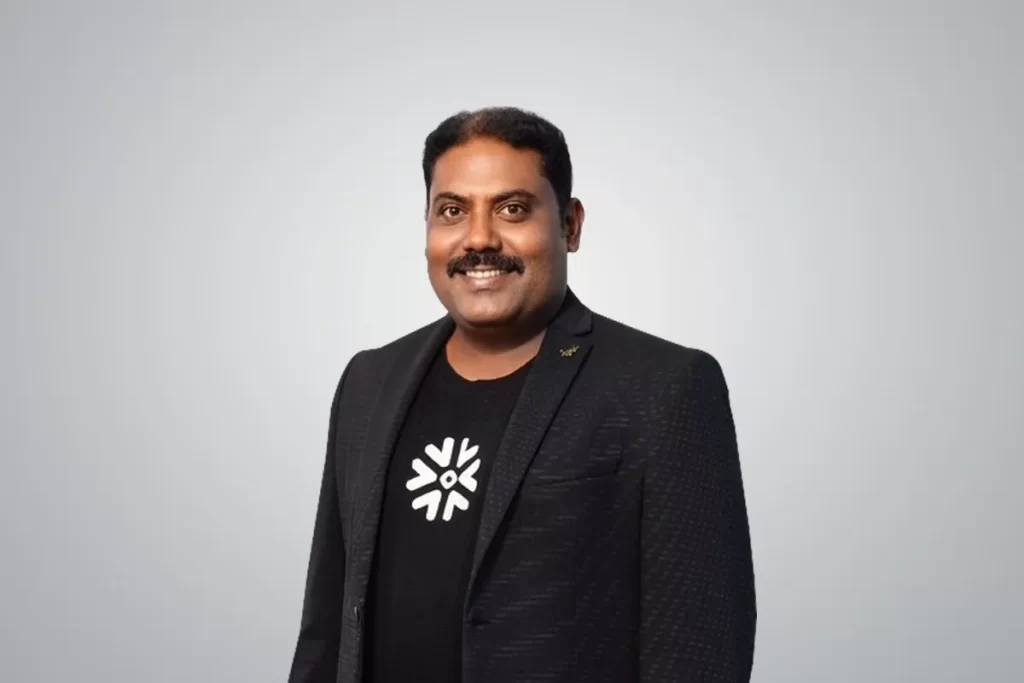
Leading with Clarity in the Age of AI
Chakrapani Kodavati
Senior Vice President & Chief AI Officer
Infojini Inc
Leading with Clarity in the Age of AI
Chakrapani Kodavati
Senior Vice President & Chief AI Officer
Infojini Inc
While much of the technology industry is focused on accelerating AI adoption, Chakrapani Kodavati has long championed a more important question: what business value is AI creating? As Senior Vice President and Chief AI Officer at Infojini Inc., he brings nearly 24 years of experience spanning the evolution of enterprise data, from traditional ETL systems and analytical databases to cloud-native and AI-driven architectures.
Throughout his career, he has remained committed to ensuring technology investments deliver measurable outcomes rather than simply embracing the latest trends. Having served as an engineer, architect, practice leader, and executive, he combines deep technical expertise with a practical understanding of governance, ROI, talent development, and digital transformation.
Talking exclusively with TradeFlock, Chakrapani shares insights on leadership, AI readiness, data foundations, and building technology strategies that drive meaningful business impact.
Could you tell us about your journey into data and AI?
I have spent nearly 24 years in the data and AI space, evolving alongside enterprise technology. My journey began with traditional data systems, ETL tools, and analytical databases before expanding into modern platforms like Snowflake, Databricks, and Azure. I did not enter the field with a grand vision; it started as an opportunity while I was seeking a job.
One of my earliest projects involved building data pipelines for Apple, which sparked my interest in complex data challenges. Over time, I worked as an engineer, architect, practice leader, and manager, leading large teams and building enterprise platforms. What began as a role became a passion for solving real business problems.
What has been your approach to identifying and developing talent?
My hiring philosophy focuses on potential rather than pedigree. While many organisations prioritise graduates from top institutions, I look for talent that may lack visibility but has strong capability. We recruit from diverse regions and invest in structured learning to bridge academic knowledge with real-world needs.
Team members work on proof-of-concepts, MVPs, and product development, gaining hands-on exposure to enterprise challenges. This approach has proven effective, with teams contributing to AI products used globally and shaping impactful professional growth.
Where do data governance efforts typically break down?
Data governance often breaks down when organisations overlook fundamentals. A strong data foundation depends on a single source of truth, trusted high-quality data, and strong security. Many accelerate into AI without strengthening these areas. Governance goes beyond tools and includes profiling, classification, business glossaries, access controls, masking, and secure sharing.
A frequent gap is weak data classification, which undermines access control. Governance must be treated as an ongoing discipline requiring continuous monitoring, education, and improvement to ensure trust, compliance, and business value.
What advice would you give future technology leaders?
My biggest advice is to look beyond technology. Early in my career, I lacked strong mentorship and learned through experience that technical expertise alone is not enough. Future leaders must build a strong understanding of business models, industry dynamics, and the broader forces shaping organisations. Success lies in balancing three areas: mastering technology, understanding business, and staying aware of transformation trends. Strong leaders are not defined by how many technologies they know but by their ability to choose the right solution for the right business challenge. This broader perspective enables greater impact and more effective leadership.
What mindset shifts helped you evolve from a technologist to a strategic technology leader?
The transition was far from easy. As an engineer and architect, I focused on building platforms, designing architectures, and driving cloud migrations. Leading a data practice required a broader view across sales, marketing, talent development, delivery, and business growth. A key learning came through our Snowflake partnership, where technical depth strengthened customer conversations on architecture, integration, cost, and value. Building from scratch meant recruiting, mentoring, and scaling teams while ensuring delivery. The biggest shift was moving from technical problem-solving to delivering business outcomes through technology and leadership.
Why do so many digital transformation initiatives fail to deliver expected ROI?
Many organisations see digital transformation as technology adoption, but it is only one part of the equation. The real challenge is ensuring initiatives deliver measurable business value. AI should be viewed as a productivity enabler, not a replacement for people. Success depends on organisational readiness, process maturity, technology readiness, and strong user adoption.
Leaders must assess the impact on operations, productivity, and long-term growth before investing. Fragmented data, weak governance, poor change management, and adoption gaps often derail outcomes. A major constraint is the skills gap, making the right expertise and implementation partners critical for sustainable ROI.
How ready are organizations for AI, and where is it delivering measurable value?
Many organisations are moving aggressively toward AI without fully assessing readiness. A strong data foundation built on trusted, governed, and secure data is essential. Equally important is ensuring AI addresses real business problems and delivers measurable ROI. Organisations must also evaluate implementation costs carefully before scaling initiatives.
The most successful deployments focus on improving productivity and decision-making rather than automation alone. We have helped a manufacturing company reduce document search time from hours to minutes using natural-language AI, enabled CFOs to access instant insights, and built healthcare solutions that streamlined coordination and provided physicians concise patient summaries, driving clear operational impact.
Featured Magazine -

All Magazines-




Other Interviews-
- Chakrapani Kodavati-10 Best Tech Leaders in India 2026
- Ashok Shankar P-Best Education Leaders in India 2026
- Simmone L Bowe-Most Inspiring Global HR Leaders 2026
- Dato’ Sri Dr. Haji Irmohizam Ibrahim-Asia’s Best Business Leaders 2026
- Manal Hassoun-Most Impactful Women Leaders from Asia 2026
- Shilpi Yadav-Most Impactful Women Leaders from Asia 2026
- Tasnuva Shelley-Most Impactful Women Leaders from Asia 2026
- Dr. Gurdaman L Sharma-Best Education Leaders in India 2026
- Tarun Ramesh Agarwal-Best Education Leaders in India 2026
- Naseer Ali-Best Education Leaders in India 2026
