
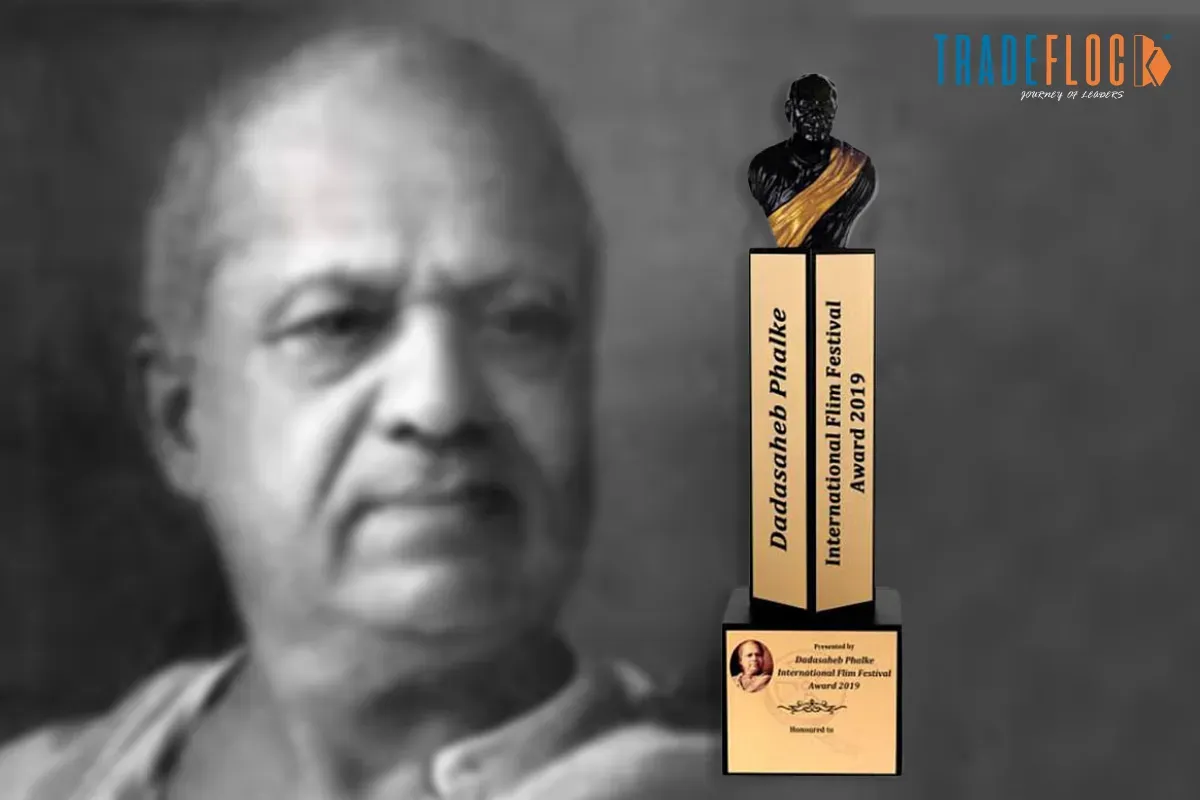
Bollywood films are the largest cinema with a huge, committed audience across the world. It is recognised globally with films released worldwide and featured at various festivals such as the Cannes Film Festival, the Busan International Film Festival, and many more. Bollywood films (Hindi Cinema) are touching the sky with their achievements and awards. However, there is a highly prestigious award in India called the Dada Saheb Phalke award. Many actors are honoured with it, which has led to speculations such as, ” Who is Dada Saheb Phalke”?
If you are also wondering about Dada Saheb Phalke and why the award holds so much value, this is the right place for you. Read this blog and learn exclusive insights about him.
Who is Dada Saheb Phalke – The Man Behind the Award
The Dada Saheb Phalke Award is named after the Father of Indian Cinema, Dadasaheb Phalke. A man whose vision and dedication shaped the landscape of today’s Hindi Cinema. He directed the first film of the Indian nation, called Raja Harishchandra, in 1913. It was the first full-length silent feature film that faced several difficulties, such as social resistance, technical limitations, and lack of finance, but it still made history. The film gave birth to Indian cinema, which made Dada Saheb Phalke a national icon.
Why Dada Saheb Phalke Award Hold So Much Value?
Dada Saheb Phalke’s immense contribution to the Indian film Industry makes him recognisable. He not only laid the foundation of Hindi cinema but also directed and produced more than 95 feature-length films and 26 short films. While making films, Dada Saheb did not forget his culture and roots. He ensured that cultural identity remained central to his cinematic creations.
On February 16, 1944, Dada Saheb Phalke passed away, leaving behind a legacy that endures and continues to immortalise his influence. His passion and resilience continued to echo long after his death. This is why the Indian Government introduced the Dadasaheb Phalke Award in 1969, which is regarded as the highest honour in Indian cinema, awarded annually at the National Film Awards. This award is a symbol of his invaluable contribution to Indian cinema, which will be cherished forever.
Over time, the Dada Saheb Phalke Award has been awarded across languages, industries, roles, actors, directors, producers, composers, technicians, and every other role in the filmmaking process. Dada Saheb Phalke Award winners really signify the love of cinema and the will to do something that leaves a great mark on Indian cinema.
Early Life & Foundation
Dada Saheb Phalke, whose birth name was Dhundiraj Govind Phalke, was the son of a priest. Since childhood, he has shown an interest in creative arts. Later, he joined the Sir JJ School of Art in Mumbai and Kala Bhavan in Vadodara, where he practised painting. He explores various interests, including lithography, amateur dramatics, architecture, and photography. Learning all these helped him reshaped as a man of artistic brilliance and cultural patriotism. Dada Saheb worked as a painter, theatrical set designer, and photographer, and also indulged in music and magic. His childhood has shaped him into a true artist who knows what to present, how to present, and when to present a piece of art that remains memorable.
| Date of Birth | April 30, 1870 |
| Birth Place | Trimbak, Maharashtra |
| Spouse | SaraswatiBai Phalke |
| Education | Creative Arts & Painting |
| Occupation | Producer, Director, Screenwriter & Cinematographer |
| Died | February 16, 1944 |
Cinematic Career & Other Goals
Dada Saheb Phalke’s interest initially drew in printing, and he established a printing press in 1906, which is named after him, Phalke Engraving and Printing Works. While working there, he got a chance to work with Ravi Verma, whose paintings of the Hindu gods were so mesmerising that Phalke got influenced, which led him towards spirituality.
He later portrays God in the mythological films. Phalke also established a new company along with his partner in 1908 called Laxmi Art Printing Works. However, Dada Saheb Phalke left the printing press due to a conflict with his partner. After that, he stepped towards the cinema. His cinematic career started when he first watched a silent film called The Life of Christ (1910).
Dada Saheb was deeply inspired by the film. Since then, he had dreamt of bringing Indian culture and mythology to the moving picture screen. To fulfill his dreams, he secured a loan from a local businessman and went to London in 1912 to learn the craft from British pioneer filmmaker Cecil Hepworth. His visit to the country brought him various knowledge and skills that shaped his cinematic career.
For his first feature film, he studied the king of Hindu mythology and made an excellent film. Even though the film was a critical and commercial success, it helped Dada Saheb to earn huge recognition. He didn’t lose hope; instead grew stronger and made Mohini Bhyasmasur in 1913 and Satyavan Savitri in 1914. His vision keeps getting bigger, and he continues to make films afterwards successfully.
Debt Turned Into Success
Even though Dada Saheb Phalke was successfully creating films and contributing to cinema. But his films did not bring him enough money to continue making films, which put him in a difficult spot. During World War I, he was in debt and struggling to obtain film stock.
But how can he stop when he had the courage to turn his dark nights into brighter mornings with his persistence and hard work? At that time, Bal Gangadhar Tilak, who was a Nationalist leader, helped Phalke by appealing to the general public to raise the funds. He secured substantial funds and finally made the Lanka Dahan in 1917, which was inspired by the Ramayana, and became one of the commercial hits.
After the success of Lanka Dahan Dada saheb established the Hindustan Cinema Film Company with the support of several business partners in 1917. The first film made under this banner was Shri Krishna Janma in 1918. However, after some time, Phalke and his partner started having disagreements, which led him to leave the company in 1920.
Later, he came back and made films under his banner till 1929. However, after the introduction of sound cinema, he gradually left filmmaking and later died. Dada Saheb Phalke received the maximum number, leaving a great number of films that have shaped Hindi Cinema.
The Unforgettable Legacy
Nobody to date has had a bigger impact on Indian cinema than Dada Saheb Phalke. After all these years, he remained a prominent figure in Hindi Cinema. His award is one of the most honourable awards in the country.
The Dada Saheb Phalke Award is more than just an award; people who have received it and those who work hard to be honoured with it are considered exceptional in their craft.
He has left an unforgettable, unmatched legacy in the industry, unrivaled by any other director or producer in Indian cinema.