
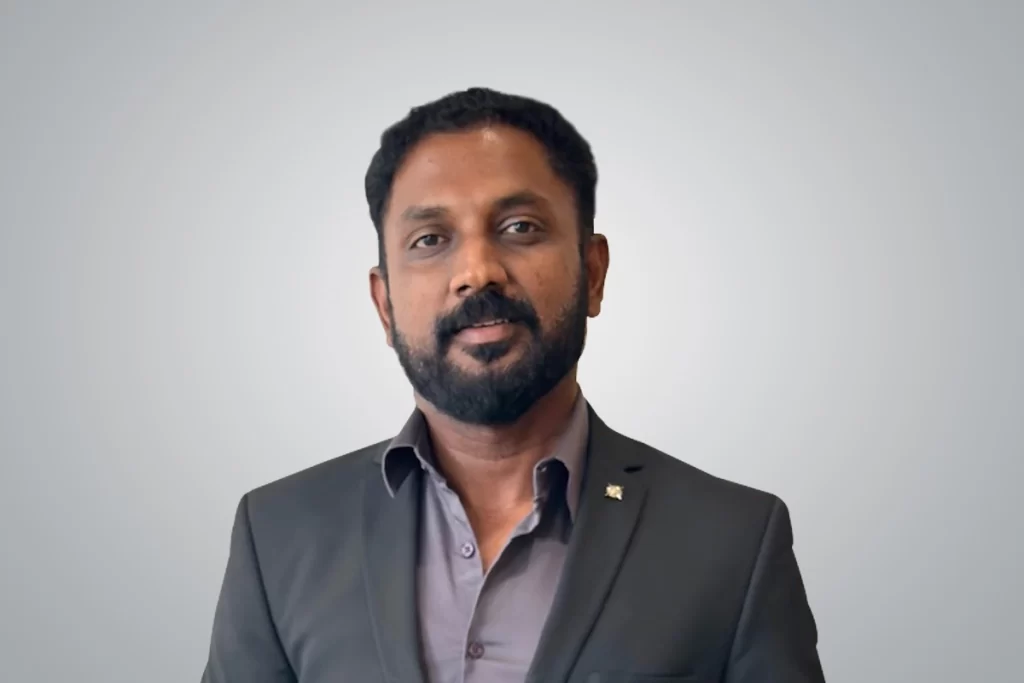
Building Reliability Long Before Loyalty
Sandip Balakrishnan
COO
Double Horse
Even the best customer experience starts long before the consumer sees a product. The quality, consistency, and predictability that customers reward are seeded deep in operational decisions, supply chains, and execution rhythms. Industry research shows that when leadership aligns operations with customer outcomes, organisations build trust that outlasts market volatility. Sandip Balakrishnan has lived this truth throughout an energy-packed 20-plus-year career spanning fresh food, FMCG, retail, and hyper-scale ventures, including work with iD Fresh Food and Swiggy. His journey from building procurement and supply systems to stabilising retail execution and driving scalable category growth reflects a deep connection between backend excellence and customer experience. Now Chief Operating Officer of Double Horse, fuelled by relentless energy and speed with soul, he is steering a consumercentric transformation anchored in discipline and measurable outcomes. During an exclusive interview with TradeFlock, he discussed his journey, challenges, and the thinking that continues to guide his leadership.
You’ve worked across fresh food, FMCG, retail, and hyper-scale platforms. What were the toughest obstacles, and what lessons still guide you today?
Looking back, the toughest obstacle was never complexity. Complexity can be learned and managed. The real challenge was building predictability inside systems that resist it by nature. Fresh food made that clear early. During the dairy launch at iD Fresh, planning logic met reality fast. Milk-based products move on their own timeline. Shelf life keeps shrinking. Customer perception shifts even when technical quality is intact. That phase was uncomfortable because it stripped away the belief that intent alone protects outcomes. Operations were no longer quietly supporting the brand. They were carrying its promise every single day. Retail tested a different kind of discipline. While handling the Kerala zone, demand and brand recall still existed, yet execution had collapsed. Replenishment cycles were broken. Wastage was normalised. Teams had lost confidence. Growth was irrelevant at that stage. The work began with fundamentals, availability, freshness, morale, and trust. Only after stability returned did momentum follow. Hyper-scale later changed the tempo entirely. At Swiggy, especially while building the HORECA division Assure, everything had to move together. That experience reinforced a belief that still guides me. Strategies evolve. Weak systems eventually surface.
In your current role, what technologies are shaping how you operate today, and which ones will redefine operations ahead?
Technology today primarily reduces decision-making delays, which matter enormously in perishable and high-velocity environments. Real-time dashboards, demand forecasting, supplier analytics, and inventory ageing help close the gap between what is happening and how quickly you respond. That speed itself becomes a competitive advantage. What lies ahead is more structural. AI-driven demand sensing, predictive shelf-life and quality analytics, deeper supplier digitisation, and semiautonomous replenishment systems will change how decisions are made. As this evolves, the role of the operations leader will shift as well. Managing processes will no longer be enough. Leaders will need to understand how systems learn, know when to trust algorithms, and recognise where human judgment must remain central.
What did you have to unlearn about leadership, and what should young leaders prepare for?
Early in my career, leadership felt synonymous with having answers, driving outcomes personally, and being indispensable. Experience challenged that belief repeatedly. Building categories, starting businesses from scratch, and turning around struggling operations made one thing clear. Leadership works best when it creates clarity rather than control. Systems and teams that perform without constant intervention are not signs of disengagement. They are signs of maturity. Business schools teach frameworks well. Operations teaches judgment under pressure. No classroom prepares you for accountability without authority or decisions where every option carries risk. Young leaders need to become comfortable acting with incomplete information, recovering quickly, and choosing long-term trust over short-term optics. Recognition may follow, and I value it, but it is not the scorecard. The real measure is simple. Did customers trust us more? Did teams grow stronger? Did the system improve? Did we arrive?
Can you recall a backend decision that directly affected the customer experience?
A defining moment came during the early days of the dairy category at iD Fresh. A backend optimisation decision was made to slightly extend sourcing and holding cycles, primarily to improve cost efficiency. On paper, the logic held. Quality checks passed, and costs moved in the right direction. However, customer behaviour told a different story. Nothing dramatic happened, but something shifted. Repeat purchases softened, and complaints surfaced before dashboards reflected any issue. That lag between operational metrics and lived experience was hard to ignore. At that point, the choice was clear but not easy. The sourcing window was tightened again. Coldchain rhythm was redesigned. Some efficiency was deliberately given up. Not because the model failed on paper, but because trust does not operate on spreadsheets. A similar pattern appeared during the Kerala turnaround for ABRL stores in Kerala. Backend corrections in assortment and replenishment changed what customers saw on shelves. Footfalls returned before marketing activity increased. Operations rebuilt confidence long before communication could.
You’ve led large teams across geographies. What do people need from you that no SOP or dashboard can provide?
SOPs and dashboards bring structure and visibility. They rarely bring reassurance. While building businesses across retail,ecommerce, and manufacturing, SOPs were evolving as the business was already running. Teams were dealing with supplier inconsistency, quality variation, and demand swings simultaneously. Documentation alone could not steady that environment. What helped was clarity around intent and reassurance that uncertainty was understood at the leadership level. Over time, patterns become visible. People want to know why a decision is being taken now. They want confidence that short-term discomfort has a longer-term purpose. They also want safety to speak honestly when something feels off. Burnout does not announce itself through metrics. It shows up when strong performers stop questioning or when leaders execute without thinking aloud. Staying present, through market visits, warehouse walks, and unscheduled conversations, often surfaces disengagement before numbers ever do. “Burnout doesn’t show up in dashboards first. It shows up when good people stop questioning.”
Featured Magazine -

All Magazines-







Other Interviews-
Building Reliability Long Before Loyalty
Sandip Balakrishnan
COO
Double Horse