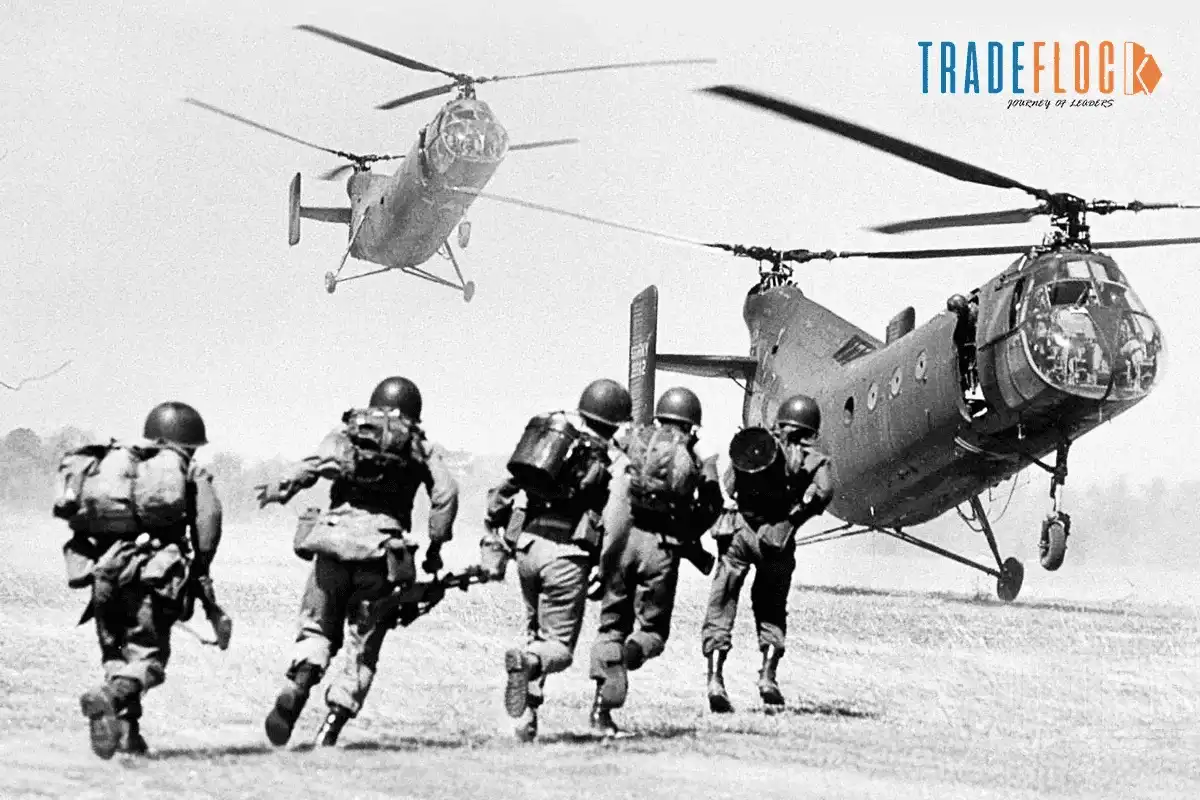
History usually arrives with a mission order and a single operational decision. On January 12, 1962, a profound moment unfolded in Vietnam. The United States launched Operation Chopper, its first official combat mission in the country. It did not begin with massive troop landings or television speeches. It began with helicopters lifting South Vietnamese soldiers into battle, backed by American pilots and planners, unaware of the fact that it marked the start of something new that would have a long-lasting impact on history.
Table of Contents
What Actually Happened that Day
Operation Chopper was an air assault near Saigon aimed at targeting the Viet Cong positions. US Army helicopter crews, flying H-21 “Flying Banana’’ helicopters, transported South Vietnamese infantry into combat zones. Officially, American forces were advisors; practically, they were now directly shaping battlefield outcomes.
This was not a declaration of war. President John F. Kennedy framed it as assistance to the ally under threat. Yet this operation crossed a line: the US military was no longer just advising from the sidelines. It was enabling, executing, and adapting combat tactics on the ground.
The mission succeeded in its narrow objective, but its deeper impact was strategic and symbolic. It showed that America was willing to test its Cold War theory of limited engagement, using technology, mobility, and advisory forces to contain communism without full-scale war.
Bodies and People Involved
The human scale of Operation Chopper was small compared to what followed, but it mattered. U.S. involvement included helicopter pilots, crew chiefs, intelligence officers, and military advisers. South Vietnamese troops carried out the ground fighting. President John F. Kennedy approved the broader strategy that enabled such missions. Secretary of Defence Robert McNamara and military planners believed air mobility could change the nature of warfare.
Casualties from Operation Chopper itself were limited, but the precedent it set was costly. Within a few years, U.S. troop levels in Vietnam would rise from a few thousand advisors to more than half a million soldiers. Operation Chopper was not about numbers; it was about commitment.
The Technology Bet
Operation Chopper was also a test of American innovation. Helicopters were still a relatively new battlefield tool. Military planners believed that vertical lift could overcome Vietnam’s dense terrain and provide the allied forces with speed and surprise.
In business terms, this was a classic early-stage bet on disruptive technology. In 1962, helicopters were seen as a symbol of confidence in American engineering and operational efficiency. What planners overlooked was that technology alone could not resolve political instability, local resentment or guerrilla warfare rooted in civilian populations.
This mission demonstrated that a helicopter could transport troops, but it did not demonstrate that it could win the war.
The Cold War Lens
To completely understand Operation Chopper, one must understand fear, specifically, Cold War fear. The domino theory shaped US foreign policy. Officials believed that if South Vietnam fell, the entire region of Southeast Asia would follow.
Operation Chopper was intended to demonstrate strength and determination to both allies and enemies. From Washington’s perspective, it was a calculated risk. The U.S. had nuclear power, a strong economy, and global influence. Vietnam seemed like a manageable challenge. But small wars can grow surprisingly large. Each small step often leads to the next. Operation Chopper facilitated escalation, not because it was inevitable, but because it was politically simpler.
Socio-Economic Opportunities and Costs
At first glance, the early U.S. presence sparked economic activity. Bases provided jobs, and contracts were awarded to logistics companies, aircraft manufacturers, and suppliers. This military-industrial cycle expanded, thereby boosting domestic innovation and profits.
In Vietnam, the situation was more complicated. While some city areas gained from aid and infrastructure, rural regions experienced displacement and unrest. The foreign military presence changed local enemies, societies and trust. Operation Chopper didn’t cause the tension; however, it unintentionally exacerbated the situation.
This situation underscores that external investment alone is insufficient; capital, technology, and skills cannot replace the need for legitimacy and local consent.
Leadership and Limits
President Kennedy often spoke about restraint, yet he approved a steady increase in involvement. Operation Chopper demonstrates these contradictions clearly: it was brave but careful, new but incomplete.
Leaders believed they could control the extent of their involvement. History itself is a strong example that they were mistaken in this perception. In business and politics, the absence of a clear exit plan can turn small risks into long-lasting problems.
The Long Shadow
Back then, Operation Chopper barely caught anyone’s attention. However, this small mission set off a chain of events: years of wars, social chaos, and a national soul-searching.
Today’s investors, policymakers, and leaders must understand that early action matters more than it appears. Now, strategy is about small and practical moves.
Operation Chopper demonstrates that when a powerful nation tests its strength, even a minor step can leave a lasting impact. History doesn’t question us about our planning and execution; it just records and examines our deeds.