

The Architect of Dignified Ageing
Dr Lakshmipathy Ramesh Nagarajan
Founder & Managing Director and Senior Consultant Geriatrician
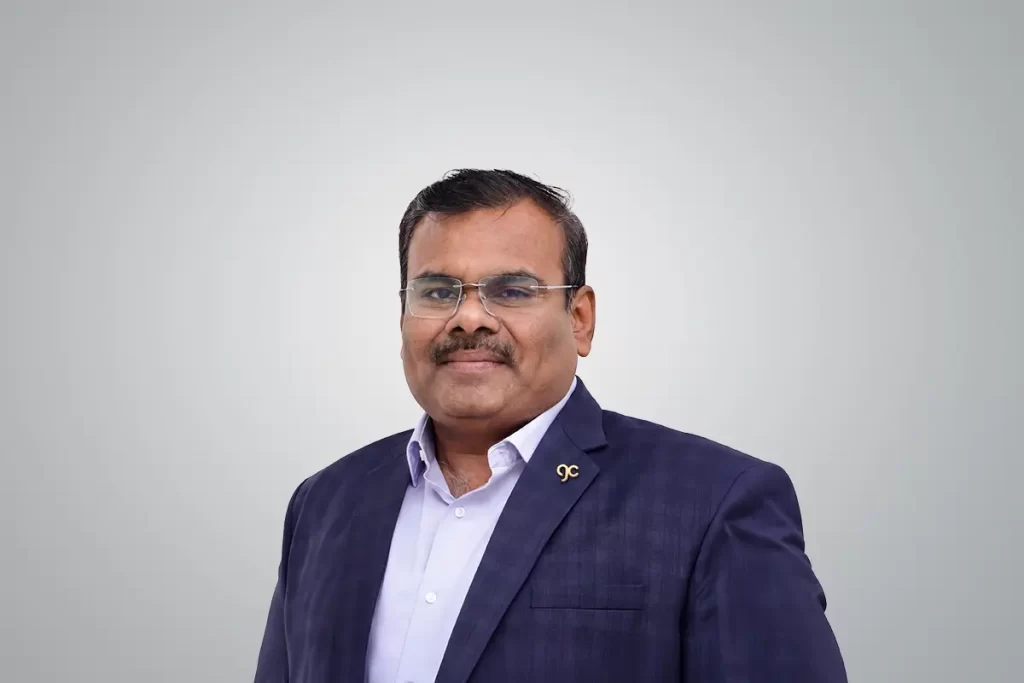
The Architect of Dignified Ageing
Dr Lakshmipathy Ramesh Nagarajan
Founder & Managing Director and Senior Consultant Geriatrician
Geri Care Health Services Pvt Ltd
India is ageing faster than its healthcare system is prepared to handle. By 2050, the country’s elderly population is projected to cross 300 million, yet for decades, the medical infrastructure built to serve them has remained episodic, fragmented, and designed around everything except the realities of growing old.
Dr Lakshmipathy Ramesh Nagarajan saw that gap long before it became a policy conversation. A geriatrician by training and a builder by instinct, he spent years inside India’s most respected hospital systems, where he established many firsts in multidisciplinary senior care practice, before concluding that working within existing structures would never be enough. In 2018, he founded Geri Care Health Services, India’s first integrated eldercare institution, built around a single conviction: elderly care cannot be episodic, and dignity cannot be an afterthought.
Seven years later, Geri Care operates across hospitals, skilled nursing facilities, home care, community clinics, and rehabilitation services, with over 1,000 team members and more than 75,000 elders served across Chennai, Bengaluru, and Coimbatore. TradeFlock spoke with him about what it took to build it, and what it will take to fix the system entirely.
What first drew you toward geriatric medicine, and how did that eventually lead to building Geri Care?
When my father came home from the hospital after his cancer treatment, I expected the hardest part was behind us. It was not. The medical system had managed the disease with skill and care. But the moment he crossed the threshold back into our home, the structure disappeared. There was no coordinated plan, no continuity, no one whose job it was to hold the pieces together. Our family was left navigating recovery largely on our own.
My father was an ex-serviceman. A man of discipline and quiet resilience. Watching him, and watching our family struggle not because of medical failure but because of a structural gap in how care was designed, planted something in me that never left. Geriatric medicine eventually gave me the vocabulary for what I had witnessed. Elderly patients rarely arrive with isolated conditions. Their care involves rehabilitation, cognitive decline, emotional vulnerability, and above all, the question of how to preserve dignity at a stage of life when healthcare systems most often become fragmented. Geri Care grew directly from that understanding.
Most healthcare organisations claim to offer integrated care. What does it actually mean inside Geri Care?
It means the same geriatric philosophy follows the patient across all settings, rather than having to start from scratch each time they transition. It sounds simple, but it is extraordinarily difficult to build operationally.
Most systems still run as disconnected silos. Hospitals manage the acute phase. Rehabilitation happens somewhere else. Home care operates independently. Families are left coordinating across all of it without the clinical knowledge to do so confidently. Elderly patients suffer most precisely during those transitions.
We built four connected verticals: home care, community clinics, skilled nursing facilities, and multi-speciality geriatric hospitals. Skilled nursing facilities matter most to me personally because they address the missing middle. They function as Long-term Care Hospitals, offering a sustainable solution and environment for any elder requiring care, sans the infrastructural and financial burden of a hospital. This is particularly important when the elder is stable enough to leave the hospital but not yet safe to be fully at home. Elderly care does not end at discharge because, for too many patients, discharge was where care was effectively being abandoned.
India's elderly population is among the fastest-growing in the world. Where was the system most visibly failing them?
Three gaps were impossible to ignore once we started looking seriously. Medical systems had been built around acute, episodic care, not around the realities of ageing physiology. Care was fragmented among specialists, with no coordinating physician who held the full picture. And families, who had historically carried much of the caregiving responsibility, were increasingly unable to do so as urbanisation reshaped household structures.
What struck me most was how much unnecessary suffering was happening immediately after discharge. Patients were medically stable but not genuinely ready to manage at home. They fell back into crisis. Families panicked. Readmissions followed. We started with coordinated home-based care and comprehensive geriatric assessments precisely because the evidence pointed in that direction. COVID made what had been a structural argument into an urgent, visible one almost overnight.
You believe the future of eldercare sits largely outside hospitals. How near are we to this future?
Closer than most people in the system are comfortable acknowledging. Today, nearly 30% of our revenue already comes from home care, skilled nursing facilities, and allied services outside traditional hospital environments. Not a projection. This is where we are right now.
Over the next decade, close to 80% of eldercare interactions and more than 60% of healthcare value creation will occur outside hospitals. The question is not whether the transition happens. The question is whether India builds the infrastructure to manage it with clinical rigour, or leaves families to navigate it alone again.
Technology is central to the answer. Remote monitoring, teleconsultation, home diagnostics, and rehabilitation tracking. These will not be replacements for human care, but act as the connective tissue that makes continuity possible at scale.
Featured Magazine -

All Magazines-






Other Interviews-
- Dr Lakshmipathy Ramesh Nagarajan-India’s 10 Most Influential Healthcare Leaders 2026
- Chetan Bipinchandra Shah-India’s 10 Most Influential Healthcare Leaders 2026
- Dr Priyanka Bahl-India’s 10 Most Influential Healthcare Leaders 2026
- Prahalad Singh Patel-10 Best CEOs in India 2026
- Rakesh Gaur-10 Best CEOs in India 2026
- Dr Vijay Viswanathan-India’s 10 Most Influential Healthcare Leaders 2026
- Dr Atantra Das Gupta-India’s 10 Most Influential Healthcare Leaders 2026
- Subhashis Chakraborty-Best Corporate Leaders in India 2026
- Vipul Jambucha-Best Corporate Leaders in India 2026
- Jyotsna Kumar-Best Corporate Leaders in India 2026
