
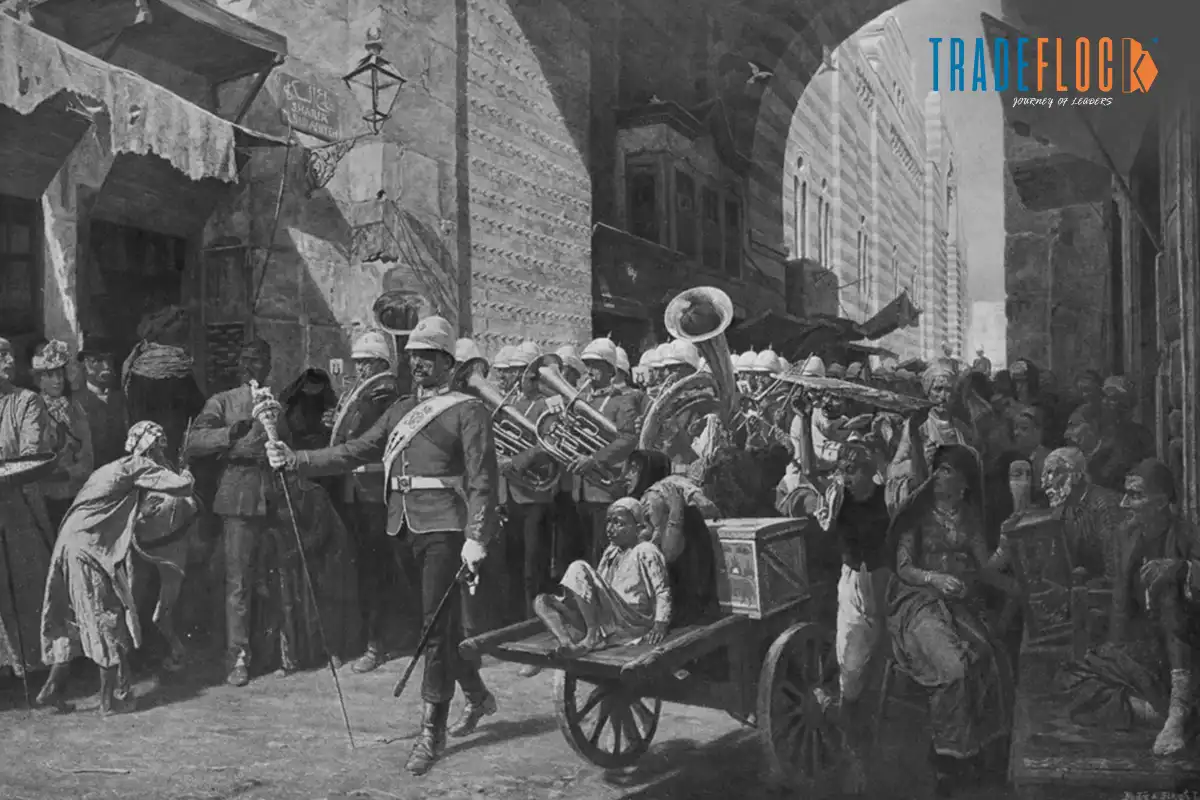
September 29, 1923, marks a significant moment in history as the British Empire reached its maximum geographical extent. On this day, the Union Jack flew not only over government buildings but also across banking halls, trade records, and global supply chains.
This empire represented more than mere territorial control; it was a vast business enterprise operating on a global scale. The British Empire peaked at 13.71 million square miles, encompassing nearly a quarter of the world’s land and governing one in every five people on Earth. However, behind the maps adorned in red lay a complex system of resource extraction, market dominance, and military power. While celebrations erupted in Britain, the global economy responded with a mix of admiration and rising tension.
Table of Contents
The Rise of an Imperial Superstructure
The British Empire reached its peak in 1923 after three centuries of strategic expansion and commercial dominance. It started with the East India Company in 1600, transforming trade into territorial control. By the 18th century, military victories secured vital colonies like India and Canada, establishing a global footprint.
The 19th century marked rapid growth fueled by the Industrial Revolution and maintained by the Royal Navy’s Pax Britannica, a period of peace that kept markets accessible. After World War I, Britain acquired new territories through League of Nations mandates. By September 1923, the Empire was the largest in history, controlling resources, routes, and a fifth of the world’s population.
The Imperial Playmakers
The British Empire functioned similarly to a large multinational corporation, with King George V serving as its symbolic figurehead, akin to a corporate chairman. Actual decision-making authority rested with Parliament and the Colonial Office, which shaped imperial policies and prioritized profit. At the core was the East India Company, originally a trading entity that evolved into a dominant economic and military power, combining commerce with conquest and transforming global trade into a tool for territorial growth, laying the foundation for Britain’s international influence.
Supporting this extensive system was a network of specialized agents: civil servants acted as administrative managers ensuring effective governance; missionaries served as cultural consultants to influence local identities in line with imperial aims; and merchants, functioning as financial managers, sustained the economy by managing trade and capital. Together, they kept the empire’s machinery operational, ensuring Britain’s global enterprise was both credible and prosperous.
Economic Footprint of Empire
The British Empire extended beyond political authority; it functioned as a global business network centered around resource extraction, financial influence, and cultural reach. Colonies provided raw materials such as cotton, rubber, gold, and sugar, which Britain processed and resold, creating a self-sustaining economy primarily focused on British profits.
The pound sterling was the dominant currency for trade within the empire, with London establishing itself as a leading global financial center. Soft power through language, education, and customs helped sustain control, making English a means of social mobility. Infrastructure projects like railways and ports mainly supported resource extraction rather than local development; for example, in India, 90% of railway profits were sent back to Britain.
However, widespread inequality caused famines, land seizures, and economic dependence, leading to resistance movements ranging from Gandhi’s nonviolent protests to the Mau Mau uprising. The empire’s expansion was fueled by exploitation and was not hindered by it.
Governance-Driven Socio-Economic Realignment
On 29 September 1923, the beginning of British and French mandates marked a key change in colonial governance with significant socio-economic effects. In Palestine, British officials acted as policy planners, encouraging more Jewish immigration, which upset the local social balance.
Simultaneously, infrastructure projects like railways and ports were mainly aimed at supporting imperial logistics and trade. In Syria and Lebanon, the French mandate functioned like a cultural franchise, revamping public institutions and promoting French language and values to create a loyal managerial class, while also shifting agricultural and industrial output to fit the economic supply chains of the homeland.
At the same time, Mussolini’s move to refund 10 million lire to Greece served as both a reputation boost and a liquidity boost, providing social capital by helping refugees and stimulating local economies amid instability.
Looking Beyond the Surface
The events of September 29, 1923, show how post-World War I mandates and reparations acted as strategic tools, reshaping political borders, reorganizing societal structures, and recalibrating regional economies to serve European imperial goals.
These colonial governance systems created economic dependence and reinforced social hierarchies, while also fostering the development of national identities and grassroots resistance. This complex legacy not only changed the geopolitical landscape but also laid the groundwork for long-lasting socio-economic divisions and political instability, which continued to influence history, Middle Eastern market trends, and governance issues for years to come.


