
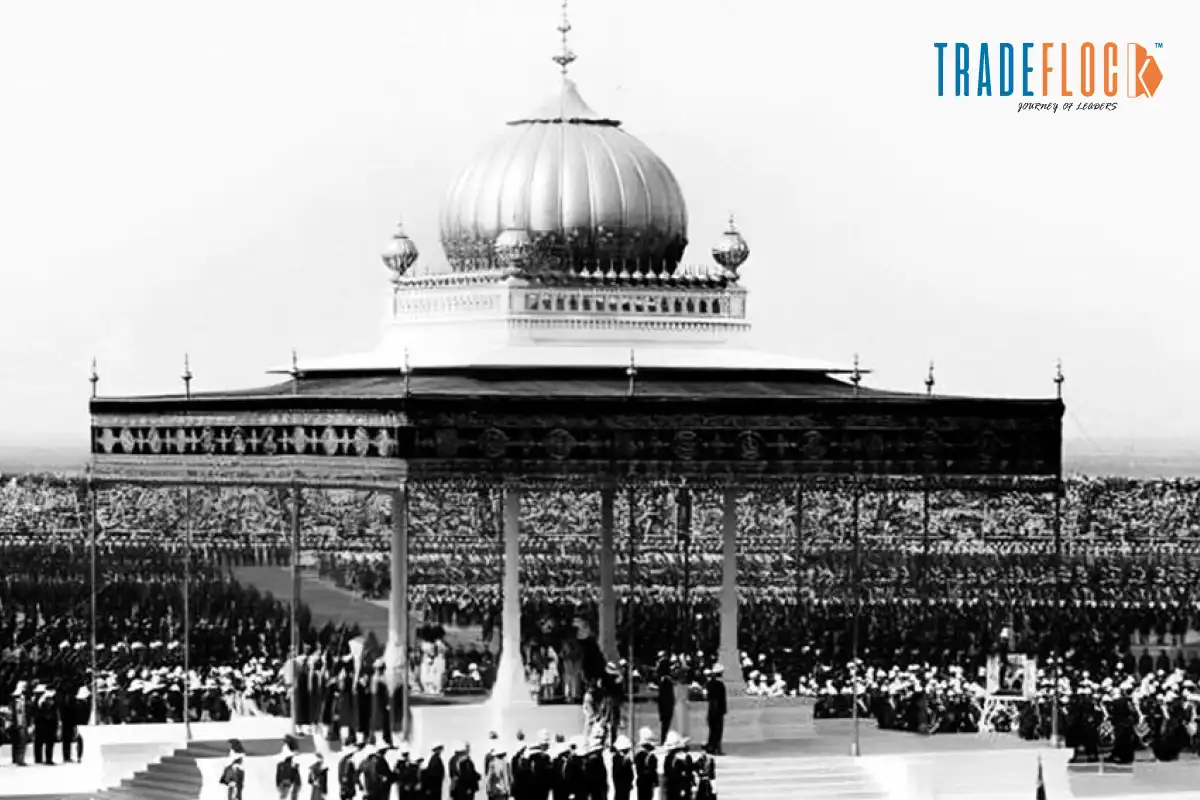
It was more than just an administrative change when King George V announced at the Delhi Durbar in 1911 that the capital of British India was moving from Calcutta to Delhi. It symbolised a re-establishment of political authority, a strategic adjustment of colonial rule, and marked a pivotal moment in India’s national history. The move redefined imperial priorities, shifted the political landscape, and laid the groundwork for modern Delhi, a city at the heart of Indian identity, politics, and aspirations.
Table of Contents
A Kingdom’s Announcement That Changed an Empire
During the grand ceremony of the Delhi Durbar on 12 December 1911, King George V spoke to thousands of dignitaries and Indian princes. In his proclamation, he announced that the capital of British India would be moved to a more ancient city, Delhi, which had housed empires over the centuries, rather than Calcutta, the busy seat of Bengal. The decision was not a trivial one.
Calcutta was a commercial hub and a centre of intellectual life, but it also represented the centre of increasingly strong nationalist sentiment. The movement against the Partition of Bengal in 1905 was so threatening to the colonial government that it exposed the fragility of the colonial government’s eastern rule. Delhi, however, symbolised imperial continuity. It carried the legacy of the Mughals, Sultanates, and countless other dynasties that had become intertwined with India’s political psyche. The British chose Delhi as their new capital to achieve both administrative efficiency and symbolic legitimacy.
Why Delhi, and Why Then? A Calculated Colonial Strategy
The decision made by Delhi was strategic, political, and psychological. Geographically, it offered a more central location in the vast subcontinent. Administratively, it enabled easier control over areas in the north and west that were vital to the Raj’s military and political interests.
For the British, shifting the capital was also a way to diminish Calcutta’s political weight. Bengal had become a hotbed of anti-colonial activity, breeding writers, revolutionaries, and organised movements. The growing unrest threatened the stability of the Raj. Moving to Delhi allowed the colonial government to distance itself from an increasingly antagonistic intellectual centre and to be closer to the more conservative princely states that were more supportive of imperial rule.
Another purpose of the move was to appease Bengal. Along with the announcement, King George V officially rescinded the Partition of Bengal, trying to win back the support of the Bengali people. Hence, the rise of Delhi was accompanied by political damage control in the east.
A New Capital Takes Shape in the Shadows of History
After the announcement, plans for a new imperial city began. The British wanted a modern capital that showed glory, power, and dominance, unlike any other in India. The administration moved to Delhi in 1912, starting a major urban redesign.
Architects Edwin Lutyens and Herbert Baker designed the new capital. Over 20 years, a planned city with wide streets, grand buildings, and blending Western and Indian styles emerged. Known as New Delhi, it symbolised imperial permanence and power, with structures like Rashtrapati Bhavan, the Secretariat, and Rajpath.
Meanwhile, government functions continued in Old Delhi, creating a mix of ancient and modern spaces representing India’s imperial past and colonial present.
Political Ripples Across India
The change caused significant political repercussions. In Calcutta, many viewed it as a deliberate attempt to diminish Bengal’s political influence. The city, long regarded as India’s cultural and intellectual centre, responded with resentment and introspection. The move prompted leaders and organisations to reconsider their strategies, diversify their bases, and expand their influence beyond Bengal.
Elsewhere in the country, the change enhanced Delhi’s role as a political centre. Nationalist movements gradually gravitated towards the city, recognising its importance as both a seat of power and a venue for political expression. Over the following decades, Delhi became the focal point of national agitation, debate, and organisation, an evolution that accelerated in the years leading up to independence.
A Shift That Redefined India’s Political Landscape
The change in the capital in 1911 did not instantly transform the country’s fate, but it redirected the political landscape in a way that would shape the nation’s future. It brought governance closer to the heart of India, moving away from the trading-focused seat of the colonial era in the east. It connected the power of the Raj with the historical legacy of the earlier empires. It also gave the new name of Delhi, not solely the demise of the dynasties that came before, but the foundation of a new nation.
It appeared to be fate that Delhi would become the capital of India when the country gained independence in 1947. The city had become a centre of politics, culture, and symbolism. What had begun as a colonial policy ultimately became the core of a nation.
The British aimed to tighten control in December 1911 when Delhi replaced Calcutta as the capital. However, they inadvertently triggered a series of events that would turn Delhi into the heartbeat of an independent India. In this city, authority, culture, opposition, and creativity would converge over time.


