
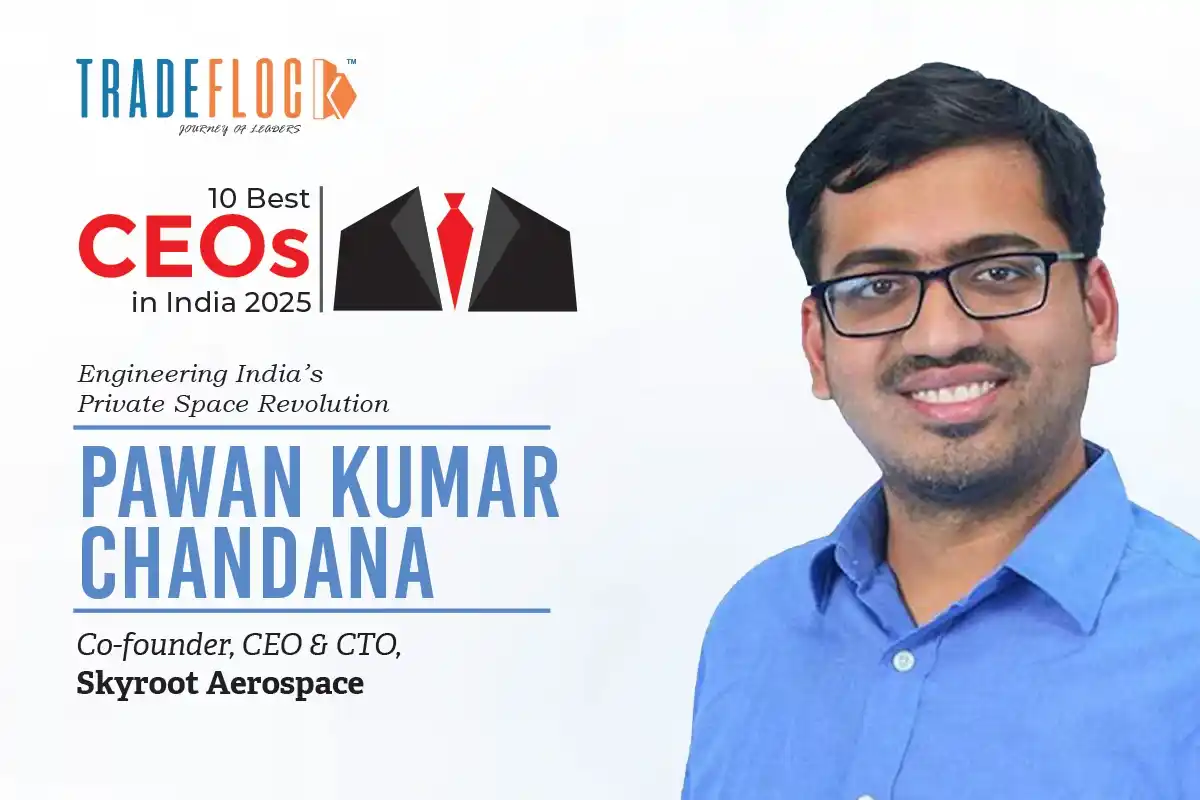
Long before rockets with “Made in India” labels were soaring into space, Pawan Kumar Chandana was a curious child in Telangana, sketching launch vehicles in the margins of his notebooks and dreaming of distant galaxies. Years later, that fascination turned into a mission, to reach space and to democratise access to it. After working at ISRO and contributing to some of India’s prestigious space programs, Pawan realised that the private sector had a vital role to play in accelerating the future of space exploration. That realisation led to the birth of Skyroot Aerospace, co-founded with like-minded visionary Naga Bharath Daka. As CEO & CTO of Skyroot, Pawan now leads India’s first private company to successfully launch a rocket, Vikram-S, into space.
Table of Contents
The Eureka Moment: Redefining Space Access from India
By 2018, with the example of international space pioneers and the new Indian policy environment, Pawan, together with a colleague, Naga Bharath Daka, had a vision of democratising space. He noticed that India could manufacture cheap rockets, but the demand for satellites was increasing exponentially, and the frequency of launches and accessibility were lacking. He pointed out that space access is cost-prohibitive and not very reliable. It was at that point that they started Skyroot Aerospace in June 2018.
Meeting the Challenge: Building Space Tech from Scratch
Skyroot started with only 10 employees in the T-Hub incubation centre in Hyderabad. They had several obstacles: the absence of governmental policies, the absence of the private testing infrastructure, the shortage of deep-tech talent, and the absence of experience in entrepreneurship. The pandemic put things on hold-and it also spurred change. By the middle of 2020, lax regulations, an MoU with ISRO, and seed capital allowed it to test major engines.
Innovating Under Pressure: Tech Breakthroughs
Skyroot, under the leadership of Chandan, was the first to introduce a number of new technologies:
- Raman-1: The first Indian privately developed hypergolic upper-stage engine, bench-tested in July 2020.
- Kalam-5 and Kalam-100: Carbon-composite solid fuel engines tested in December 2020 and May 2022, respectively. The latter is the largest rocket stage in the history of the Indian private sector.
- Dhawan -1: Cryogenic engine LNG/LOX, tested in November 2021.
- Stage separation system: Pneumatic, ultra-low shock separation system, qualified mid-May 2025, the key to the next Vikram-I mission.
These inventions demonstrated progressive engineering- carbon composites, regenerative LNG technology, 3D-printing, and light-weight pneumatic systems.
Historic Firsts: Vikram‑S to Orbit-Bound Vikram‑I
Skyroot successfully launched the Vikram-S, India’s first privately developed suborbital rocket, to 89.5⯩km altitude on November 18, 2022. It confirmed the avionics, propulsion, and structural designs, the foundation of Vikram-I, which is to launch into orbit by the end of 2025.
Industry Impact & Scaling Strategy
To Pawan Kumar Chandana, the role of CEO and CTO of Skyroot has been instrumental in the company’s growth in the private space industry. Under his leadership, Skyroot has assembled a team of more than 350 professionals, including the best minds in mechanical, electronic, and avionics engineering.
Chandana has been able to raise approximately $68 million, which began with $11 million in Series A in May 2021, then followed by $4.5 million in bridge/B/B rounds in January 2022, and lastly, the $27.5 million in pre-Series C funding in October 2023. More importantly, he has established strategic alliances with ISRO since 2020 and has access to test facilities, which is an unprecedented privilege for a private player. Chandana has also managed to successfully manoeuvre the liberalised space policy of India to set Skyroot on international horizons. Skyroot has a vision to offer small-lift launches on-demand and customisable, similar to a taxi service, as opposed to the bus or train model of SpaceX.
Accolades & Recognition
Chandana and Skyroot have achieved a high level of popularity due to the many prestigious awards that demonstrate their innovativeness and contribution to the space and startup ecosystem. They have won the ISRO Best Innovative Product and Idea Award in 2016 and the Aerospace Engineering Division Prize of the Institution of Engineers in 2018. In 2020, the Government of India honoured them with the National Startup Award and the Aegis Graham Bell Jury Choice Award in 2020 (presented in 2021).
In 2021, Skyroot was awarded the Pride of Telangana Startup Achiever and the Telangana Best Innovator Award. In 2022, they won the National Technology Startup Award in the category of excellence in cryo, liquid and solid propulsion technologies. Skyroot also appeared in the Top 25 Startups in LinkedIn India in 2021, and ranked seventh, and Chandana was included in Forbes 30 Under 30 Asia list in 2020, and in the India Today Young Achiever list in 2020 and 2022 respectively.
Overcoming Key Challenges
Chandana addressed multiple formidable problems:
- Infrastructure & Testing: Built indigenous engine and stage test facilities.
- Technical Mastery: Developed proprietary carbon composite, cryogenic, and pneumatic systems.
- Talent Scarcity: Recruited deep-space experts despite national shortage.
- Financing: Secured significant capital in India’s nascent private space investment environment.
- Policy Framework: Aligned with Space Department reforms to access ISRO facilities and partnership frameworks.
Charting India’s Path to the Stars
The story of Pawan Kumar Chandana, an ISRO scientist and a space entrepreneur, reflects the privatisation of space dreams in India. He and Bharat Daka have turned Skyroot into a modern space-tech firm that marries innovation with cost-effective launch economics and is focused on making space as commonplace as flying an aeroplane.
Skyroot is beginning a commercial phase with the launch of Vikram-I later in 2025, and Chandana is its dual CEO. His narrative indicates how profound technical knowledge, entrepreneurial spirit, and policy synergy can catapult the Indian space ecosystem into the international space-opening space to satellites and, perhaps, to the entire humanity.