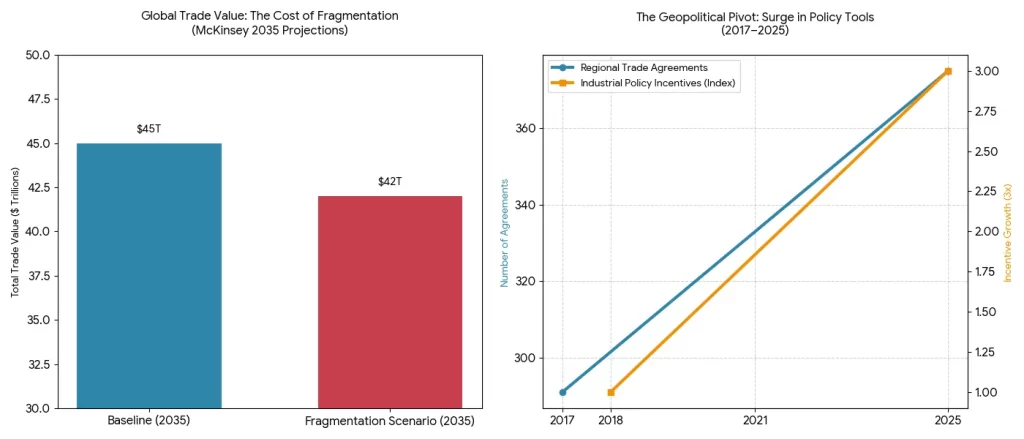
Strategies, finance, and product were the only ingredients that business leaders needed to succeed. The modern business landscape is more complex: geopolitical disruptions, stricter regulations, activist shareholders, and reputational shocks can bring a strategy down overnight. According to the World Economic Forum (WEF) Global Risks Report 2026, which ranks the most systemic risks business leaders face today, geopolitical and economic fragmentation is among the most significant, with a cross-border fault line a key characteristic of the decade.
Table of Contents
Why Diplomacy is No Longer an Option
Once trade routes shift, sanctions are imposed, or a regulator targets a business model, the C-suite must go beyond playbooks to focus on performance and engage with the political landscape. This includes building relationships with governments, crafting narratives with civil society, and negotiating outcomes with partners and competitors. McKinsey’s 2025 analysis of the changing landscape of global trade shows that companies are already adjusting supply chains and investments because politics, not just efficiency, determines where scale can be safely built. Strategic leaders who lack political agility risk placing strategy at the mercy of events they could have influenced.
When Politics Becomes a Profit Variable
In global surveys, CEOs cite geopolitical uncertainty as a top concern, and boards want management to discuss not only market risks but also political risks. PwC’s 29th Annual Global CEO Survey (2026) highlights geopolitical risk and regulatory changes as major factors that can threaten growth, indicating that investors seek political foresight rather than just balance-sheet solutions.
Meanwhile, supply chains, the essential circulatory system of modern business, are vulnerable. Deloitte consultants emphasise that disruptions have become systemic, and resilience involves engaging with local governments, diversifying sourcing, and using contingency diplomacy to keep goods moving through conflicting routes.
Corporate Diplomacy as a Core Capability
Corporate diplomacy encompasses a practical set of skills, including awareness of situational dynamics, building long-term relationships, and carefully choosing communication methods. It combines three core capabilities: stakeholder mapping (identifying who influences policy and sentiment), narrative crafting (persuading regulators, employees, and customers through strategic storytelling), and credible bundling (offering tangible benefits such as jobs, technology, or training in exchange for predictable rules). Experts emphasise that this is not grand diplomacy but a repeatable craft: small, credible actions that reduce surprises and secure ongoing approval.
Initially, prepare the strategy team for political scenarios by using scenario planning to simulate sanctions, tariffs, and cross-border data regulations. Subsequently, establish relationships and proactively develop networks with regulators, non-governmental organisations, and peers in high-risk markets, even when immediate engagement is not required. Thirdly, professionalise stakeholder engagement by integrating policy discussions within customer and investor narratives, rather than treating them as supplementary efforts. Lastly, educate executive leadership and the board on political literacy to enable rapid, well-informed decisions on compliance, communication, and country strategies.
Power Built on Partnership
Companies that pay attention to policies and communities reduce the risk of disruptive enforcement, bans on costly products, or public boycotts. Some analysts, like McKinsey, show that firms with well-developed geopolitical playbooks move capital faster and gain first-mover advantage in local markets. The alternative is expensive stop-and-starts: plant idling, costly legal battles, and brand damage that no strategy slide can undo.
Leaders should set an example by being humble and reciprocal. Successful corporate diplomats use fewer absolutes and more offers: training programmes for local workforces, clear compliance schedules, or shared innovation with national labs. Such a factual, cooperative, and accountable tone builds trust over the long term. In a crisis, organisations that have invested in local relationships receive calls that lead to solutions; unprepared firms receive subpoenas.
Political mapping should be a key topic for the board. Create a cross-functional team (legal, policy, comms, ops) empowered to act quickly. Train top managers in negotiation, stakeholder engagement, and cultural intelligence. And make diplomacy a measurable skill, its KPIs include permits, regulatory outcomes, partner satisfaction, and time-to-resolution.
Power is the New Product
The leader of a corporation in the twenty-first century must exemplify the qualities of a strategist and statesman. As markets become increasingly fragmented and regulations proliferate, organisations that endure and prosper will be managed by executives capable of analysing political developments, forming enduring coalitions, and converting commercial opportunities into societal advantages. Investing in political diplomacy has shifted from a civic obligation to a fundamental competency for generating value and expanding influence in a landscape where the next significant disruption in the boardroom is expected to arise from power dynamics rather than product innovation.