History tends to come with a mission order and a single operational decision. A very momentous day in Vietnam took place on January 12, 1962. The United States initiated Operation Chopper, which was its first official combat operation in the country. It was not initiated by huge numbers of troops landing or television addresses. It started with helicopters bringing South Vietnamese soldiers to the battle with American pilots and planners, not knowing that it was the beginning of something new that would make a long-lasting impact on history.
Table of Contents
What Really Transpired on that Day
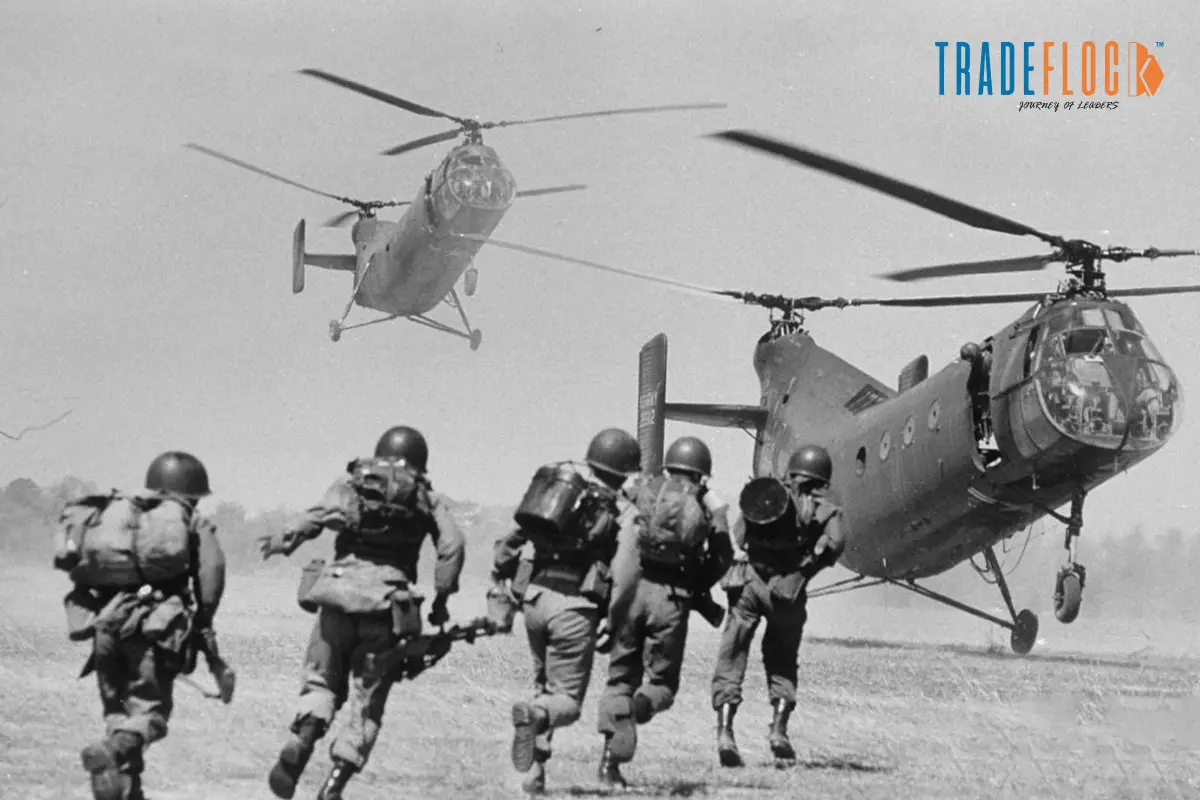
Operation Chopper was an aerial assault on Saigon, which was meant to attack the Viet Cong positions. The US Army helicopter crews, in the H-21 helicopters, known as the Flying Banana, moved the South Vietnamese infantry into the combat areas. On the record, the US troops were advisors; in reality, they were now the direct determinants of battlefield outcomes.
This did not amount to a declaration of war. President John F. Kennedy put it in the context of aiding an ally in danger. However, this operation was a step too far: the US army was no longer merely coaching on the sidelines. It was empowering to implement and adjust ground combat strategies.
The mission achieved its small goal, but its greater impact was strategic and symbolic. It demonstrated that America was ready to put its Cold War belief in limited involvement to the test, using technology, mobility, and advisory forces to keep communism at bay without war.
Participating Bodies and Persons
Operation Chopper was a small, human-scale operation compared to what was to come, but it counted. The U.S involvement consisted of helicopter pilots, crew chiefs, intelligence officers and military advisers. The ground fighting was done by the South Vietnamese troops. The broader plan to facilitate such missions was approved by President John F. Kennedy. Robert McNamara, who was the Secretary of Defence, and the military planners felt that air mobility would transform warfare.
The cost of the precedent was high, although the actual casualties in Operation Chopper were minimal. In a couple of years, the number of U.S troop in Vietnam would increase to over half a million troops as opposed to a couple of thousand advisors. Operation Chopper was not a matter of numbers; it was a matter of dedication.
The Technology Bet
American innovation was also put to the test in Operation Chopper. The use of helicopters in the battlefield was still in its early days. Military planners thought that the dense terrain in Vietnam could be overcome with vertical lift, which would give the allied forces speed and surprise.
This was a typical early-stage investment in disruptive technology in the business world. In 1962, helicopters were regarded as symbols of American confidence in engineering and operational efficiency. What planners failed to realise was that technology was not going to fix the political instability, local resentment, or guerrilla warfare that were rooted in civilian populations.
This mission proved that a helicopter could deliver troops, but it did not prove that it would win the war.
The Cold War Lens
To fully comprehend Operation Chopper, one needs to know about fear, that is, Cold War Fear. The US foreign policy was influenced by the domino theory. Officials were of the opinion that once South Vietnam was overrun, the whole of Southeast Asia would be overrun.
Operation Chopper was intended to demonstrate strength and determination to both allies and the enemy. It was a calculated risk, according to Washington. The U.S. possessed nuclear power, a robust economy and international influence. Vietnam appeared to be an easy task. But little wars may become very big. A little step will go a long way. The escalation was made easier by Operation Chopper, not because it was inevitable, but because it was politically easier.
Costs and Opportunities of Socio-Economic Opportunities
On the face of it, the initial U.S. presence provoked economic activity. Bases were a source of employment, and logistics firms, aircraft manufacturers, and suppliers received contracts. This cycle of military-industrial growth intensified, thereby boosting domestic innovation and profits.
In Vietnam, the situation was more complex. Whereas certain parts of the city benefited in assistance and infrastructure, the rural areas were displaced and in unrest. The presence of the foreign military transformed the local adversaries, cultures and faith. Operation Chopper didn’t cause the tension; however, it unintentionally exacerbated the situation.
This scenario highlights that external investment alone is not enough; capital, technology, and skills cannot substitute for the necessity of legitimacy and local consent.
Leadership and Limits
President Kennedy frequently talked of restraint, but he authorised an incremental rise in the participation. Operation Chopper exemplifies these contradictions: it was valiant and cautious, recent, yet unfinished.
Leaders thought that they can dictate the degree of their participation. History itself is a good demonstration that they were wrong in this perception. In the world of business and politics, the lack of an exit strategy can transform any minor threats into a prolonged issue.
The Long Shadow
Operation Chopper hardly attracted attention at the time. But this little mission was a springboard to a series of events: years of wars, social anarchy, a national soul-searching.The current investors, policymakers, and leaders should think that action is not as crucial as it may seem. Strategy now is of tiny and sensible actions.
Operation Chopper proves that even a small step can have a significant effect when a great power tries to prove its power. History does not ask us about our planning, execution, it simply documents and studies our actions.