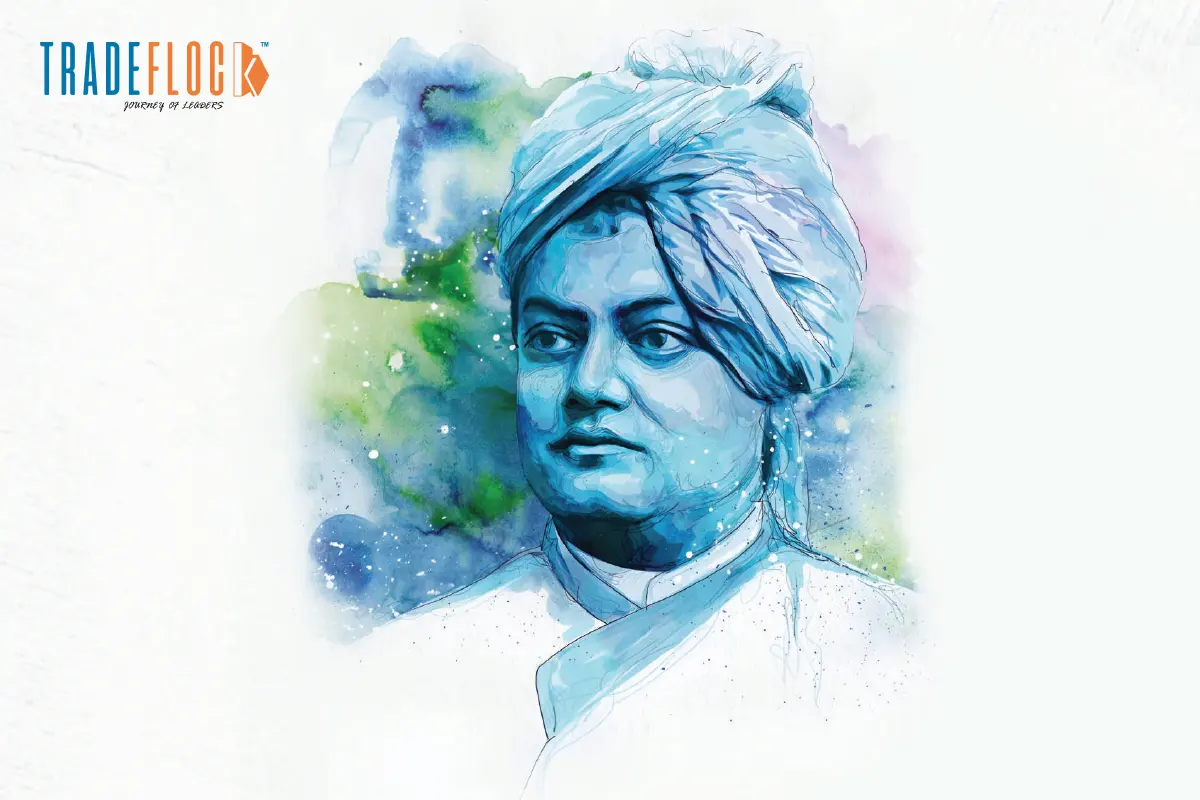
Wake, rise and cease not till the goal is accomplished. There are a few lines in history which have been so long-lived. These words were more than a slogan; they were a call to bravery, inner confidence, and an unremitting search for truth. They embodied the spirit of a man who was not ready to tolerate weakness, be it personal or national. Swami Vivekananda did not simply teach spirituality; he woke up a slumbering civilisation. He made his life a bridge between the wisdom of ancient Indian and the turbulent modern world, reminding humankind that strength and compassion should go hand in hand.
Table of Contents
Narendra to Vivekananda: A Restless Seeker
Narendra Nath Datta, a doubting person, was born in 1863 in Calcutta as Vivekananda. An intelligent, adventurous and questioning student, he was strongly influenced by Western philosophy but also attached to Indian culture. As a young man, he was on a continuous quest for answers to the most important questions in life: Does God exist? Why is life? His search led him to the simple yet deep spirituality of Sri Ramakrishna Paramahamsa, which changed Narendra in a new way.
It is under the guidance of Sri Ramakrishna that his scepticism led to personal experience. When Sri Ramakrishna died, the young disciple renounced worldly life and became Swami Vivekananda a monk, who did not want to escape but wanted to serve.
Walking India, Finding its Soul
Vivekananda was shaped by the experience of the wandering monk to his perception of the world. He walked all over India and found spiritual richness and abject poverty. He marvelled at temples and had villagers who were ravaged by starvation. These trips made him even more convinced that spirituality without human suffering was not complete. Religion to Vivekananda was not about scriptures, but one that was meant to uplift the masses.
This enlightenment influenced his pragmatic philosophy of Vedanta, which held that service to man was equal to service to God. He thought that India could not be elevated by emulating the West, but by returning to its inner strength.
Power is the Essence of His Philosophy
Vivekananda was not timid about discussing power, unlike many religious leaders of his era. He ruled out the notion that spirituality was feeble or aloof. He said that the basis of true religion was fearlessness. He urged people to be strong-bodied, sharp-minded and good-hearted.
His Vedanta stressed the divinity in every individual, that all souls can be divine. His life was meant to express this divinity through selfless work, devotion, discipline, and knowledge. This profundity of spirit, coupled with interest in the worldly, rendered his philosophy immortal..
The Chicago Moment which Changed the World
Vivekananda first appeared on the international scene in 1893 at the World Parliament of Religions in Chicago. He gave the people what is now remembered as a legend, without aid and unidentified, dressed in saffron robes, the words, “Sisters and brothers of America.” It was an electric reaction.
India was not a colonised country at that time, but a great civilisation of the West. Vivekananda talked of universal acceptance, tolerance, and harmony among religions and said that there was no other way to reach the same truth. His address condemned dogma and cast India as an ethical and spiritual force in the modern world.
India as Seen by the World
In 1895, Vivekananda travelled to the United States and Europe a couple of years after his lecture in Chicago. His lectures were centred on Vedanta, yoga, education and integration of religions, which attracted scholars and thinkers.
But India was in his heart, although the world was familiar with him. His influence helped him demonstrate to the world the things that were going on in India under colonial rule not in a political outcry but through moral positions. He was of the opinion that the nation would be revived through education, character-building and self-confidence. Freedom of an inner state was about him.
It is Not Only Ideas but Also Institutions that Should be Built
Vivekananda realised that institutions are required to support ideas. In 1897, he established the Ramakrishna Mission, which was a blend of social service and monastic discipline. It prioritised his dream of service as worship, involving activities such as education, healthcare, disaster relief, and spiritual training. Vivekananda was not trying to annihilate tradition as many reformers did, but to redefine it to suit contemporary life. He focused on scientific temper, the empowerment of women, and universal education, which were extremely radical for his age.
A Brief Bio, An Interminable History
In 1902, at the tender age of 39, Swami Vivekananda passed away naturally, perhaps because of overwork and asceticism, a cerebral haemorrhage. But he produced a much greater impact than his years would imply. He motivated generations of leaders, philosophers and liberators. His words inspired Mahatma Gandhi, Subhas Chandra Bose and millions of educators. His message continues to reverberate in the world today, which is grappling with division, fear and lack of purpose. His was not a spiritual but a civilisational voice.
Vivekananda Still Matters
Vivekananda’s message is especially timely in an era of anxiety and distraction. He reminds us that self-belief is no arrogance, spirituality is no escape, and the greatest way of expressing faith is to serve others. Rise and wake is not a call to rush and live blindly, but to live consciously, fearlessly and kindly. Not only history, but a challenge to us to do our best to be better than we are: the story of Swami Vivekananda.