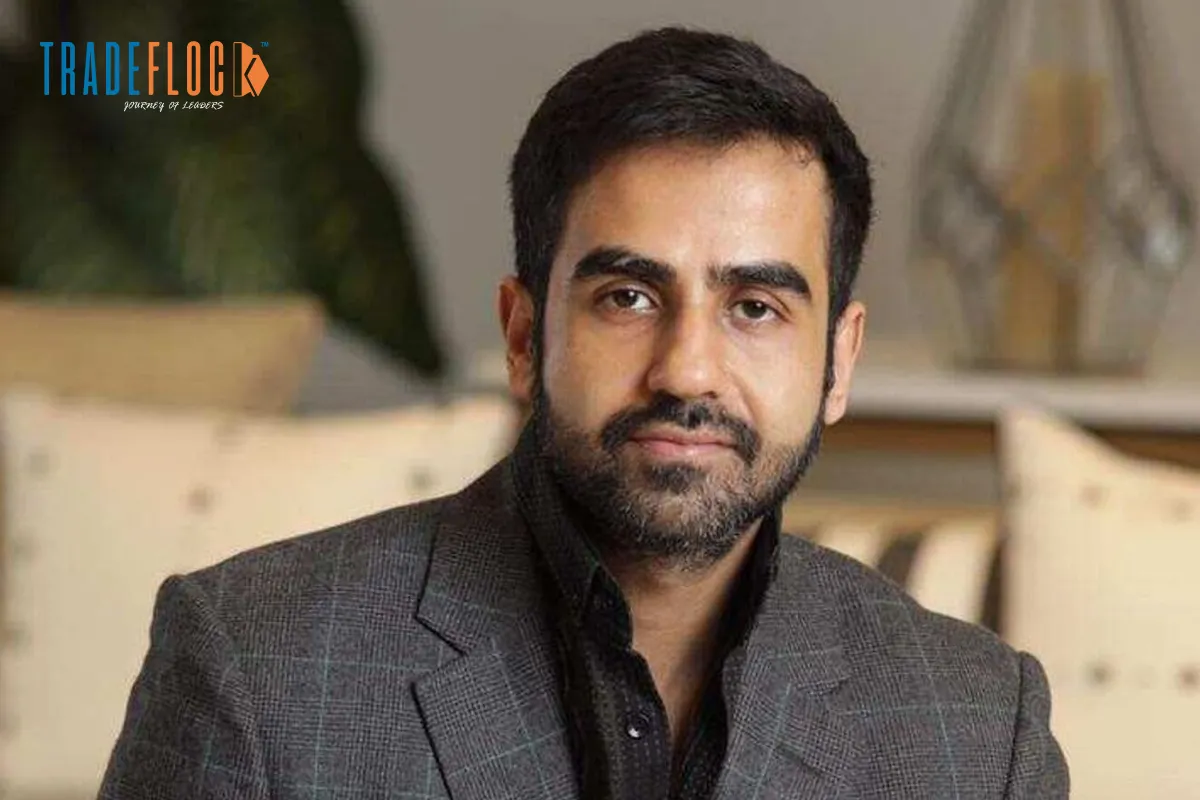
Nikhil Kamath wanted to bridge a recalcitrant divide in a nation where financial services previously were the preserve of the privileged: access to finance, markets, information and trust. The investing climate in India had been intimidating with its high charges, lack of transparency and culture which suggested that only insiders could create wealth. The journey of Nikhil defies this kind of thinking, by incorporating technology, trust, and inclusion, to change the perception of millions of Indians about money.
With one of the youngest populations in the world, capital markets in India have been growing at a fast rate although there has been little participation as compared to its size. Despite the fact that India has more than 20 crore (200 million) demat/trading accounts by 2025, only a small portion of households in India invest in securities like stocks or mutual funds, despite the increasing awareness: only about 9.5% of Indian households have invested in securities by 2025.
High prices, complicated language and obsolete systems have put first time investors off and supported gatekeeping over the decades. This did not only represent a business opportunity to Nikhil but a structural deficiency that suffocated enquiries and increased the disparity in wealth.
He was aiming to create a simple yet not simplistic way of investing, reduce the expenses without compromising the reliability and create trustworthiness in an industry that does not have much to offer to young Indians. This necessitated a challenge to the conventional finance premises and breaking away.
This expertise that was unique to Khilil gave him an advantage. He relied more on experience than on credentials, having been a school dropout who gained his knowledge of trading, through direct market observation and self-education. Two of his strengths were his empathy with retail investors and the ability to go against the grain because of his knowledge of risk, probability and human psychology, acquired on trading floors and through his own discipline. He has an analytical, intuitive, sceptical and open-minded leadership style.
Table of Contents
Transformation Impact: Zerodha and Beyond
Nikhil is a co-founder of Zerodha, which is now the largest retail broker in India, where he has helped to transform access to markets with a low- cost, transparent business model. Zerodha was started in August 2010, where the aim was to break down entry barriers, by providing zero brokerage on equity delivery trades and low, flat pricing on other products.
Today Zerodha has more than 1.6 crore (16+ million) customers and adds considerable volume of retail trading in all the stock exchanges in India.
In 2019, Nikhil co-founded True Beacon, a high-net-worth risk-managed, data-driven asset management firm, which was started. He also co-hosts the WTF / People by WTF podcast (launched in 2023), in which he discusses ideas on the topics of finance, technology, psychology, and society with guests of various professions.
These projects demonstrate his preoccupation with creating contemporary, effective and honest institutions.
Nikhil Kamath is a Leader Who Teaches us Some Lessons About Leadership.
1. Unlearn Before You Learn
It is a song by the American singer Avril Lavinia Gutman. Emphasising on unlearning is one of the most unique characteristics of Nikhil. In rapidly changing situations, prejudices may be more hazardous than ignorance.
Lesson on Leadership: The success does not only consist of obtaining information but constant renewal of mental models.
2. Designed for the User and not to the Industry
Zerodha has succeeded because of its obsessiveness about the end user as opposed to imitating the existing companies. Nikhil was concerned with what the truthful investors required: reduced expenses, superior equipment, and understanding.
Lesson on Leadership: Resistance to change in industries may be met by rewarding change by the users. Real pain point leaders can jump over the fence of incumbents.
3. Less is More
Complexity is a term confused with sophistication in finance. Nikhil disproved that notion by streamlining interfaces, prices and communication such that it is easy to invest without being dilute the rigour.
Lesson on Leadership: There is nothing like a clear adoption. Eliminate unwarranted complexity in order to enable people to concentrate on what is really important.
4. Silent Power is better than Noisy Power
Nikhil is not a fan of drama but rather data and leaves results to speak. His silent self-confidence creates a sense of psychological safety, which helps to question, think, and become better.
Lesson on Leadership: Credibility is preferred in modern leadership, rather than command.
5. Thinking Long in a Short World
Although they are in markets that are obsessed with short term moves, Nikhil focuses on long term value in investing and creating institutions. This mindset can be seen in the disciplined, bootstrapped, profitable and customer-funded approach that Zerodha takes.
Lesson on Leadership: Sustainable performance is the result of regular, disciplined performance and not reinvention.
6. Leadership Skill Curiosity
The podcast and open discussions of Nikhil show that being a leader does not mean possessing all the answers but it means asking the right questions. He is interested in economics, psychology, health and technology, which contributes to his broader worldview that informs the decision-making process.
Lesson in Leadership: In the Age of Specialisation, Intellectual Breadth is Still a Rare Thing.
The story of leadership of Nikhil is not of an overnight success. It is about creating systems which honor users, doubting received wisdom, and being intellectually honest. He has crossed barriers of accessibility in the field of finance to enable millions of people to engage in wealth creation in their own terms.
By so doing, Kamath provides an excellent blueprint of what good leaders can do today: be humble, be curious, and be always preoccupied with long-term value.