Before the data, there are the companies. Tesla reshaped the global auto industry. Google reorganised how the world accesses information. NVIDIA became the backbone of the AI revolution. Stripe reengineered digital payments. Zoom turned into critical infrastructure overnight during a global pandemic.
What do they share beyond scale and influence? Each was founded or co-founded by an immigrant, and they are not anomalies.
Nearly half of the companies on the Fortune 500 list were founded by immigrants or their children. In the United States alone, immigrants represent roughly 14% of the population, yet account for a significantly larger share of new business formation. Across OECD economies, migrant entrepreneurship has risen steadily for nearly two decades. The pattern repeats in technology, manufacturing, retail, and services.
The story is not about isolated brilliance. It is about structural advantage.
Table of Contents
The Numbers Are Telling A New Story
Often regarded as the hub of global businesses, the United States has several successful examples of immigrants who are legendary business builders.
By 2026, immigrants will make up nearly 25% of all new business founders across the country, with immigrant families driving about 46% of new ventures. Moreover, their influence extends to the corporate world, as they or their children founded 46.2% of the Fortune 500 companies in 2025.
Immigrant entrepreneurship remains critical globally. In OECD countries, approximately 17% of self-employed individuals are migrants, compared with 11% in 2006. It is much higher than the proportion of the workforce.
It is not the abstract proportions of India. They create millions of jobs, generate millions of dollars in revenue, and provide a greater pool of economic strength than native- born entrepreneurship alone.
Purpose and Persistence: Not Just Simple Opportunism
Why would such immigrants establish businesses? It is not just a matter of economics.
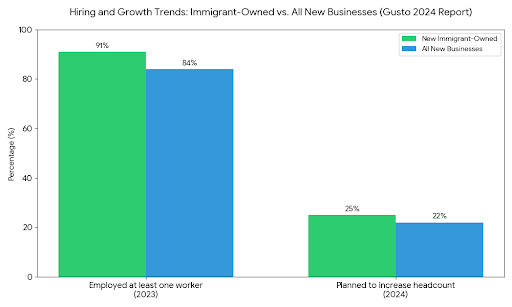
According to a survey by Gusto, most immigrant founders do not start businesses solely to get a quick paycheck, but to achieve independence and security. Almost 70% report launching their businesses to gain greater control over their lives, a share higher than that of the average founder.
The academic literature highlights that many immigrant founders strategically draw on aspects of their histories. According to SBS Oxford, rather than attempting to erase their cultural identity, they incorporate it into what they offer to satisfy unmet needs in their new markets; cross-cultural knowledge is packaged into products, services, and brands that are broadly appealing.
This is not nostalgia. It has temporal depth, setting business models in the lessons of the past and sprinting towards future opportunities.
Community and Networks: Invisible Infrastructure
Relationships are vital in business, especially for immigrant founders who depend on trust-based networks as a core, not just a by-product. Community capital fills gaps when financial capital is absent, with family, fellow immigrants, ethnic groups, and diaspora networks serving as initial employees, customers, and informal advisers—helping new businesses survive and grow.
This strategic network integration, highlighted in SBS Oxford Research, reduces risk and enhances stability, moving beyond social warmth to practical resilience. During the Covid-19 pandemic, immigrant-led firms adapted faster due to networks providing quick feedback, cooperation, and shared resources.
Flexibility: Transforming Uncertainty into Opportunity
Entrepreneurship is unpredictable. That’s part of its nature. Uncertainty is not something that happens to many immigrant founders; it is a commonplace.
The process of negotiating immigration systems, new cultures, new languages, and legal frameworks develops what some scholars define as strategic flexibility. These founders do not suffer change; they strategise it, anticipate it, and turn.
In times of economic slowdowns and industry shocks, this flexibility becomes a competitive advantage. Immigrant-owned businesses also redesign supply chains, experiment with new delivery models, and redefine business propositions more quickly than others who may not have undergone a life-changing experience.
Innovation and Job Creation: The Long-Arc of Impact
The impact of immigrants on entrepreneurship is substantial and quantifiable.
According to an NBER survey, the proportion of immigrants among entrepreneurs in business formation in the United States has increased significantly over the last few decades, reaching approximately 24% in 2019. However, it remains lower than in the general population. Immigrant-owned companies are also likely to produce more patents and be in higher-growth industries than native-founded businesses.