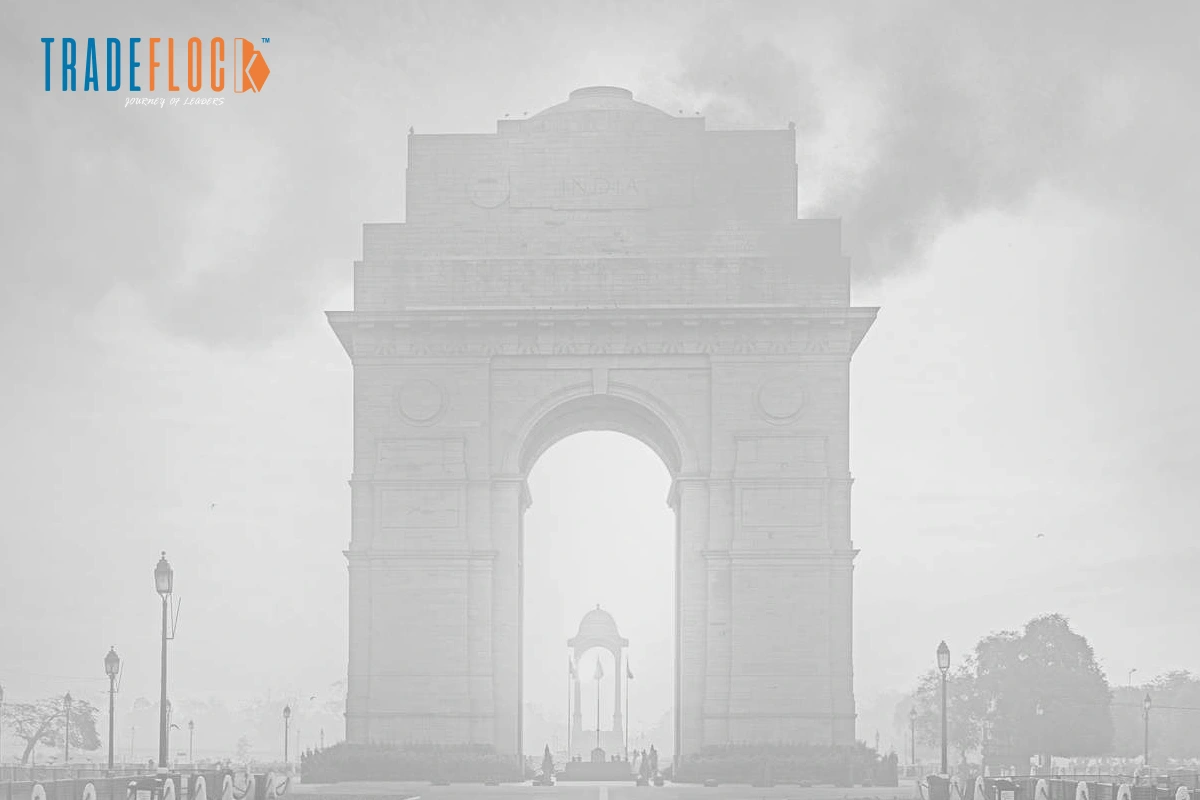
Delhi, a city where ancient minarets and modern skyscrapers once coexisted, is now overwhelmed by its own polluted air. As November 2025 approaches, the Air Quality Index (AQI) reaches an alarming 414, indicating a hazardous and toxic environment where every breath poses a danger.
This crisis has driven citizens to protest in rare demonstrations, with masks symbolising their desperate plea: “I just want to breathe.”
The problem goes beyond seasonal smog, reflecting a systemic failure of governance fueled by greed and global apathy. This analysis examines the data and legal battles shaping Delhi’s lethal air quality, questioning where justice resides in a city suffocated by its own environment.
Table of Contents
Numbers That Choke: A Data Deluge of Despair
Delhi’s air crisis is more than a story; it’s a measurable disaster.
On November 11, 2025, the city hit its first ‘severe’ alert of the year with an AQI of 428. Hotspots like Anand Vihar saw PM2.5 levels soar past 300 µg/m³, sixty times the WHO’s safe annual limit. October 2025 was the worst in three years.
Despite a drop in farm fires, Delhi remains hazardous. For 65% of 2025, the air was ‘unhealthy’. This pollution led to 1.67 million deaths across India in 2019, with Delhi alone seeing 10,000 premature deaths each year.
The economic toll is staggering: $36.8 billion was lost to India’s GDP in 2019, and $2.5 billion is lost annually for the Delhi region. With 70% of residents distrusting government enforcement, the system is failing.
These statistics aren’t abstract; they mean missed school, diverted flights, and overflowing hospitals. Delhi is drowning not in water, but in the deadly air it breathes.
Legal Lifelines and Lapses: Courts as the Last Clean Breath
If data diagnoses the illness, the courts offer a slow, often frustrating, prescription.
The “Delhi pollution case” is a tangled legal drama. On November 11, 2025, the Supreme Court criticised the Delhi government for neglecting the “green lungs” of the city, the Ridge forest belt. Citing the 1996 Godavarman case, the court ordered immediate protection and revived the dormant Ridge Management Board, granting it real power.
However, this cycle of issuing stern orders and then failing to follow through is common. In October 2025, the NGT demanded action against 1,700 polluting industries; however, compliance audits reveal that only 40% of basic plans are being enforced. The Supreme Court even hesitated to adopt the WHO’s strict air quality standards outright, citing practical challenges.
This “toxic governance” means arresting activists instead of polluters. Cases argue for a “fundamental right to breathe” under Article 21, inspired by the Shayara Bano case, but too many verdicts go unimplemented. Fines are too small, industry lobbies are too strong.
The law is being used like a scalpel when what Delhi needs is a sledgehammer.
Human Cost: Beyond the Haze, the Heartbreak
Behind the troubling AQI figures, real lives are suffering. In Delhi’s crowded alleys, PM2.5 particles invade millions of lungs uninvited. Each year, 2.2 million children develop asthma.
A 2025 study underscores the risk: on “severe” air quality days, excess deaths increase by 10%, with the worst risks in poorer neighbourhoods. This crisis also silently hampers productivity, costing India billions and causing workers to lose weeks of income annually.
On the streets, the plea is urgent: “I can’t breathe.”
The burden falls most heavily on the vulnerable- women, the elderly, and the poor. A recent report warns that unless prompt action is taken, the 2025 death toll will surpass previous years, worsened by climate change anomalies. This catastrophe isn’t only a health issue; it damages the city’s heritage and dims its future amid a cloud of despair.
Pathways to Pure Air: From Finger-Pointing to Fist-Pumping Fixes
But hope is not lost.
Reinstating the Ridge Board could capture approximately 500,000 tons of CO2 annually. Expanding the odd-even scheme and implementing electric vehicle mandates could eliminate up to 30% of vehicle pollution by 2030. Combining industrial cleanup with carbon pricing could generate billions for new green technologies.
Innovation requires courage: rooftop forests, AI-powered monitoring drones, and turning farm waste into clean fuel are all possible solutions. A pilot project in Punjab successfully converted 20% of crop residue into fuel pellets.
Delhi needs a “Clean Air Pact” that binds all nearby states, accompanied by transparent, real-time data dashboards, to rebuild public trust. The technology exists; the courage to use it is what’s missing.
Exhaling Justice: A Call to Clear the Skies
Delhi’s pollution is not merely a matter of fate; it is a stark reminder of how political neglect hinders progress. As courts gather and citizens protest, the emphasis moves from assigning blame to building breathable futures. Let the Ridge stay free of pollution, enforce laws rigorously, and let data inform our decisions. In this choking capital, clean air is a fundamental right, not a privilege; it is a liberty. Will we act or continue making excuses? With the AQI climbing, the decision to improve it lies with us.