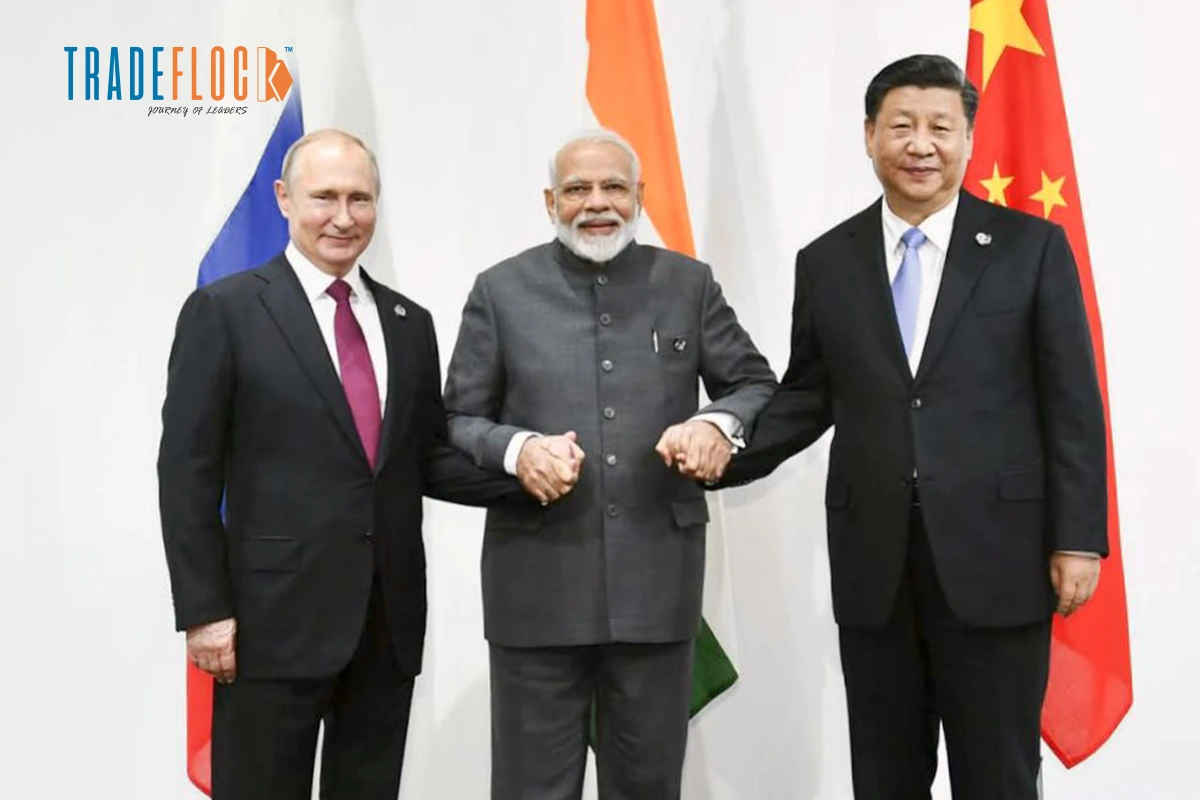
On August 31, 2025, SCO leaders convened in Tianjin, highlighting their multipolar ambitions. China’s President Xi Jinping greeted Russian President Vladimir Putin, Indian Prime Minister Narendra Modi, and officials from Central Asia, Iran, and Belarus. The widely circulated images showed more than mere handshakes; they symbolized a changing global landscape where Western influence is waning.
Table of Contents
Multipolar Messaging at the Summit
Xi Jinping emphasized the importance of a new global order based on fairness and respect for the Global South. Reuters viewed the summit as a challenge to U.S. dominance, with China advocating for development finance, yuan-based trade, and cross-border energy routes. AP described the SCO as a growing challenge to America’s global leadership, noting internal contradictions, especially India’s delicate balancing act between East and West.
Al Jazeera highlighted the symbolism of Russia and China positioning the SCO as an alternative power bloc, while India remained aligned with the United States. The Economist pointed out that the SCO excels in making statements but struggles with enforcement, casting doubt in the West about its ability to turn rhetoric into reality.
U.S. Reaction: Skepticism, but Not Complacency
In the U.S., the SCO meeting drew intense scrutiny. The Associated Press called it ‘performative diplomacy,” citing internal divisions that limit cohesion. The New York Times noted that while optics matter, the group lacks NATO’s hard power or the G7’s economic unity. Brookings analysts said the SCO symbolizes multipolarity but lacks substance, and Carnegie described it as ‘more a megaphone for grievances than an enforcement mechanism.’
An Atlantic Council report warned that SCO initiatives could weaken dollar dominance in Eurasian trade, diluting Washington’s financial influence over time. Treasury officials, as Reuters quoted, cautioned that while the yuan trade is niche, developing parallel payment systems could gain strategic importance if unchecked.
India–Russia Trade: A Quiet Revolution
Beyond the discussions in Tianjin, a parallel story unfolded in Vladivostok during the Eastern Economic Forum (EEF). Sberbank, Russia’s largest bank, used the event to announce practical measures aimed at boosting trade between India and Russia, often overshadowed by more prominent SCO declarations.
Alexander Vedyakhin, Sberbank’s First Deputy Chairman, informed reporters that Indian suppliers can now receive immediate payments for goods, even if contracts include deferred payment terms. This is enabled by tools like letter-of-credit discounting and post-shipment loans, which ensure exporters are paid promptly. He added that 60% of payments from Russia to India are now processed in less than 10 minutes, thanks to Sberbank’s innovations. “Successful business means high speeds,” Vedyakhin commented, noting that the bank is also expanding its services for students, tourists, and remittance transfers.
Building Trade Infrastructure
Sberbank’s ambitions go beyond speed. The bank predicts multiple growth in India–Russia trade, with a target of $100 billion by 2030. Unlike the West’s portrayal of the trade relationship as limited to oil and energy, Vedyakhin emphasized new opportunities for small and medium businesses in IT, pharmaceuticals, agribusiness, and engineering.
To facilitate this expansion, Sberbank has created a comprehensive guide for Indian companies localizing in Russia, covering everything from ownership structures to tax regimes and special economic zones. “It is a navigator for Indian businesses,” Vedyakhin said, reflecting the rising demand from Indian clients seeking to hedge against Western-centric markets.
Why the U.S. is Uneasy
From a U.S. official’s viewpoint, these developments matter less in terms of the SCO’s public statements and more in the behind-the-scenes infrastructure being quietly established. The Financial Times noted that “summit speeches less threaten the U.S. than by the plumbing of new payment systems that bypass dollar routes.”
Indeed, U.S. experts fear that such networks could erode the effectiveness of sanctions, create resilient parallel markets, and gradually normalize yuan- or ruble-based settlement in Eurasia. The Atlantic Council warned: “It is not the size of today’s transactions but the architecture being built for tomorrow that matters.”
At the same time, American officials are realistic about India’s position. The Washington Post reported that the White House sees New Delhi’s hedging not as betrayal but as “strategic autonomy in action.” Maintaining India’s trust, while accepting its Russian ties, remains central to Washington’s Indo-Pacific strategy.
Russia’s Security Narrative
At the summit, Vladimir Putin reprised familiar talking points, blaming NATO expansion for the Ukraine war and promoting a Eurasian security model. Radio Free Europe/Radio Liberty (RFE/RL) reported on Moscow’s messaging, noting that Putin’s narrative resonated with some SCO members but was diluted in the final declaration to accommodate India’s sensitivities.
Here, again, U.S. analysts were skeptical. The Carnegie Endowment concluded that “Moscow is leveraging the SCO stage to normalize its Ukraine framing, but the group’s diversity prevents consensus on security.”
Narratives vs. Realities
Western media largely agree that the SCO is impressive visually but struggles with effective implementation. The Associated Press described its statements as “ambitious but watered down,” Al Jazeera mentioned “language scrubbed to keep India involved,” and The Economist pointed out that the bloc lacks real enforcement power.
Despite the Western criticism of the SCO’s abilities, Russia and China continue to develop its institutions. Meanwhile, India and Russia are demonstrating that alternative systems, like Sberbank’s instant payment services and localization efforts, can be successful, even if they are not perfect.
The Long Game
The SCO 2025 summit offered a glimpse of a shifting landscape. While Washington viewed it as a performance, the reality is that alternatives to Western frameworks are forming. The U.S. balances strategic ties with India, rising yuan trade, and countering Moscow and Beijing. Russia and China aim to turn optics into systems and rhetoric into resilience. India’s role in SCO and EEF highlights its position in a new multipolar world, where power is dispersed, choices abound, and Washington is no longer the sole reference.