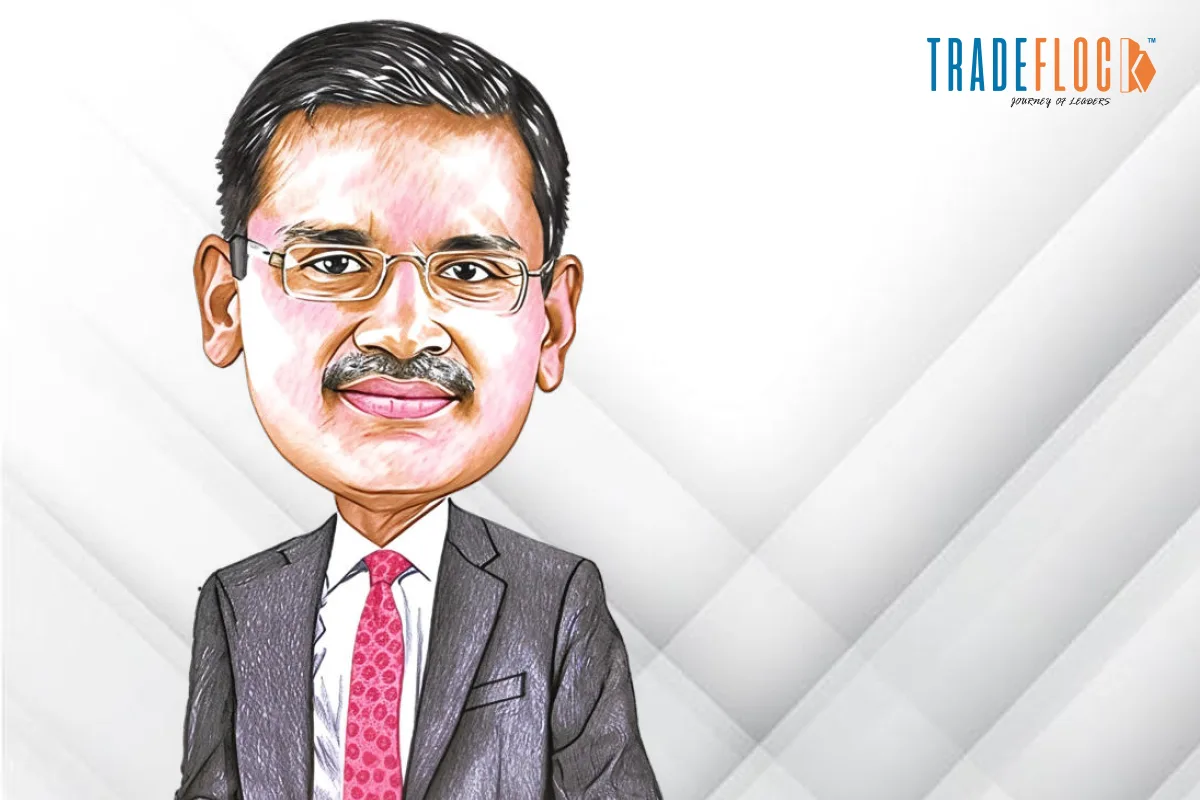
The world of IT services is fast-paced, and few companies have navigated change as gracefully as Tata Consultancy Services (TCS). Over the past decade, the industry has faced rapid technological disruption, evolving client expectations, stricter regulations, and rising competition. Amidst these challenges, TCS has reinvented itself, going beyond mere survival. Revenue soared, innovation accelerated, and employee engagement strengthened. Steering this transformation required a leader with vision, clarity, and a deep understanding of both business and people. This leader could turn disruption into opportunity and make strategy come alive across hundreds of thousands of employees worldwide.
Rajesh Gopinathan is the former Chief Financial Officer (2013-17) and then CEO & Managing Director of TCS from 2017 to 2023. Over a 22-year career with the company, he took the reins at a moment when the industry demanded more than steady performance; it demanded reinvention. Under his leadership, TCS grew revenue by roughly 63%, from about ₹1.18 lakh crore in FY2017 to ₹1.92 lakh crore in FY2022. Profits rose by nearly 46%, margins remained strong, and market capitalisation nearly doubled from USD $74 billion to approximately $143 billion.
Here are some leadership lessons drawn from Rajesh Gopinathan’s journey, lessons that go beyond numbers, touching on culture, strategy and the human side of transformation.
Table of Contents
Embrace Disruption Before It Becomes Painful
When he assumed the CEO role in 2017, the traditional model of IT services, especially outsourcing, was under threat: newer players, automation, cloud, and changing client expectations loomed large. Gopinathan didn’t wait. He led TCS to adopt its “machine-first delivery model”, systematically using automation and AI to give technology the “first right of refusal” in solutions. He also pushed forward the “Agile 2020” initiative and a location-independent framework (Secure Borderless Work Spaces), which proved invaluable during COVID-19.
Lesson: Strong leaders don’t simply react to change; they anticipate it, set the experiment-lab culture in motion, and build resilience into strategy.
Protect Margin Without Losing Growth Ambition
Gopinathan’s leadership shows that profitability and scale need not be enemies. Over his tenure, revenue grew 63%, profits 46%; EBITDA and net profit margins held steady in the strong 20-30% range. Yet, he was unafraid to forgo lucrative contracts if they threatened to erode margin discipline. That kind of decision tends to be unpopular in the short run — but over time, it builds trust with shareholders, employees and clients alike.
Lesson: Growth is hollow if margins decay. A leader must make hard calls, sometimes rejecting big orders in favour of long-term financial health.
Talent, Inclusion and Culture are Strategic Assets
In his farewell message, Gopinathan highlighted the role of more than 600,000 TCS employees as foundational to what was achieved. Under his tenure:
- Women made up ~35% of the workforce, one of the highest among Indian technology firms.
- Leadership roles held by women (business development, delivery, etc.) and patent holders saw notable increases in female participation.
- Mid-level transformation and upskilling programmes were conducted, and over 40,000 mid-level employees got certified.
He recognised that systems, not individuals, create sustained performance. He expanded the number of named business unit leaders, built stronger internal governance, and emphasised employee development.
Lesson: A leader’s legacy is less about their own achievements and more about how they lift others. Building an inclusive culture and capability is non-negotiable.
Communicate Value — Internally and Externally
One of the less obvious but powerful shifts under Gopinathan was in how TCS told its story. Under his leadership, the company sought to reduce what he called the “value gap”, making sure the work done internally was understood and valued as much externally. He emphasised that clients should see value, not just effort. While engineering elegance was appreciated, what mattered more was solving difficult problems and articulately explaining the solution.
Also, the brand value grew dramatically; TCS became the second-most valuable IT services brand globally. Share price grew over 150% from February 2017 to early 2023.
Lesson: Doing great work isn’t enough. A leader must help the world see the quality, complexity, and value of that work with humility, clarity, and purpose.
Lead With Clarity During Crisis, Balance Empathy & Rigour
Between visa challenges in the US, regulatory uncertainty, pandemic shocks, and the pressure of global competition, TCS under Gopinathan faced test after test. What stood out was how he balanced empathy (for employees, remote working realities, concerns about job security) with rigorous expectation setting. In the face of uncertainty, his message to leaders was to stay in “perpetual beta” — always adapting, learning, not expecting everything to be certain.
Lesson: Leadership in crisis is a mix of calm priorities, humane understanding, and relentless execution.
Rajesh Gopinathan led TCS through a period of transformation and helped redefine what it means for a large global tech titan to be agile, profitable and humane. In six years, he didn’t merely aim for scale; he aimed for sustainable scale. The lessons from his leadership are especially relevant now: in an age of disruption, volatility and social expectation, success belongs not just to those who build big, but to those who build well. For upcoming leaders, his journey is a reminder that vision must be paired with rigour, ambition with empathy, and success with legacy.