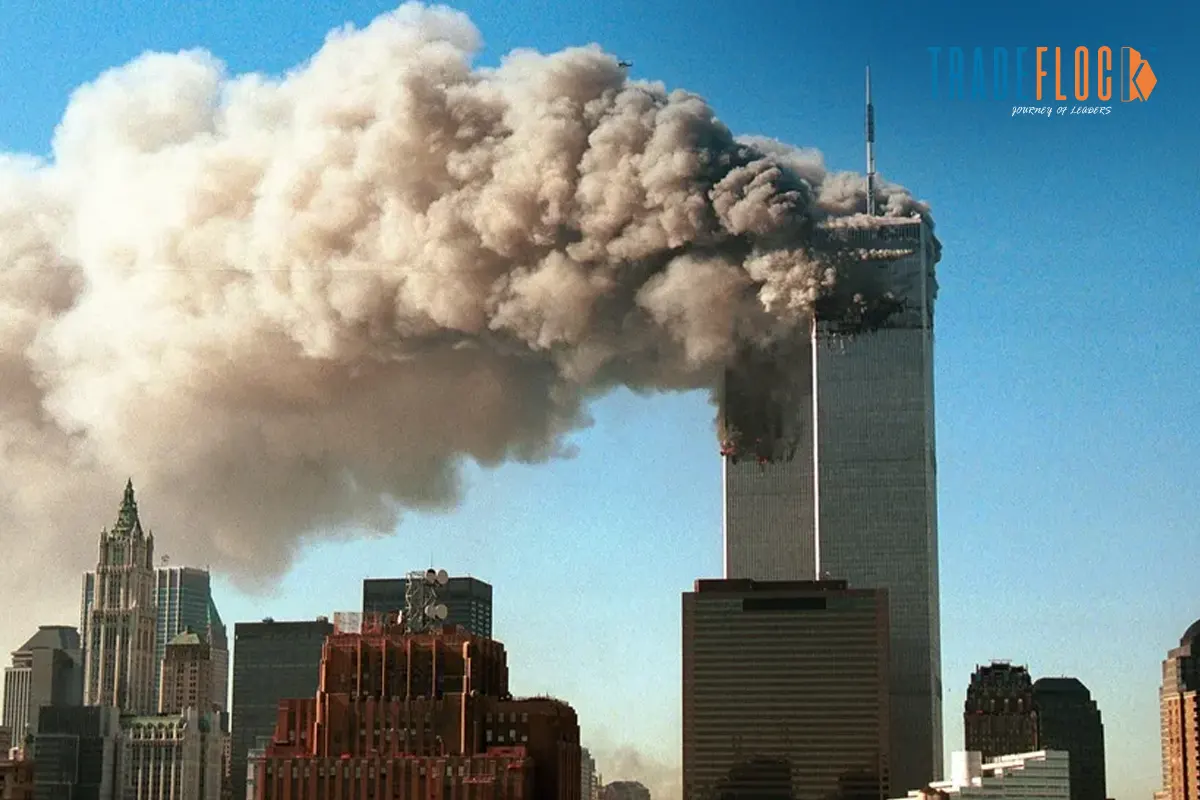
September 11, 2001 stands as a pivotal moment in modern global affairs. On that clear morning, the United States experienced the most lethal terrorist attack in its history when Al-Qaeda launched four coordinated suicide missions. Nearly 3,000 individuals lost their lives, and thousands more were injured. Beyond the immediate human tragedy, the destruction of the World Trade Center symbolized a direct challenge on global stability, economic confidence, and core value of democratic systems.The aftermath reshaped international security, economic policy, and risk management for decades to come.
Table of Contents
A Morning That Shook the World
The morning began like any other in New York City, with clear skies and the daily flow of workers, tourists, and students. Yet by mid-morning, the financial district was engulfed in smoke and disruption, triggering immediate and widespread consequences for business operations, infrastructure, and international markets.
At 8:46 a.m., American Airlines Flight 11 collided with the North Tower of the World Trade Center, first assumed to be accidental. Seventeen minutes later, United Airlines Flight 175 struck the South Tower, exposing a deliberate, coordinated terrorist attack with significant consequences for national security and economic resilience.
By 9:37 a.m., American Airlines Flight 77 impacted the Pentagon, the center of U.S. military command. At 10:03 a.m., United Airlines Flight 93 crashed in Pennsylvania after passengers intervened, likely preventing further casualties. These coordinated attacks resulted in significant loss of life across civilian, military, and emergency sectors, profoundly reshaping New York’s skyline and global security landscapes.
What Led to the Attack
Al-Qaeda, established by Osama bin Laden in 1988, originated from the U.S.supported Mujahideen during the Soviet-Afghan conflict. . Eventually, the group redirected its hostility toward the West, criticizing U.S. military deployments, cultural reach, and political involvement across the Islamic world.
Bin Laden viewed the U.S. military presence in Saudi Arabia following the 1991 Gulf War as a provocation, perceiving it as a violation of sacred territory. He cited American support for Israel and broader regional involvement as further evidence of Western encroachment. Al-Qaeda’s mission was not merely retaliatory, it sought to challenge and undermine the Western-dominated geopolitical framework through a sustained campaign of extremist ideology and violence.
By the late 1990s, Al-Qaeda had executed multiple significant attacks, including the 1998 bombings of U.S. embassies in Kenya and Tanzania and the 2000 attack on the USS Cole in Yemen. These events demonstrated the group’s expanding reach and served as early indicators of the sophisticated and unprecedented scale of the 9/11 attacks that would follow.
From Plotters to the Fallen
Nineteen individuals predominantly from Saudi Arabia gained entry into the U.S. over several months, remaining inconspicuous while organizing the operation. Some underwent pilot training in Florida; others integrated into residential neighborhoods. The plot was directed by Khalid Sheikh Mohammed, with Osama bin Laden providing funding, strategic leadership, and ideological rationale.
The attackers operated with a structured international network, not independent operatives. The 9/11 Commission Report subsequently identified key intelligence shortcomings and coordination breakdowns, resulting in, significant policy reviews and institutional reforms.
The victims represented a broad cross-section of society from emergency personnel and aviation crews to professionals and international travelers spanning over 90 countries. The human toll was immense, with lasting emotional and health impacts, particularly for first responders exposed to hazardous conditions at Ground Zero.
Societal, Economic, and Political Ramifications
The attacks caused a significant global economic disruption. U.S. stock markets remained closed for nearly a week, reopening to significant declines. The airline sector faced severe financial strain with bankruptcies and workforce reductions. Tourism demand fell sharply, oil prices rose, consumer confidence weakened, and insurance markets experienced considerable volatility.
The long-term consequences of 9/11 were chiefly geopolitical. The U.S. launched Operation Enduring Freedom to eliminate the Taliban regime in Afghanistan, supported by a multinational coalition. In 2003, the U.S. invaded Iraq based on contested claims of weapons of mass destruction and terrorist links, which subsequently affected its global standing and diplomatic relations.
On the domestic front, the Patriot Act expanded intelligence-gathering and counterterrorism authorities, prompting debates over individual rights. The establishment of the Department of Homeland Security streamlined national security operations, while air travel saw enduring modifications through heightened security measures, weighing public safety against privacy rights.
9/11: A Legacy of Resilience
The September 11 attacks represented a critical turning point in defense approaches, risk assessment, and international relations. Over the past two decades, their impact has influenced geopolitical conflicts, political instability, migration flows, and policy debates on surveillance and national identity, shaping the business and geopolitical landscape worldwide.
We remember 9/11 not only to honor the victims but to evaluate our collective response.
Have we adopted more strategic approaches or reactive measures? Fostered greater unity or heightened divisions? Have we encouraged stronger collaboration or increased fragmentation?
The world paused on September 11, 2001, and continues to navigate its lasting impacts. Let this memory reinforce our commitment to vigilance, empathy, and fostering global stability.