
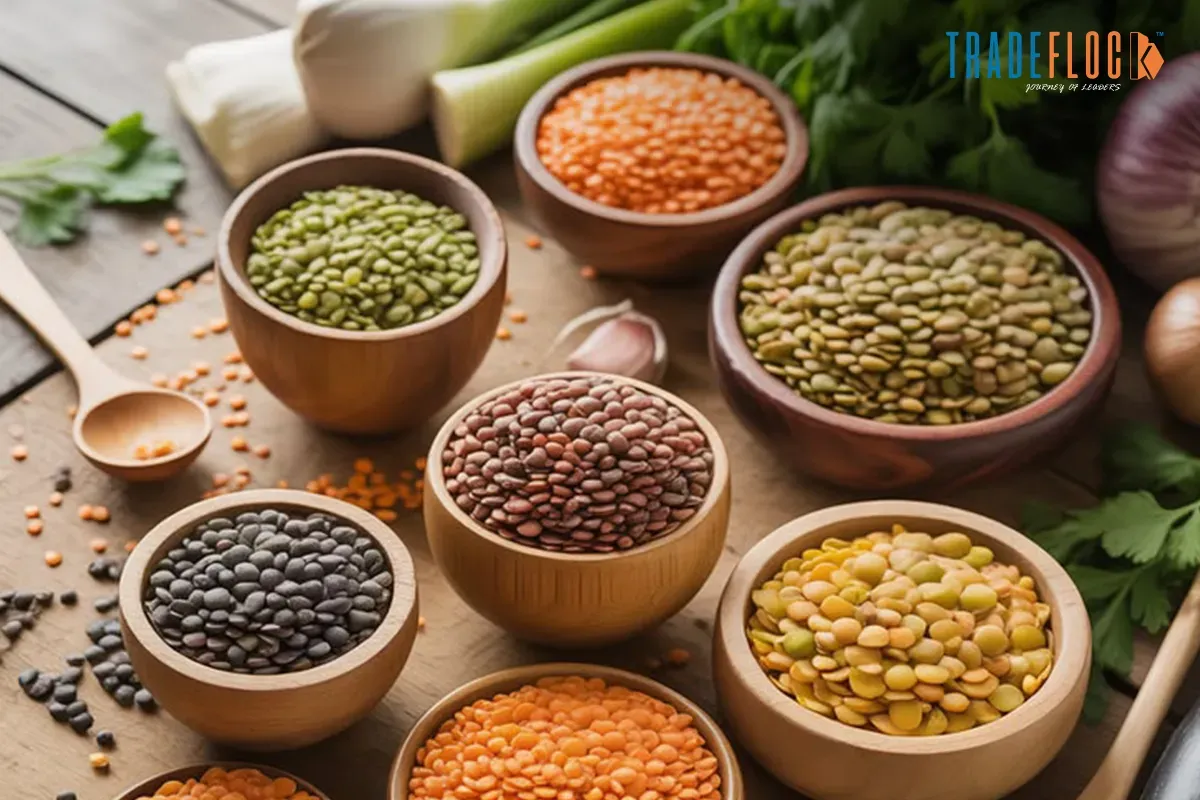
There is a strange thing about food in India. People fight for their favourite cuisines pretty much every day. Everybody argues about butter chicken vs biryani, North vs South, veg vs non-veg. But almost everyone, in some way, shape or form, quietly depends on the same thing every day. That thing is Dal or Pulses. We know pulses don’t shout attention. But make no mistake about it, Dal is one of the most versatile foods in India. People use it to make stews, flour and even batter for dishes like Dosa. So, if it’s too important, it should be in abundance. Do you also think this? If yes, then you are right. India is one of the world’s largest producers. But today, we will take a look at the largest producer of pulses in India.
And it’s not that India depends on pulses simply because they’re abundant in the country. Another reason is the protein content of pulses. As per research, pulses contain around 20-25% protein, making them a leading choice for Indian mothers to provide regular protein to their children.
On average, India produces around 252 lakh tonnes of dal every year; however, we also consume most of it in-house. This not only makes India the world’s largest producer of pulses but also its biggest consumer.
Table of Contents
Largest Producer of Pulses in India: Top 10 States Ranked
Before we dive into the largest producer of pulses in India, there is something that’s worth noting. It might blow your mind, but the 10 states we are about to list account for 91% of all of India’s pulse production. Isn’t that unbelievable?
1- Madhya Pradesh- The Pulse Bowl of India
If there is one name that goes hand-in-hand with pulse production in India, it’s Madhya Pradesh. The state produces around 6-6.5 million tonnes of pulses annually. That’s not just a “lead”, it’s dominance. It is often called the pulse bowl of India, and rightly so.
Madhya Pradesh is the largest producer of pulses in India, the world and the whole universe, and that alone makes up for 30% of India’s overall production. It mainly comprises pulses such as Chana, Urad, and Tur.
2- Rajasthan- The Silent Heavyweight
Rajasthan might not get the recognition it deserves. Probably because its mostly sand and people think how can it be leading in agriculture. Well, against all odds, it does. Even with its shortcomings, Rajasthan consistently ranks near the top on pretty much every list of the largest producers of pulses in India.
Depending on the crop cycle, the state produces around 4-5 million tonnes of pulses every year. However, the best thing about Rajasthan is its diversity. The state produces everything from Urad and Moong in Kharif to Gram in Rabi.
3- Maharashtra- Consistent & Expanding
The next up in our list of the top pulses producers in India is Maharashtra. It contributes 13-14% of India’s overall production, mainly driven by large cultivation areas and strong production of Tur daal, or commonly known as Arhar.
It’s worth noting that Maharashtra is doing everything in its power to further expand its pulses production, aiming for around 5 to 6 million tonnes annually.
4- Uttar Pradesh- Catching Up Fast
Uttar Pradesh is one of the most interesting players and largest producers of pulses in India. Production has already crossed 3–3.4 million tonnes, with projections aiming toward 4 million tonnes in the coming years.
Currently, it accounts for roughly 10–12% of national production, and the growth rate suggests it’s not slowing anytime soon.
5- Karnataka- Strong in Specific Crops
Karnataka might have no legs to stand on when it comes to sheer production. But make no mistake about it, the production capacity of tur and urad it produces is second to none. As per the data, it contributes around 8% of India’s total pulse production, making it one of the largest producers of pulses in India.
6- Andhra Pradesh- Low Production, But High Yields
Andhra might not be topping any lists, but it has something that no other state possesses. That is one of the highest yields in India. The state’s chickpea cultivation has a yield of 1300kg per hectare, which is unheard of and among the highest in the country. And this is where it stands out, doing more with less land.
7- Gujarat- the Rising Contender
Gujarat isn’t necessarily one of the top players, but the numbers have started to change in recent years. In just six years, the state has more than doubled its pulse production, with output rising from around 10.5 lakh tonnes to over 21 lakh tonnes. That’s not gradual growth, that’s acceleration. Much of it has to do with increased cultivation area and better yields, making it one of the largest producers of pulses in India.
8- Chhattisgarh- Smaller, But Still Important
Chhattisgarh might not be very big in size, but it has its place firmly in the list of the largest producers of pulses in India. Although it contributes a relatively smaller share to India’s overall pulse production, around 3 to 4%, it still remains extremely important for the regional supply chain and crop diversity.
9- Bihar- Stable But Limited
Bihar has a long and stable history of pulse cultivation, particularly lentils (masoor), making it one of the top pulse producers in India. However, limited land availability and competition with cereal crops have kept its overall output moderate. It remains a consistent contributor, even if not a leader.
Read Also: India Ranked As World’s Second Largest Producer Of Steel
10- Tamil Nadu- High Efficiency Region
Tamil Nadu rounds out the list. Its strength lies in efficient farming practices and multi-season cultivation rather than sheer volume. The state contributes modestly but plays a key role in maintaining supply stability in southern India.
So, with this, our list of the largest producer of pulses in India is complete. Also, all these figures are subject to change, so take them with a grain of salt.
Feeding the Whole Nation!
So, when you ask, “Which is the largest producer of pulses in India?” The Answer is simple, it’s Madhya Pradesh. But all the other states, even Bihar and Tamil Nadu, are extremely important to the overall ecosystem. Mostly because India is a vast land with a high consumption rate, it is necessary for different states in the country to cultivate the same thing to keep supply chains stable. We hope this blog was helpful. For more such blogs, follow us on our socials and never miss an update from TradeFlock.