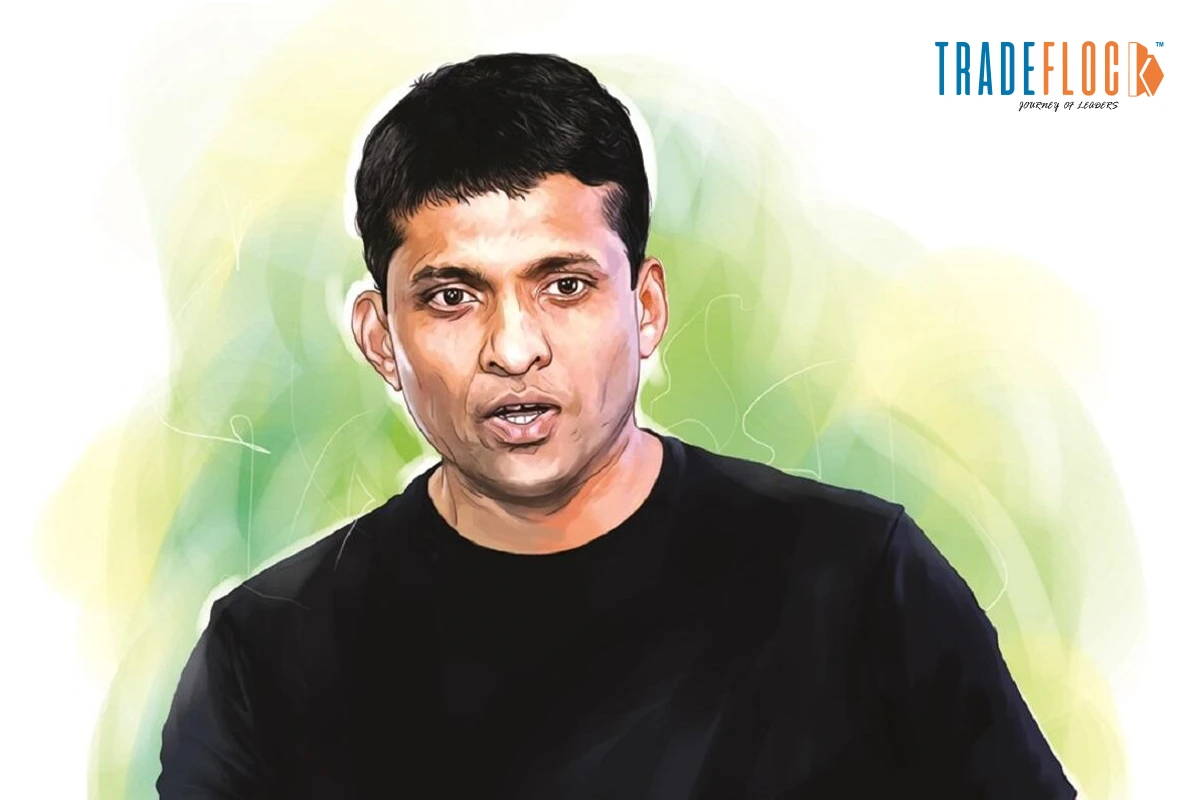
The story of Byju Raveendran is the business parable of modern India: a teacher-entrepreneur who built a category-defining edtech brand, only to encounter the strict realities of leverage, governance, and trust. At its peak, Byju personified its ambitious aims: international acquisitions, celebrity endorsements, and a bold promise to make learning addictive. At its lowest point, it had become a case study in how quickly momentum can turn uncertain when cash flow tightens, and stakeholders lose confidence.
Table of Contents
The Magnetism of a Founder Who Might Teach and Sell.
It was not content, but conviction, that Raveendran regarded as his superpower. He saw learning as performance: making difficult parts simple, creating a narrative arc, and helping students feel competent. That teacher’s instinct was transformed into a product vision with a broad-market brand that aimed to be aspirational in education. It also fostered an internal cultural drive: teams rallied around mission-first narratives, and customers believed results could be achieved through participatory pedagogy. In its own communications, Byju highlighted FY22 gross revenues of around Rs 10,000 crore, reflecting the scale the group aimed to project as it integrated various businesses.
Lesson: Founders who elucidate generate movements. Charisma is transparency; if you can instruct a concept, you can hire believers, customers, staff, and investors.
When Speed Becomes a Strategy and Then a Risk.
Byju was on an upward trajectory when capital was favouring hypergrowth. That sentiment was reflected in the peak valuation the company reached, approximately 22 billion dollars (documented extensively regarding 2022): prioritise the category first, then optimise the unit economics. However, speed has its downsides. Aggressive growth and acquisition-driven expansion can lead to operational complexity that only becomes apparent when funding becomes expensive and patience wears thin. In October 2024, Raveendran publicly stated that the company’s valuation had effectively dropped to zero, marking an unprecedented reversal that cast the era of growth at any cost in a new light as a warning.
Lesson: Durability differs from ambition. The market tolerates some losses but rarely confusion, unclear numbers, controls, or accountability can cause issues.
Numbers Do Not Report Reality, They Decide It.
Financials in leadership are not merely paperwork; rather, they are a system of trust. The financial strain experienced by Byju as reported in FY22: revenue through operations is approximately Rs 5,015 crore, and the net loss is approximately Rs 8,245 crore. Whether focusing on top-line growth or on worsening losses, the governance implication is identical: after losses magnify faster than confidence, all reluctances, wrangles, and departures become louder than the product narrative.
Such corrosion of trust was also evident externally. Further EGMs to remove Raveendran as CEO were held in February 2024 by major shareholders; the company challenged the legality of the meeting on quorum grounds, and the incident marked a period of governance instability. Despite procedural arguments, there remains a perception that boards and investors reflect what the market believes about leadership.
Lesson: Remove ” story ” and ” scoreboard ” to focus on value creation. This prevents organisations from spending more time protecting credibility than creating value.
Debt Turns Disagreement Into Litigation
The Byju leadership warning saga might be the most enduring legal and capital-structure spiral related to its $1.2 billion term loan in 2021 and the lender’s allegations concerning approximately $533 million borrowed. Regardless of the final outcome, the core principle of management remains clear: after burdening a rapidly growing business with heavy debt, there is no room for compromise on governance. Lenders are not interested in vision but in enforceable protections.
By the end of 2025, the disagreement had escalated to the theatrics of bankruptcy court in the US. An extraordinary damages order was granted by a Delaware court due to ongoing non-compliance, amounting to billions of dollars; shortly afterwards, a separate component of damages was upheld or stayed pending further proceedings, and another phase was scheduled for early January 2026 to decide the extent and nature of the damages to be awarded.
Lesson: Legal process is also drama. The leader’s reaction, including attendance, cooperation, documentation, and tone, influences stakeholders’ perceptions before judgments.
Insolvency as the Harshest Mirror of Governance
The issues confronting the company back home shifted towards formal restructuring. India’s public records show that Think and Learn Pvt. Ltd. (parent of Byju) entered insolvency proceedings in July 2024 (NCLT admission visible on the Insolvency and Bankruptcy Board of India portal). During these times, the concept of legacy will be less about branding campaigns and more about how efficiently the organisation can preserve value for its employees, students, and creditors.
Lesson: Governance persists when optimism fades. High controls, transparency, and stakeholder alignment turn downturns into recoveries; without them, downfalls lead to investigations.
What Byju Raveendran Still Teaches Leaders About Legacy
To truly honour Raveendran’s legacy, two conditions must hold simultaneously. On the positive side, he mainstreamed digital learning in India, made aspirational educational products more accessible, and demonstrated that teaching can be a competitive advantage that the founder can scale. On the negative side, the next chapter shows that founder-centredness can become a weakness, that rapid acquisition and poor integration may strain culture and finances, and that governance conflicts, once public, can drain leadership time.
For today’s CEOs and founders, there is a clear, tough lesson, as in the case of Byju: create the dream, but also build the infrastructure. The true measure of a legacy isn’t just its highest valuation; it’s the system you leave behind, auditable, resilient, and truste,d especially as the market stops applause.