
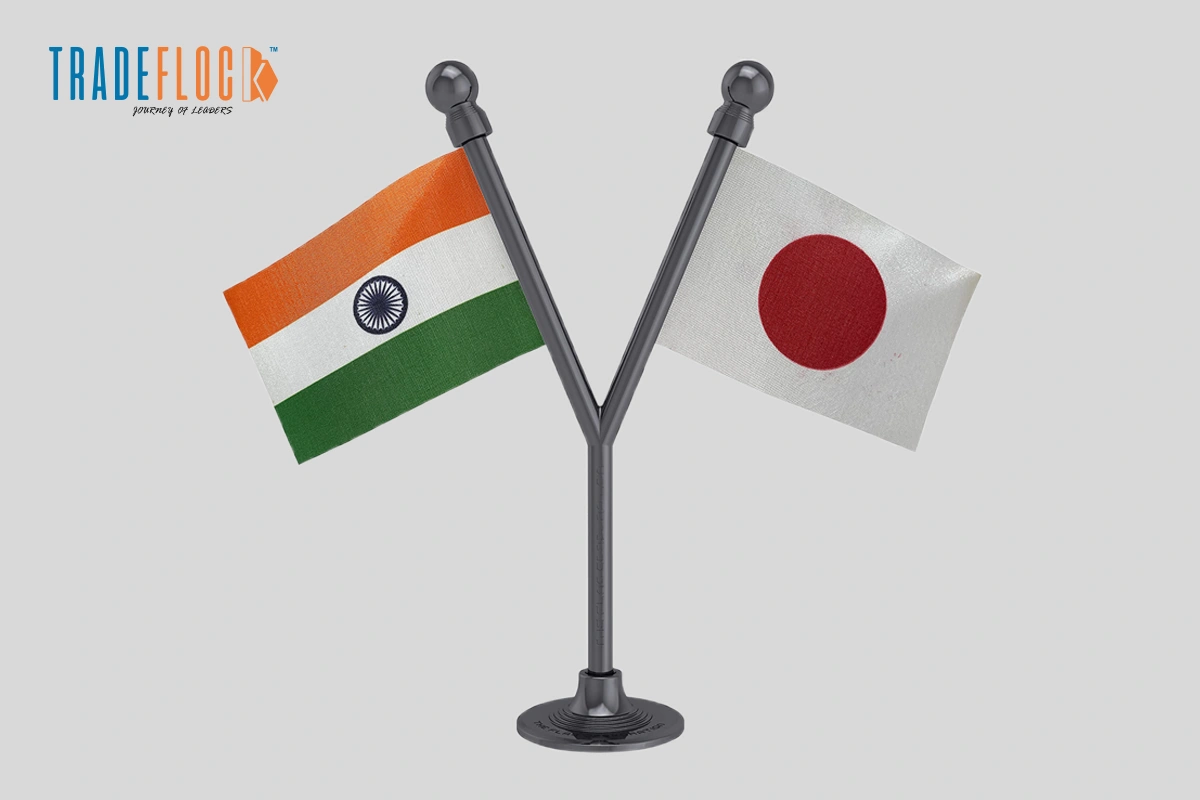
As the global economic landscape transitions into the post-pandemic era and continues to be shaped by ongoing geopolitical shifts, Japan faces challenges such as stagnation, inflation, and rising trade tensions, particularly with the United States. Meanwhile, India is steadily climbing the economic ranks. The July 2025 Rubix Country Insights report forecasts that India will overtake Japan to become the world’s fourth-largest economy by the end of this year. This milestone reflects not only India’s accelerated growth but also a reinterpretation of trade dynamics within Asia.
Table of Contents
Two Economies
Japan, which has been perceived as a stable country, is experiencing a period of low growth. In 2024, its real GDP increased by just 0.1%, a sharp decline compared to the 1.5% recorded in the previous year. This poor performance is attributed to slow household consumption and a significant increase in living expenses, accompanied by no wage growth. Conversely, India is projected to have an end-2025 GDP of USD 4,187 billion, slightly above Japan of USD 4,186 billion.
More tellingly, the Japanese experience with deflation has now turned around. Inflation has been on the rise since the middle of 2022, with the Consumer Price Index (CPI) reaching multi-decade highs. The Bank of Japan responded by increasing its short-term interest rate to 0.5 % by January 2025. However, inflation has not ceased, with the core CPI at 3.7% in May 2025, and a further rate hike is anticipated.
The Tariff Bombshell of the US
One of the main themes in the Rubix report is the increasing pressure from tariffs in the United States, which is Japan’s largest export market. Japanese goods will be subject to a 25% tariff starting August 1, 2025, with a particular emphasis on the automotive and electronics industries. Although this did not involve the threatened 3035% tariffs imposed by the Trump administration, exporters may lose up to a quarter of their profits, taking 0.26 %age points off the GDP growth.
To prepare, the Japanese government announced a two-part relief plan in April 2025, which involved corporate financing assistance, gasoline subsidies, and electricity bill credits. But these are viewed as temporary solutions to an inherently changing global trading environment.
India-Japan Trade Corridor: Asymmetry and Opportunity
Trade between India and Japan remains modest, despite the good diplomatic ties between the two countries. In FY2025, India’s imports from Japan account for only 1%, and its exports account for 2%. However, growth is evident: Indian exports to Japan grew at a 9% CAGR between FY2021 and FY2025, while imports grew 15%, boosting bilateral trade to over USD 25 billion.
India’s automotive and smartphone sectors are expanding into Japan, with automobile exports reaching 13% of all exports in FY2025, up from 1% in FY2021, and smartphone shipments quadrupling over the same period, signaling India’s rise as a manufacturing and trade partner. Conversely, Japanese exports to India focus on precious metals, refined copper, auto parts, and high-tech steel, vital for India’s infrastructure growth. Notably, the trade deficit has nearly doubled over the past five years, reaching USD 12.7 billion in FY2025.
Investments and Strategic Realignments
In addition to trade, the Rubix report indicates a huge increase in bilateral investments. Japan is currently the fifth-largest foreign equity investor in India, with a cumulative FDI of USD 44.4 billion since 2000. Recent developments include a 20% stake in Yes Bank by Sumitomo Mitsui Banking Corporation and a new manufacturing plant in Rajasthan by Nidec Corporation.
Joint ventures are also growing in semiconductor production, defence, renewable energy, and smart infrastructure. The India-Japan Semiconductor Supply Chain Partnership, signed in 2023, aims to reduce reliance on China and aligns with Japan’s USD 65 billion initiative to revitalize its chip industry by 2030.
Regional Trade Architecture Implications
These advancements have a significant impact on the Asian trading infrastructure. With inflation, population decline, and protectionism, Japan may need to shift its focus from traditional exports to emerging markets, such as India and Southeast Asia. India exemplifies a broader trend of economic southward shifts as global companies adopt a China-plus-one supply chain strategy.
Additionally, regional trade agreements like RCEP increase pressure on both nations to reassess their regional economic roles. Japan may reorient its focus toward investment, while India aims to leverage its manufacturing capacity and youthful population to attract global interest.
Power Shift in Asia
The Rubix report is more subtle: Japan is still a strong economy with deep capital markets and sophisticated manufacturing, but it is evidently under strain. India, however, is not only expanding; it is also becoming a significant hub for trade and investment in Asia.
To the business and policy-makers, the message is clear: the pendulum of power in Asia is swinging. With Japan coping with new tariffs and local headwinds and India climbing the world GDP ladder, this shifting equation will not only redefine bilateral relations but also the very fabric of intra-Asian trade in the years ahead.