
Welcome to The Creature Compendium, your field guide to creatures that never existed, culled from knotted recollections of stories nobody quite knows. It’s a realm where legend blurs and fancy supplies the gaps. Do you know of the Whistle Fox, whose whistle sounds like a laughing child to entice traveling wanderers at night? Or the Glass-Winged Mammoth, a towering fossil with crystalline tusks that glimmer like moonlit frost? If not, that’s alright—neither has anyone else. That’s where you come in.
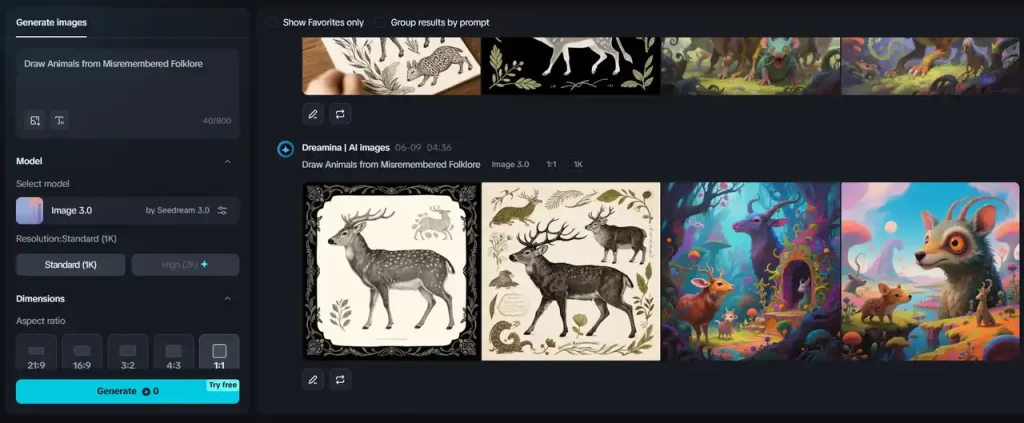
With Dreamina’s AI image generator, you’re able to create these mythic creatures, not merely as pictures, but as complete ecological listings—beasts with habitats, history, and quirky little quirks. The entertainment is about re-creating folklore that never was and pretending it has been all along. You’re not creating monsters, you’re creating a visual folklore that’s older than time itself.
Table of Contents
Brand your beasts with folkloric flair
Now that your creature is storied and living, why not name it and symbolize it? Dreamina’s AI logo generator lets you easily create an emblem or sigil that feels ripped out of a holy book or hunter’s coat of arms. You can create icons reflecting your creature’s clan, its place of origin, or the fictional institution that documented it. Perhaps the Glass-Winged Mammoth stamp looks like a spiral ice-flake with reflected tusks. The symbol becomes the seal on your guidebook, the emblem of your imagined expedition team, or the crest of an ancient lost civilization.

These details give your world the depth and age of having discovered a long-lost bestiary in fragments of dreams Linkhouse
Dreamina’s image generation process
Let’s go through creating your first legendary creature with Dreamina’s three enchanted steps.
Step 1: Write a text prompt
Start your mythic journey by opening Dreamina’s Image generator. Here is where your imagination blossoms. Imagine your prompt as a half-forgotten, wondrous legend shared around the campfire—half-remembered, full of awe. Be descriptive.
Here’s a test:
“A ghostly mammoth with iridescent glass-like wings and ice-encrusted ivory tusks, standing quietly in a white forest beneath aurora borealis. Its body glows softly with an inner light, and blue birds alight on its back, mist curling up from its breath.”
The more sensory your description, the more visceral your monster. Don’t be shy—go poetic, it’s folklore, not biology.

Step 2: Refine parameters and generate
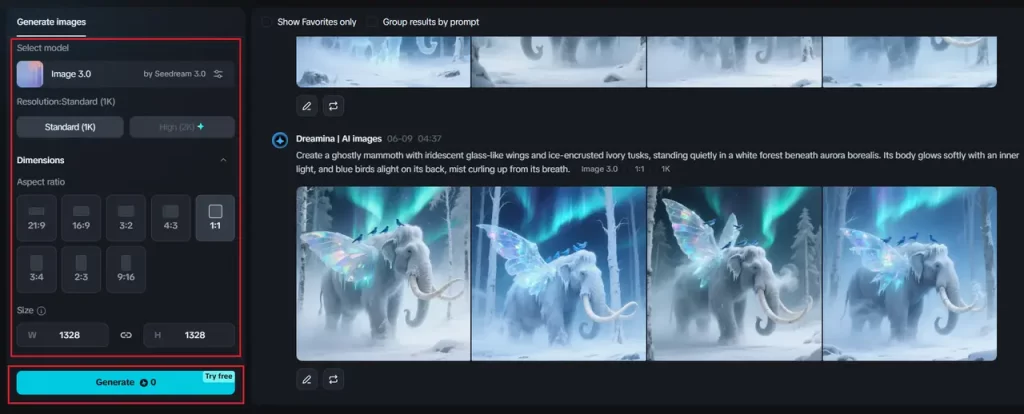
Once your prompt is set, it’s time to shape your creature with the proper settings. First, select a model that fits your look—whether painterly and loose, or sharp and hyper-realistic. Then select an aspect ratio that crops your beast just so.
Next, select the image size and resolution. 1k is good for rapid concepts or display on smaller devices, but 2k provides the richness and depth required for a full-blown entry in your mythical field journal. Once everything looks satisfactory, click “Generate” and await your conceived beast to emerge slowly, as from out of the mist of neglected dreams.
Step 3: Customize and download
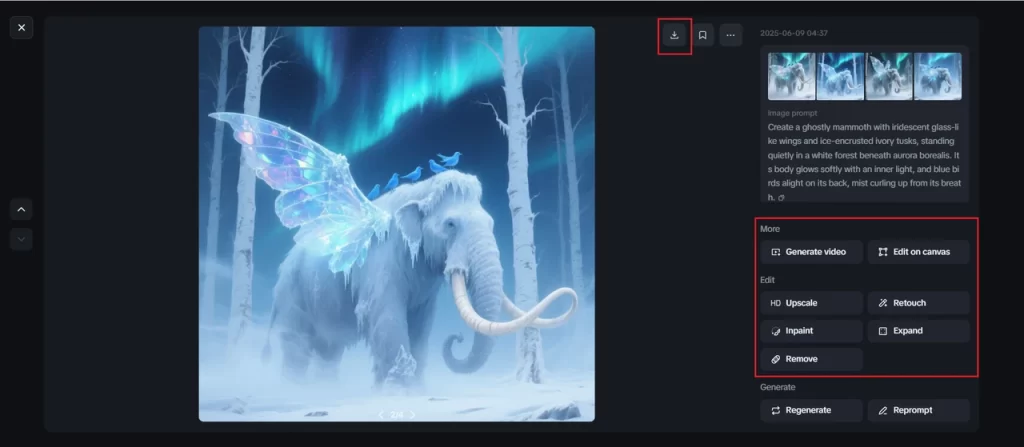
Now that your creature is visible, it’s time to refine your work. Dreamina’s editing feature is like magic tools in your artist’s box. Need to correct a wonky tusk or remove a rough spot? Use the “Retouch” tool. Experiment with “Expand.” If there are strange AI anomalies, tidy them up with “Remove.” Need to introduce more visual mythology, a mystical symbol on the creature’s hide or creepy fog? Use “Inpaint.”
After you’ve perfected your field guide photograph, click the “Download” icon to store it. You have a section of forgotten folklore resurrected, with speculative realism and surreal design.
Make your creatures into reality
Now that you have a name, a history, and a symbol, you can make it real. Dreamina’s sticker maker allows you to craft collectible folklore stickers. You can use them in notebooks, sketchbooks, water bottles, or even an imaginary museum gift shop. Every sticker is a small piece of your invented ecology, a takeaway token from a world that never existed. Trade them to friends, or create an entire sticker sheet of cryptid classes—fliers, burrowers, sea spirits, mountain guardians.

You’re not only creating art—you’re making an entire alternate natural history you can take with you.
Write its story, invent its ecology
Building these monsters is only half the pleasure. The second half is bringing them to life with words. What does your monster eat? What stories are told of it? Is it feared or revered? Does it reside in one secret valley or range over seasons? Create its habits, its vulnerabilities, even its part in local rituals. These stories enrich your artwork, and you can draft them right alongside your picture to fill out your field guide entry.
For instance, the Whistle Fox may be famous for misguiding travelers on nights of fog, its laugh sounds like a lost child’s cry. But it’s not wicked, only alone. Local villagers place small wooden flutes in the woods as gifts, hoping to keep them from loneliness. Such touches confuse the boundaries of fantasy and anthropology, and your creations sound hauntingly real.
Conclusion: mythmaking in the age of machines
The Creature Compendium isn’t about remaking ancient myths, it’s about remembering them poorly. With technology like Dreamina’s AI image maker, you’re the mythmaker, the discoverer, and the collector of a folklore that only exists in imagination. These beings are half memory, half imagination—phantoms of tales no one shared but you.
Plunge headfirst into your imagination’s wild landscapes, where unseen beasts creep between tales and reason has no authority. Whether you’re drawing a wide-eyed swamp serpent from Loria’s mist-shrouded lands or chronicling the cloud-surfing yaks of Hollowpeak, you’re not simply creating art—you’re bringing life to myths that never were, a fantastical creature at a time.
Let the legends begin.