
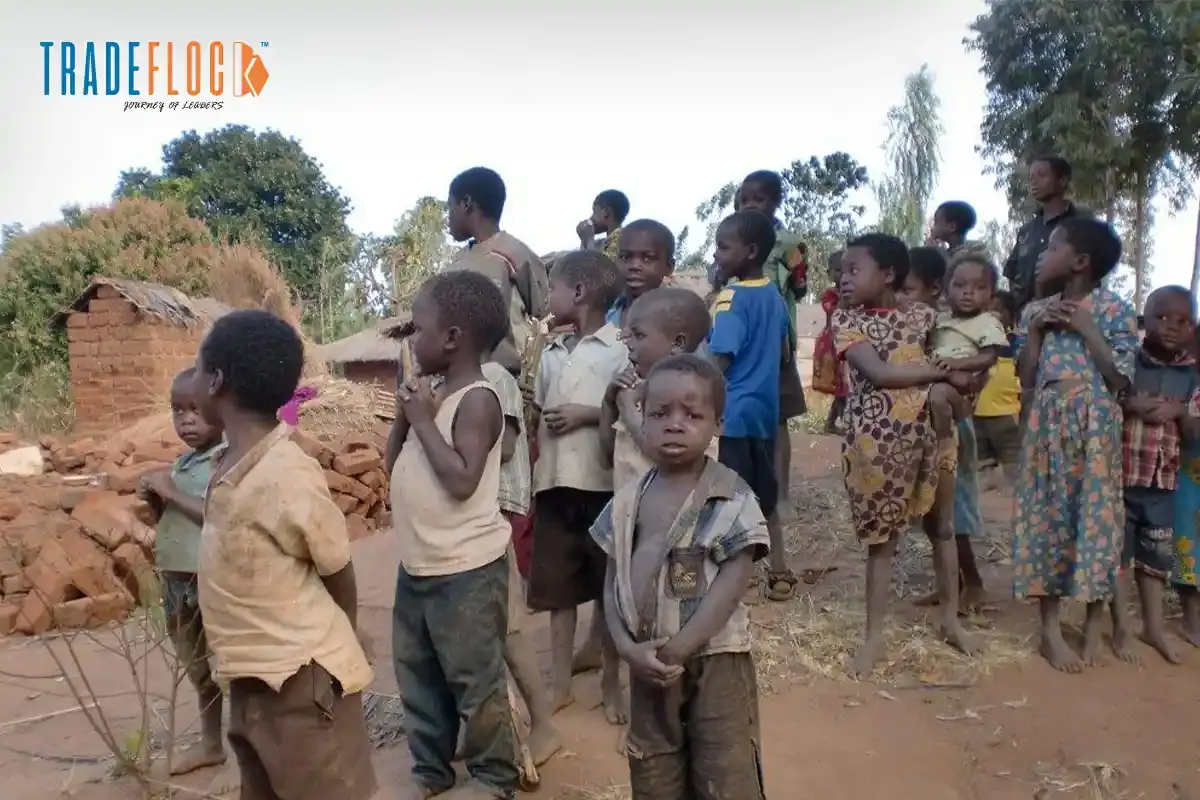
Our global economy is more than $30 trillion. Meaning that if we were to distribute it among the 8 billion people in the world, each would get around $ 3,750. But that ain’t happening. The Wolf of Wall Street and every other market, for that matter, won’t ever let it happen. But this stat shines a light on something even more daunting. There are people who are living well below this global average. In this blog, we will discuss who are the poorest people in the world and if there is any way, even in theory, that can possibly free them from the shackles of extreme poverty.
For the sake of keeping this blog objective and credible, we have ranked the countries based on their per capita income as per their purchasing power parity.
Table of Contents
10. Madagascar- $2043/ Capita
Madagascar gained its independence from France in 1960, and ever since then, the country has been in dire straits and easily one of the poorest country in the world.
Mostly because of political instability, violent coups, or disputed elections. But aren’t these things the most common in the world? They are, but not at Madagascar’s level, trust us. It’s like the Madagascar movie, but instead of animals, you see politicians doing senseless things that are not good for them or their country.
However, this wasn’t the end of it, as the people of Madagascar saw a ray of hope in the president, Andry Rajoelina, who was elected in 2019 and re-elected in 2023, and made various promises to reduce corruption and poverty while developing the economy. But in true politician fashion, she didn’t live up to any of her promises. Can you even blame her?
You see, the test of time is brutal. It shows everything these politicians try to hide. And the people of Madagascar learned that in the worst way possible, when even after two terms, Madagascar is still one of the poorest countries in the world, with almost 75% of its population living below the poverty line. So, you wanted to know who the poorest people in the world are, right? Here they are.
9. Liberia- $2005.76/ Capita
Liberia is a bit of a rollercoaster. Right when you think things have started to make sense, Liberia will throw another thing at you.
When George Weah took over in 2018, expectations were through the roof. A football icon stepping into politics, people thought maybe this time it’ll be different. It wasn’t.
Inflation, unemployment, and economic contraction, the usual suspects, showed up again. By 2023, he was out. Now, the interesting part, things have started to move slightly. Growth is expected to stay above 5%, and poverty has dropped from 40.9% to 26.4%. That’s not nothing.
But here’s the catch: Liberia has seen hopeful phases before. The real test is whether this one sticks or fades out like the rest.
8. Somalia- $1915.71/ Capita
Somalia is one of those cases where you’re not quite sure what to call it, progress or survival.
On one side, there are reforms happening. Trade links are improving. Some structure is coming into place.
On the other side, insurgencies, floods, droughts, locust invasions, it’s like the country is constantly in crisis.
And still, nearly 70% of the population lives below $2.17 a day. That number alone tells you everything.
It’s not that nothing is working. It’s that everything is working against it at once. Why? Simply because people in power are governing the country for their own benefit, not the people’s.
7. Democratic Republic of the Congo (DRC)- $1884.15/ Capita
Now this one, honestly, doesn’t make sense at first glance. The DRC is loaded. Minerals, forests, hydropower, fertile land. It’s the world’s largest producer of cobalt, which is critical for electric vehicles.
You’d think that kind of resource base would put it in a completely different position.
But no.
Decades of instability, corruption, poor infrastructure, and ongoing conflict have kept it stuck. It’s like having a full tank but no engine to run it. The potential is there; nobody doubts that. The problem is getting from potential to reality.
6. Malawi- $1777.95/ Capita
Malawi feels a bit like walking a tightrope. The economy leans heavily on agriculture, and not just any agriculture, rain-fed. Which basically means the weather decides how things go.
One bad season, and everything starts slipping.
Inflation hit over 32% last year, still above 24% this year. That’s not a small dent, that’s a proper hit to everyday life. Add currency issues, rising debt, and food shortages affecting a country of 24 million people, and you start to see how quickly things stack up.
5. Mozambique- $1728.85/ Capita
Mozambique is where numbers can fool you. For years, it showed strong growth, over 7% at times. On paper, that should’ve been enough to move it up the ladder.
But then reality steps in again. Insurgency in the north, political tensions, and climate problems. Growth dropped to 1.8% after being above 5%, and now projections are modest at best. It’s like running hard but staying in the same place.
4. Yemen- $1674.74/ Capita
Yemen… this one’s not even about economics anymore. It’s survival. Since 2014, conflict has taken over everything. More than 150,000 lives lost, infrastructure damaged, the economy practically hollowed out.
Oil exports have collapsed. Government revenues are down over 30%. And food insecurity… well, more than half the population in some regions is struggling with hunger.
At that point, growth charts don’t really matter.
3. Central African Republic- $1329.96/ Capita
The Central African Republic is another case of “rich on paper.” Gold, oil, diamonds, uranium, you name it. But then you look at the ground reality. A population of just over 5 million, and large parts of the country aren’t even under full government control.
There have been small signs of recovery, agriculture picking up, some trade returning, but it’s slow. Really slow. Like trying to move forward while someone keeps pulling you back.
2. Burundi- $1015.17/ Capita
Burundi’s situation is quieter, but just as heavy.
Around 80% of people depend on subsistence farming, which doesn’t leave much room to grow. Food insecurity is almost double the regional average, and basic infrastructure is limited.
Less than 5% of the population has electricity. Think about that for a second. Inflation is expected to hit around 40%, which only adds to the pressure. It’s not one big problem. It’s a lot of smaller ones piling up.
1. South Sudan- $716.249/ Capita
And then you reach South Sudan. This one hits differently. Why? They are literally the answer to your question, “Who are the poorest people in the world?” If that wasn’t enough. The atrocities and bloodshed that the people of Sudan have witnessed are second to none.
A country rich in oil, but struggling to keep things stable. Oil accounts for about 90% of government revenue, but conflict, corruption, and infrastructure issues continue to limit its impact.
Inflation reached 128% last year, and even now it’s expected to stay around 65%.
And here’s the part that really lands: projections suggest that nearly the entire population could fall below the poverty line.
At that point, you’re not talking about a struggling economy. You’re talking about a system that hasn’t found its footing yet.
You Might Also Like: UN May Eliminate 7,000 Jobs Amid Financial Crisis
Breaking the Shackles of Poverty
See, before we end this. We have to say that poverty has been around since the world’s infancy and will continue to be when it’s all said and done. However, the reason is what matters. If lost opportunity, corrupt politicians & the system, ill intent, and a lack of initiative are the reasons, it’s not acceptable. Folks who are the poorest people in the world should get their due.
What we mean is, every human in the world deserves the opportunity to at least get out of poverty. However, the countries we mentioned earlier are so messed up that they can’t even provide that opportunity. So, what option do those poor people have? We can say the usual BS about people having to come together and all, but that’s not it.
People have been helping the poor for almost half a century. What difference did it make? Don’t donate them money, enable them to make money. Enable them to be sustainable on their own. Don’t offer food; offer them the opportunity to harvest their own food. That’s the only way. If donating a few million just to look yourself in the mirror is what people want, nice going. If not, things have to change for good.


